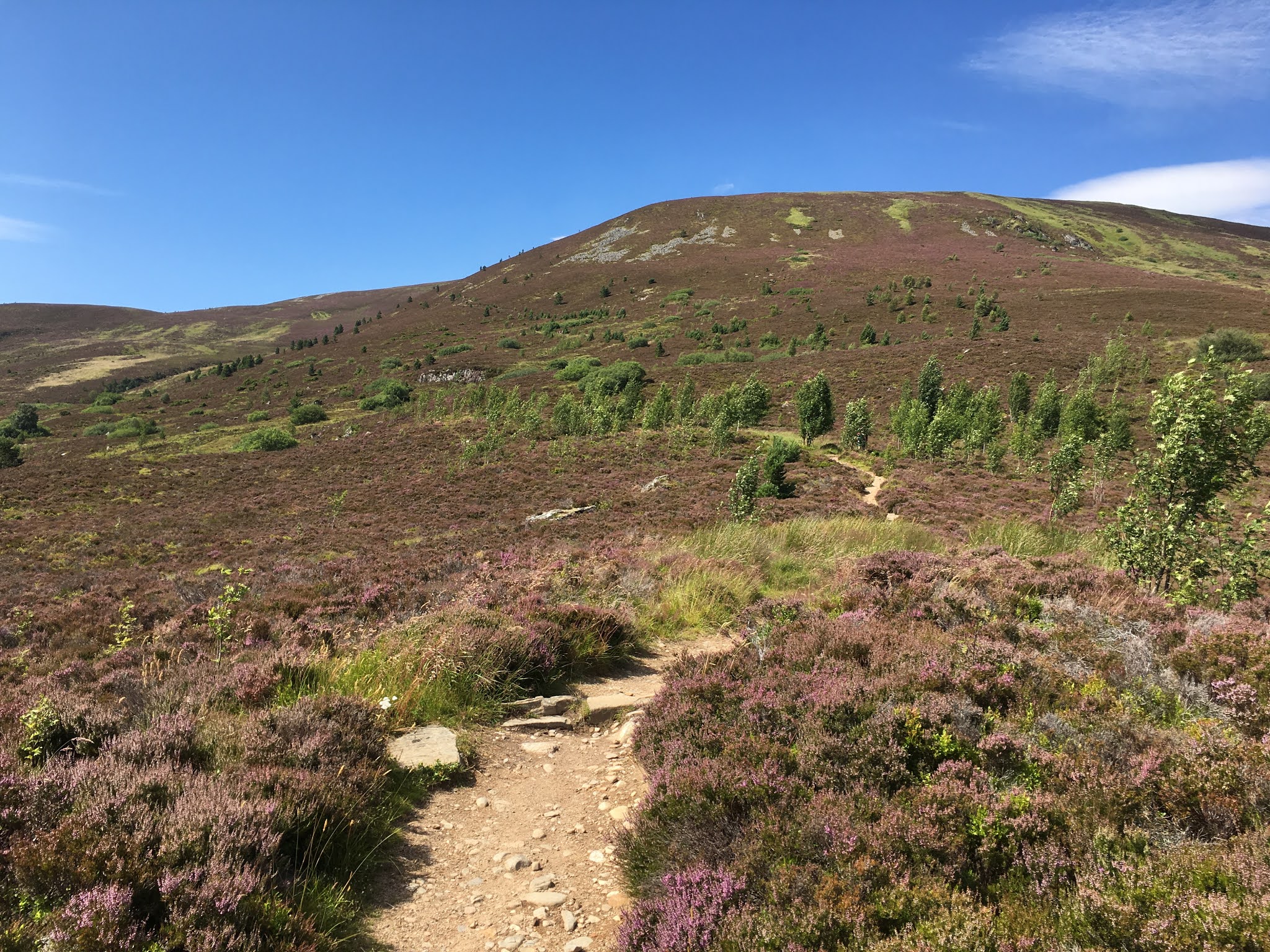
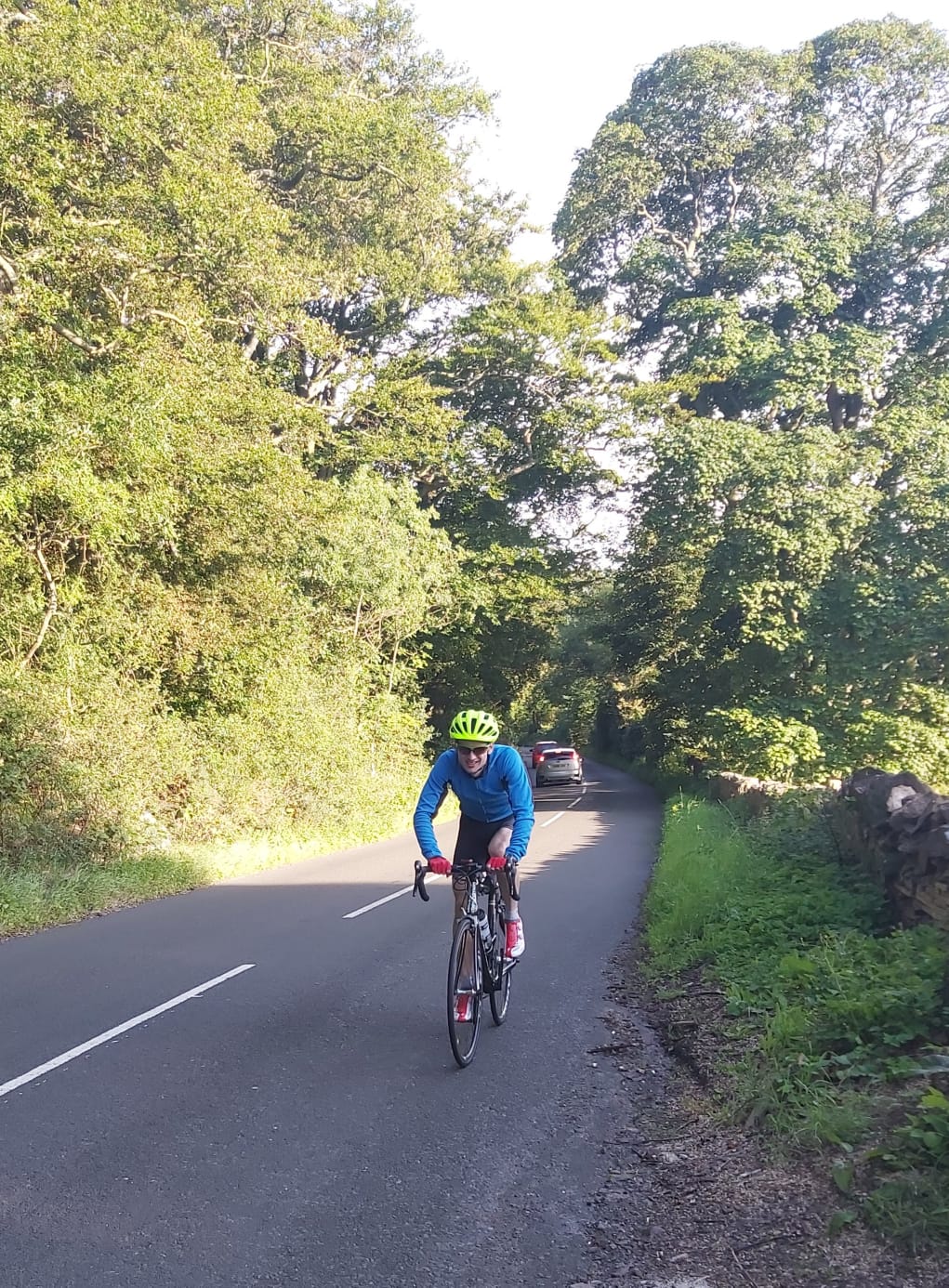
I've got a colleague/friend at work who recently completed the Scottish National Trail. I wrote a short article, copied below, about his genuinely incredible and world-class achievement. The article speaks for itself, so no further detail here! I cycled out to visit him one day when he was on the trail, and I met him off the train after he had finished. He didn't look like a man who had just done what he had done, he looked remarkably fresh! I wish I could do the like!
Edinburgh resident
Matt Girvan has just broken the record for the fastest time to complete the
Scottish National Trail. The demanding 864km route winds its way from Kirk
Yetholm near the English border, through the Borders, Central Belt, Cairngorms
and the remote far north-west before finishing at Cape Wrath. Girvan completed
the route unassisted in a time of 13 days, 19 hours and 35 minutes, eclipsing
the previous record by a full 4 days. His accomplishment deserves high acclaim,
ranking as a major achievement in the field of international adventure racing.
The modest
29-year-old New Zealander, a mechanical engineer who works for Scottish Water,
covered 50-70km daily, putting in 14-16 hour days on the trail. He ran where
possible, and power-hiked the sections where the terrain and elevation made
running impossible. He chose to complete the trail in a “self-supported”
manner, carrying all his own equipment including a tent, sleeping bag,
clothing, navigational equipment, and enough food and drink for each section
between top-ups in villages along the way.
Girvan, no stranger
to feats of endurance, was elated on finishing and breaking the record,
enthusing: “It’s only sinking in now! My main emotion is relief, I’m amazed at
how well it all played out. I thought 15 days might be possible if it went
well, but I’m over the moon to claim a new solo self-supported record of less
than 14 days. It’s nice not to have to do it all again tomorrow! I’m looking
forward to a shower, some proper hot meals, and maybe a wee dram!”
Earlier in the
summer, Girvan completed the arduous “Bob Graham Round”, summiting 42 peaks in
the Lake District over a 106km circuit, in less than 24 hours. This gave him confidence
to press on with his plans for the Scottish National Trail. He explained: “The
trail seemed like a brilliant way for me to get a snapshot of many iconic
Scottish landscapes in one trip. It normally takes 6-7 weeks but I couldn’t
take that much time off work. So I started to wonder how quickly I could do
it…”
Meticulous planning
and training underpinned Girvan’s success and he related, “There were a lot of
good times on the trail. The scenery was unreal and I was generally lucky with
the weather. The infamous Scottish midges didn’t bother me too much! Sharing
sunsets in remote glens with only the wild deer for company was amazing. I
celebrated my 29th birthday on the trail and made it to Kinlochewe just in time
for last orders – toasted sandwiches, soup and coffee – my first hot food for
days!”
It wasn’t all plain
sailing however. A bone stress injury meant Girvan was unable to run at all in
the latter part of 2019, but he battled back to fitness throughout 2020. On the
trail, he had to contend with fatigue, blisters, poor weather, darkness,
difficult logistics, and having to ration his food and drink in order to have
enough to make it to the next village – often a couple of days away. He
admitted: “It was easily the toughest thing I’ve done in terms of overall
fatigue on my mind and body. Getting out of my sleeping bag every morning at
5am in the dark and cold was tough. I was often tempted to stay in my tent for
a few more hours, but I knew this would be eroding the overall time. Once I
actually got up and got moving, things were better!”
The final day to Cape
Wrath proved exceptionally challenging, with a 14-day finishing time
tantalisingly close. Girvan described the final stretch, saying, “The finish
didn’t yield easily. It took a 19-hour day to get the job done, with the final
few hours spent navigating in darkness through bog in bitterly cold rain before
I finally finished at the lighthouse at 1:09am on 25th September.”
Girvan’s exploits
have also doubled as a fundraiser for WaterAid and he has been raising
awareness of the work the charity does: enabling people to gain access to safe
water, sanitation and hygiene education. He explained: “WaterAid are a
fantastic charity and I’ve come to know about their amazing work through
Scottish Water’s partnership with them. Their focus on hygiene seemed
particularly important in the current pandemic. Also, the importance of finding
clean drinking water was a big focus whilst on the trail, so there were lots of
parallels and I wanted to try to raise some money and awareness.” To date,
Girvan has raised almost £4000, and his fundraising website is still available
on: https://www.justgiving.com/fundraising/matt-walks
A GPS tracker allowed
many thousands of followers to track Girvan’s progress in real time, with one
saying, “Following this has been the highlight of the last 6 months!” Girvan
was overwhelmed with the support, messages and donations from all over the globe,
commenting: “It has been unbelievable, and it really was a highlight of the
trip. It made me feel that I wasn’t out there alone. The sum raised for
WaterAid is truly incredible!” In an illustration of the sense of community
amongst ultra-runners, Girvan was eager to pay tribute to the previous record
holder, stating, “Special thanks also to Graham Nash of Carnethy Hill Runners,
who was very helpful with his advice and encouragement.”
And what next for
this intrepid, elite endurance athlete? He grinned: “For now, resting, sleeping
and eating! I’ll put together a trip report and make a short film of the
journey, but in terms of sport, I’ll be back to the drawing board. I’d like to
channel my strength back into shorter-distance running in the hope that there
might be some events coming up, but I’ll make sure to rest up well before
thinking about that!”
I also wrote a slightly less formal half-way update:
#walkingforwater update (should
really be #runningforwater !)
I’m a fairly close
colleague/friend of Matt’s. I’ve been on leave for the last week and a half,
and I cycled out to visit Matt on the trail. Matt is an experienced
hiker/runner/endurance athlete and has completed challenges all over the world.
He has told me a bit about some of these challenges. I’ve also dabbled in
endurance sport myself, in single-day events and in multi-day or month-long
events. Matt and I had an interesting socially-distanced debate over what was
tougher – Matt’s Bob Graham Round (a fell-running challenge in the Lake
District which involves climbing 42 peaks over a 106km route, with 8200m of
ascent, in less than 24 hours), or “Everesting” on a bike (cycling up and down
the same hill repeatedly until you have climbed the height of Mount Everest).
But Matt’s 864km Scottish
National Trail challenge, from Kirk Yetholm on the English border to Cape Wrath
in the far remote north-west, where he is attempting to break the solo
unsupported record (currently standing at 18 days – Matt is hoping for around
15 days), is so far beyond anything I can possibly get my head around – if he
completes it and takes the record (and I believe he will), I would rank it
right up there as a major elite global/international endurance achievement. He
is also raising money for WaterAid and raising awareness of the importance of
water sources – it will be essential for him to be able to access clean, safe
water every day.
The first thing that struck me,
when he appeared on the ridge, still some distance away, was how fast he was
moving. To describe his challenge as “Walking For Water” isn’t doing justice to
the reality of what he is doing. He is running, as much as he possibly can. He
needs to move rapidly to make sure he covers enough distance every day (50 to
80km per day, depending on the difficulty of the terrain and the elevation), so
he can have a chance at breaking the record time for the trail.
He ran towards me, and was
happy to briefly stop and chat. He was remarkably fresh. Admittedly it was
quite early in his challenge, but he was very upbeat and in good shape. I had
brought with me a WaterAid t-shirt, intending to give it to him, so that he
could take it with him and use it for photo opportunities at various locations
– lochs, reservoirs, top-up-taps etc. Matt is intending to complete this 864km
route entirely unsupported, and so couldn’t accept the t-shirt. He had
meticulously planned every single item he would need, trying only to take what
was absolutely necessary in order to keep the weight of his rucksack down. He
wouldn’t take the t-shirt as it could be seen as an extra layer which could be
used to change into if a t-shirt got wet, or an extra layer of warmth. He had
decided on his kit before he started, and couldn’t change anything while en
route, otherwise it would be seen as outside support and would invalidate the
attempt. Regardless, he did agree to wear the t-shirt briefly for a couple of
photographs!
He told me that he travelled
down from Edinburgh to the start, via public transport, after a day of work.
His challenges immediately started – he had been hoping to take a bus directly
to Kirk Yetholm but it turned out this wasn’t operating, so he had a to take a
train and then a bus to Wooler (in England!), followed by a night-time 20km
“warm up” hike just to reach his starting point – an extra 20km in the dark
probably wasn’t what he needed before he had even reached the start… but he got
through it with his usual good humour and made the best of it.
I asked if I could lift his
rucksack. Another thing that immediately struck me was just how heavy it was!
He had endeavoured to keep the weight down as much as possible, but he was
attempting an 864km route on foot, solo, unsupported, through some of the most
remote and inhospitable terrain in Scotland, if not the UK, if not Europe.
Things like a tent, a sleeping bag, maps for the route, a GPS tracker, torch,
changes of clothes, clothing for the worst of the Scottish weather, first aid
supplies, and enough food and water to get through perhaps a couple of days
without ever seeing any form of civilisation – all these things add up to what
I thought was a fairly heavy rucksack – I wouldn’t have fancied walking with it
for a day, never mind running with it for two weeks…
Broadly speaking, the “easier”
section is the first half of the route, with less severe elevation changes and
also generally never more than half a day from a town or village where supplies
can be replenished (one comment was “Sainsbury’s was brilliant – food, water
and a toilet last night and this morning!”) In the first half of the route,
Matt has completed higher mileage per day, in order that he might have some
leeway up in the wild west and wild north sections. He is anticipating having
to carry food and water in greater quantities during the more remote and
challenging sections, weighing him down a bit: another comment was that the
descent of the infamous Corrieyairack Pass was “pretty tough with a rucksack
on”, but it seems the incredible sunset and sunrise and having the entire pass
to himself more than made up for it…
He is well into the way of
things now, probably over two-thirds of the way through, well on schedule,
everything seeming to hold up as well as he could hope, and he has a good daily
routine – wake up before dawn, pack things away, run/walk/eat/drink, then
50-80km later pitch the tent and sleep! The more remote sections of the far
north and west await, and the Indian summer seems to have passed (Matt’s
comment from a few days ago: “It’s HOT!!!”), meaning less clement weather may be
ahead.
He said, “There’s much more
epic scenery now but the trails are certainly much tougher. I had a few days
where I was struggling to keep to my schedule but I seem to have picked up and
am just ahead of schedule now. My feet and body are pretty beat up, but I am
managing, and I always seem to recover surprisingly well overnight!”
Hopefully everyone’s support,
the lure of the finish and the record-breaking time will help him through his
final week, as will knowing he has raised a significant sum of money for
WaterAid – currently standing at almost £2500! He’s very grateful for all the
support and is sorry that he isn’t able to post more regular updates – his
attention on the trail is fully focused on each step, and making sure that each
step is a “good step” – he certainly doesn’t want to be twisting an ankle or
tripping etc. Often he is out of reach of any sort of phone signal as well, so
I said I would post this update on his behalf!
Some links:
The Scottish National Trail: https://www.walkhighlands.co.uk/scottish-national-trail.shtml
“Everesting”. An epic activity, and this blog post has ended up being fairly epic in length too, quite possibly taking longer to complete than the actual Everesting itself...
"Everesting". Climbing the height of Mount Everest (8848m, or 29,029 feet) on a bike, in one go.
Intriguing. Quirky. Unusual. It has become very popular this year with
coronavirus restrictions meaning no racing this summer. People are looking for
some sort of a challenge to work towards and achieve. As with most things,
there’s a bit of a bandwagon now and “Everesting” is now regulated by an
organisation called “Hells 500”. They set rules for it – you have to complete
it in one go, on a single hill, climbing and descending the same hill over and
over again until you achieve the altitude. They approve your ride, and they put
you in an online hall of fame, and then you can spend a fortune buying their
Everesting kit…
They
say: “The concept of Everesting is fiendishly simple. Pick any hill, anywhere
in the world, and ride repeats of it in a single activity until you climb
8848m.” No sleep is allowed. The droplets in the official logo below represent blood, sweat and tears. I'd have added a fourth droplet to represent bike lubricating oil. Hopefully no blood is spilled in an Everesting attempt...
All
summer long, much like cycling’s hour record about 7 years ago, Everesting
seems to have exploded in popularity. I’ve watched the world records fall, and
fall, and fall again. One guy broke the record, only to have it invalidated by
Hells 500 because it didn’t meet the regulations, and he went back out soon
after and did a “legal” record. Former pro cyclist (and dodgy steak consumer)
Alberto Contador took the record, and I thought this would take some beating –
a former pro would have had access to the best equipment, good roads and a good
support team.
Then
a “relative unknown” from the north of Ireland smashed the record by almost 20
minutes, a huge gain. Rather than on a busy Alpine climb, he did it on a small
country road in the middle of nowhere in the far north of Ireland. He had a
support team who were probably able to informally close the road and hand him
the food and drink he needed. He stripped his bike down to the bare essentials:
3 gears, chopped handlebars, no excess weight. The road, with its 14% gradient,
was perfect – steep climbs mean you can gain the altitude quicker, and
completely straight meant no braking on the descent. Good for him. I wonder how
long his record will stand for. The females as well were putting in some
serious efforts. The record stood at about 10 hours, before being lowered
significantly. Current record holder Emma Pooley wrote a much better blog than me about her Everesting: https://cyclingtips.com/2020/08/an-exercise-in-pointlessness-emma-pooley-on-her-world-record-everesting/
I
remember back years ago, when mapping routes on the internet was a fairly new
thing. There was a website that you could use to plot your route on a map, and
it then gave you an elevation profile for the route, and an estimate of height
climbed. Then Garmin and Strava and mainstream GPS (and heart rate monitors and
power meters) came along and all of a sudden you could have a whole raft of
data about your bike ride (or run) at the click of a mouse.
I
also remember back many, many years ago, climbing mountains in Donegal and
Scotland. These mountains might have had 600-1000m of elevation. I remember
thinking you’d need to climb these mountains 10 times over to make the height
of Everest. The difficulty in actually climbing Everest, as I found out later
when I travelled to and tried to exercise at altitude, comes with the harsh
conditions – the weather, the cold, the altitude, the lack of oxygen. But, I
had always thought it would be an interesting thing to try to climb the height
of Everest on a bike, in a single bike ride. I’d also thought it would be good
to manage to do a 200 mile ride, and wondered if the two could be combined.
So,
for years, Everesting had been in my head, but I’d never really been able to do
anything about it. I was always busy training for goal races, and doing an
Everesting wouldn’t have helped in trying to achieve what I wanted to achieve
from my goal races. I didn’t think Everesting would be good Ironman training,
and I wasn’t willing to risk trying it and setting my training back weeks if
recovering from it took a while. But this year was different. I really wanted
to try to win the world sprint triathlon championships, and I had invested a
lot of training and thought into this. Then it became obvious it wasn’t going
to happen, then it was finally cancelled. I had developed decent bike fitness
and with no other target races on the horizon, I decided I would give
Everesting a go.
I
thought of all the hills I knew nearby. I spent a fair bit of time on Strava,
google earth and google street view, scoping out various potential hills. I
wanted a straight hill, with a good surface, with no side roads on the hill to
minimise the risk of cars pulling out. I decided on the Garleton Hill, just
outside Haddington in East Lothian. It’s also apparently locally called “the
Yak”. I knew it reasonably well. I visited it a good few times to train on it,
and get some power, heart rate, elevation and ascent/descent time data.
The
full climb was just under a mile long, with just under 100m of elevation gain.
I could power up it in just over 4 minutes at just under 400 watts, or I could
ride easily up it in 7 minutes at 200 watts. I could descend in around 2:20.
Near the top, the road flattened out before a final steep kick to the summit.
The “wee” climb (79m elevation), which removed the flat section near the top
and removed the steep summit kick, took me 3:30 at just under 400 watts, or 6
minutes at a much easier 200 watts. The wee descent took about 2 minutes. I had
to decide whether to commit to the wee climb or the full climb. In the end, I
decided that Everest was about climbing to the summit, so I would do the full
climb.
There
was a small roundabout at the bottom, so I also had to decide whether to do a
dead stop and a U-turn just before the roundabout, or whether to carry on
around the roundabout. The dead stop and U-turn would save time, but would lose
a few feet of climb, and would require very heavy braking. Going around the
roundabout would require much less braking and take a bit longer. I decided
that, because I wasn’t intending to race this, I was simply intending to
complete it, that I would go with going around the small roundabout – I would
save wearing out my brakes and rims, and would add a bit of extra distance each
time (I had an eye on this being a 200-mile effort).
I
then had to create new Strava segments for the climb and descent, because as
far as I could tell from my photographs and from Strava and satellite imagery,
the existing segments weren’t completely accurate in where they started or
finished. This is important because you need to make sure you complete the
correct altitude or the attempt will not be verified/approved. Using maps and
contour lines, I was able to determine, as accurately as I could, that the
total elevation was 95 metres (312 feet).
4 and a quarter minutes to climb it at full power.
A bit slower when trying to do 100 repeats to do an Everesting...!
The
average gradient was just over 6%. The climb was fairly flat at the bottom,
then it went through a wooded section where the gradient kicked up, before
stabilising up to the flat section (which wasn’t “flat”, it was still climbing,
but at a much lower gradient), and then a final very steep kick up to the
summit. Most of the climb was at around 7%, with the steepest sections being
probably 12-13%.
Elevation profiles. A fairly gentle initial gradient, then a consistent climb
at 7-8% until a false flat near the top, then a final kick towards the summit,
probably at 10% or more.
I raised my handlebar stem - usually it's as low as it can go, to get me lower on the bike (and therefore more aero and faster). But for the Everesting attempt, a higher and more upright position would be of benefit if I was going to be in the saddle literally all day...
I
wondered about my gearing. Going up the climb at what I thought was a realistic
Everesting pace (which couldn’t have felt any slower to me as someone who
enjoys and is reasonably good at powering up hills at full speed), meant I was
doing about 200 watts at around 70-75rpm in my lowest gear (34-28). This is
quite a low cadence and I wondered about getting lower gears to be able to spin
more easily up the hills, reducing load on my knees. To do this would have
meant buying a new cassette and I would have needed a new longer derailleur
too, to accommodate the bigger sprockets. It would have needed a mechanic to
change everything over and all of this meant I decided against it. I’d make do.
I
was then able to make a spreadsheet. To do an Everest would require 94 climbs
(and 94 descents). I rounded this up to 95 to be sure. This would total to 184
miles, or 296km. Both annoyingly short of the 200 mile and 300km milestones.
And also, 95 climbs is annoyingly short of a nice round 100.
You
can choose to carry on and complete 10,000 metres of climbing. This would
require 106 climbs (rounded to 107), which would easily break the 30,000-foot
barrier, and the 300km barrier, and the 200 mile barrier. So I decided that my
target would be 107 climbs.
From
my “training” on the hill, I anticipated that my climb time would be around
7:20 and my descent time would be around 2:24, giving a total “lap” time of
just under 10 minutes. So I could hope to complete 6 ascents per hour. This is
when I realised it would be a much longer day that I had ever anticipated… This
would mean that “Everesting” would take nearly 15 and a half hours (longer in
reality, because I would be largely unsupported and I would have to have quite
a few stops to pee, to top up my food and drink, to change my clothing
according to the temperature, time of day, and darkness levels). 10,000m-ing
would take nearly 17 and a half hours in the saddle (again longer in reality
with the breaks/stops I’d need).
I
had hugely underestimated this. I saw that the male and female record times
roughly corresponded with top-class Ironman finishing times, and I thought that
Everesting would roughly correspond with my Ironman finishing time (just over
10 hours). How wrong I was…
Perhaps
if I was able to strip my bike down, minimise weight, train specifically for an
Everesting, find a support crew willing to stand there all day and hand me food
and drink every lap, and have people warning traffic, then I could go faster,
but this was a completion endeavour, not a racing endeavour, as I had to keep
reminding myself. It was looking like a long day.
And,
to be fair, I wanted a long day. I wanted to be challenged in ways I had never
been challenged before. I wanted to hit a point where everything was screaming
at me not to carry on, and yet I had to force myself to continue, to make the
distance and elevation. I wanted to be “into the unknown”. My Ironman races
have not really been “into the unknown” – I trained specifically for them and
never had any qualms or nervousness about the distance. I knew I could do an
Ironman. Everesting felt a bit different.
Yes,
I had been cycling this year, for months, often 6 times per week. But I hadn’t
trained specifically for an Everesting. Many people do a “base camp” before
they do an “Everest”, where they do half the elevation, they see how it goes,
they learn from it, and they are better-placed to go on and do an Everest after
that. I wanted to get straight into the Everesting and challenge myself.
I
did want to put a couple more hundred-mile training rides in my legs before
trying the Everesting. Two rides in particular stand out. For most of the early
part of the “season”, I was doing all my outdoor rides on my heavy hybrid
commuter bike. This actually worked well, as it helped put strength in my legs,
and allowed me to “just ride” without worrying about power and heart rate. One
ride on this bike turned into a 100-miler. I never thought I’d do a ton on the
hybrid. It felt great when I was doing it, but I didn’t have enough nutrition
or hydration as I only intended it to be a 50-miler. So I was completely wiped out
for a good few days afterwards.
Another
ride (on the road bike this time) was out in the Lammermuir hills. There’s a
good loop out to Duns, which I have been wanting to do for a long time. It’s
quite remote, and very scenic. I knew there were a few good climbs out there
which I wanted to suss out, to see if they were viable Everesting options (they
weren’t – too far away, too remote, roads too narrow, and too steep). I did the
loop to Duns and back with a friend. A grouse flapped straight into his front
wheel at 30mph – I don’t know how he stayed upright. I felt great after our
70-80 hilly miles. I was pushing pretty hard on the climbs. One on particular
is quite well known – “the Rigg”. It kicks up to nearly 20%. I was hitting 600
watts going up it (nearly 10 watts per kilo), and I was pushing other hills
similarly hard. By the time we had finished, I was still feeling good and
decided to carry on to put 100 miles in my legs.
So
I headed for Haddington and my Everesting hill, to do a few more repeats. I did
a mix of high and low powered ascents and was still feeling good, so I thought
I would carry on to hit 200km. So I headed north to the coast, and then back to
Edinburgh along the flat coast road. I was still feeling great and powering
along the coast road. I got back to Edinburgh and was still feeling great to I
went to Arthur’s Seat and hammered out a climb there, and was able to hold well
over 300 watts for around 4 minutes. I was at a good fitness peak at this
point. Not long before this ride, I had hit 326 watts at 62kg for 20 minutes on
the turbo trainer. I was in good shape. Good cycling shape anyway. I came off
this 200km+ ride feeling really strong.
The photos below give an idea of the steepness of the summit section
But
if I have learned one lesson from this year, it is that you do not need a big
performance in training to prove that you can do a big performance. Big
performances in training actually hinder the upcoming training consistency. Big
performances should be left for the races, and I must be more aware of this in
future. Be fresh and strong for the races. Don’t over-train and lose 2 weeks
because the training was too hard or too long. Trust in the training. After my
100 miles on the hybrid, I was wiped out for a week. After the strong 200km
hilly ride, I was even more wiped out the next day and it took a good few days
to feel normal again.
Another
thing that wiped me out around this time was my first run for about 3 months. I
had been struggling with niggles and poor performances and low motivation for
running earlier in the year and when lockdown started, and with nothing to
train for, I decided I would give myself a break from running. My first run
back was part of a club “dawn-to-dusk” virtual relay for a local charity (which
I then wrote an article about for the paper!). It was an easy 30 minute run, about
4 and a half miles, half of which was on grass, and my muscles were in agony
for days afterwards. I had fitness but no running muscle conditioning
whatsoever, and it felt terrible. I’ve tried to get back running now once a
week to maintain some semblance of muscle tone and conditioning, so that when I
do start training/running a bit harder again, the muscles will be ready for it.
That’s the longest I’ve been without running for a very long time.
It
was the same for swimming. I spent months using swim cords in my flat to try to
replicate swimming, and finally did a couple of open water swims. Loch Lomond
was relatively “warm”, Loch Morlich was a lot colder. It felt good to swim
again, but the hassle of open water swimming (driving somewhere, taking ages to
put on the wetsuit, being a huge wimp in the cold, limping and stumbling barefoot across jagged stones to get into deep water, not wanting to come across
any water beasts, jellyfish etc, then having to get changed again when freezing
cold, then wash out the wetsuit and get it dried, all of these things mean I
don’t swim in open water all that often. Give me a nice benign swimming pool
any day…!
Loch Lomond
For
the Everesting ride, I had to buy an external battery pack and charging cable
for my Garmin bike computer. You have to record your ride and upload it to
Strava online for official verification. My Garmin is quite old now, and on my
longest ride (last year, 9 and a half hours), it went from 100% charged to 20%
charged. It wouldn’t last as long as an Everesting would need it to. The
battery pack was easy to source. The cable wasn’t.
When
you plug a Garmin into a computer, a 2-way flow happens: it charges (i.e.
charge flows “into” the Garmin), while simultaneously, data flows “from” the
Garmin to the computer, to be uploaded to whatever online platform you choose.
This works fine when the Garmin isn’t being used to record data as on a bike
ride. When the Garmin is in use on the bike, recoding data, plugging it in to
charge causes it to freak out and shut itself down. Which means you lose all
the data. So, 10 hours into an Everesting attempt, I didn’t want to plug it in
to the portable battery pack which would be in a top-tube storage pouch on my
bike, and have the Garmin shut down, losing all 10 hours of data… In case of
any mishaps, I planned to take photographs of my Garmin display screens periodically
during the ride so I would at least have some proof. But I did want to the
whole ride to record without any trouble.
I
needed an “OTG” cable (On The Go) which has one of the connecting pins removed,
which “tricks” the Garmin into thinking there’s no need to transfer data from
the Garmin into whatever it is plugged into. I went onto eBay and spent a few
quid on an “OTG” cable. I trialled it while on the turbo trainer. I plugged it
in and boom, the Garmin shut down. I tried again. Same result. The cable was
rubbish. I did some googling. It seems that sellers don’t often know what does
and does not constitute an OTG cable. You can do a bit of DIY with a soldering
iron, to take one of the connecting pins out of action. But I didn’t have a
soldering iron, and I wanted the correct item. So I called up a couple of local
electrical stores. In the end, I brought the Garmin and battery pack to one of
the stores and tried the cable out in person. It worked. Relief.
So
I set a date for Everesting. It was to be the week before a short “staycation”
up in the Cairngorms, where I had worked for a couple of summers many years
ago. I wanted to get it done before the break, so that I could have something
to show for the year and so that I could try to relax and enjoy the break,
climb mountains, go on the mountain bike, go trail running etc, all without
worrying about having to train and without worrying about the often-injurious
impact that doing anything that isn’t swimming, cycling or running has on my
body.
The
weather forecast continued to look good (I would have called it off had the
forecast been bad), and I went shopping the day before to stock up on food and
drink. I had no idea what I would want to eat and drink during the attempt, so
I tried to cover every eventuality. Suffice to say I spent a lot of money. In
addition to the energy gels, energy sweets and Tailwind drink mix, I bought all
manner of cereal and energy bars, all manner of fruits and nuts, all manner of
cakes and biscuits, all manner of ingredients to make “real food” wraps, all
manner of anything and everything I could possibly think of that I might
possibly want to eat. And I bought some emergency Coke and did what I could to
flatten it. Oh, and I bought a few 1.5 litre bottles of water. 18 of them. I’d
have about 30 litres of liquid in my car, including some pre-mixed Tailwind
drink.
Then
I brought all this back to my flat and packed it into a huge box. I packed a
pile of gear into another huge box. Again I covered every eventuality. Spare shoes,
multiple spare socks, leggings, tops, gilets, jackets, all manner of reflective
gear, lights, glasses, suncream, gloves, hats, towels, sanitiser, toilet paper,
kitchen roll, salt, tools, puncture repair stuff. Everything I thought I might
possibly need. Probably well over half the contents of my flat (well, nearly).
And I lugged it all down into the car. With help from my girlfriend. Several
trips back and forth were needed to pack everything.
Everesting
(or at least, an attempt on Everesting, which I wanted to be 10,000m-ing) would
be the next day. I was excited. I was a bit daunted, which I wanted to be. It
felt like very much into the unknown. Into the abyss. I had trained a lot on
the bike, but I hadn’t really done any specific training for Everesting. I’ve
never really felt daunted by an Ironman because I knew I’d done the training
and knew I could do it. This was different. I had mulled over starting off with
doing a half-Everesting or “basecamp” effort, but I figured I would probably be
able to do a half-Everesting without too many issues. I wanted to be tested and
to find physical and mental limits, and I didn’t think a half would do this. I
just wanted to get out there and ride and see how it would go. I had told a
couple of friends, who had said they would try to ride out to the hill and do a
few repeats with me at various times of the day.
So
it was all set. I wanted to have started by first light, which would mean
getting up at 3:20pm, to try to be started well before 5am. That should give me
almost 18 hours of daylight. I went to bed shortly after 8pm. And
frustratingly, I just could not get to sleep. And the later it got, the more
frustrated I got, and the more frustrated I got, the less likely it became that
I would get any sleep. It was strange. I don’t usually have problems sleeping.
I
remember in 2005 when I was working in the Alps, I had a couple of days off. I
had rented a road bike. I had planned to get up early, take the first train
towards the base of Courchevel, do the Courchevel climb, descend down, and then
climb up to the Col de la Madeleine, descend down the other side and get
another train back to where I was staying. This was a big day of cycling,
comparable to a Tour de France stage, and back then there is no way I would
have considered myself a cyclist. I was pretty excited, and a bit daunted. I
couldn’t sleep the night before this ride either. I went and did it anyway. The
Courchevel climb went fine, the descent was scary (I was overtaken by a proper
cyclist who obviously knew the road and I tried to keep up with him but didn’t
have the bottle for it), then the climb up the Madeleine was horrendous, my
knee got sore, I got to the top of the Madeleine, I was going to be very tight
for the last train home, and the descent was horrendous. Everything hurt. My
arse, my hands, my arms, my shoulders, my back, my legs. I don’t know how I got
down. I made the train by about 2 minutes…). Everesting would be a much longer
and tougher day than this…
So
my 3:20am alarm went off on the morning of Saturday 18th July, and I hadn’t
slept a wink. I got up, looked out, and it was already starting to get bright.
It was decision time. I bailed. I decided I needed to have slept before such a
long day in the saddle. I went back to bed and slept terribly.
I
tried again for the following day. Another early night. Surely I would sleep
now, given that I hadn’t slept the night before? And, same story. No sleep.
What was going on? I bailed again. I was gutted. I couldn’t believe that I
couldn’t sleep. I vegetated in bed for most of the rest of Sunday. I had to
empty the car. I wouldn’t be trying again any time soon, as the staycation was
booked, my first day off work was in 5 days’ time. I felt I had hit a physical
peak a few weeks back with a good 20-minute FTP test (nearly 5.3 watts per
kilo) and a very strong long bike ride. I felt that since then I was fighting a
bit to try to maintain fitness, and it did feel like I had peaked and gone over
the crest. At this point, after bailing twice on an Everesting, I felt like I
was well past my mental peak as well. I had felt like I needed a break from
everything, and doing an Everesting would have given me the chance to do this.
I couldn’t really cancel or re-schedule the holiday because I had to have taken
the leave by the end of July, and I didn’t want to write it off.
So
I had a couple of weeks where my diet and training slipped a bit, and I put on
a bit of weight. I did enjoy the break in and around Aviemore and the Cairngorm mountains. It's a fantastic place, and there's so much to do there. It is difficult to believe it has been 16 years since I first went there to work during summer 2004, and again in 2007. Activities included some fantastic mountain biking up to
Loch Einich, some great trail running around Loch an Eilean, some canoeing and
swimming in Loch Morlich, and some really scenic and hot hillwalking on Meall a
Bhuachaille and down to Lochan Uaine. All of these did lead to legs, knees and ankles that were a bit sore, and I had to hope they would feel better quickly because Everesting was still very much on my radar. I wanted to achieve something in 2020...
A very steep hill... mountain biking demands
a very different skill set!
The windswept, remote and spectacular Loch Einich
Purple heather was amazing
Lochan Uaine - the little green loch, where the fairies wash their clothes...
It
was then into August, and the daylight was starting to rapidly drop away,
losing 5-6 minutes per day. If I was going to do an Everesting, I would need to
hurry up. So I put in a 4-hour ride to test my legs/knees/ankles, and then a higher-powered
turbo session. Everything felt OK enough to decide to go for an Everesting on 8th
August. Most of the gear was still lying in the big boxes on the table in the
living room. I went food shopping again, went through all the preparation and
build-up, got everything ready. More wraps were made by my girlfriend. And
again I went to bed early. I knew a colleague and friend from work was
attempting the “Bob Graham Round” (100km+ of fell running in the Lake District,
climbing 42 peaks with a total of 8200m elevation) at exactly the same time as
I’d be Everesting. We had chatted a bit about the respective endeavours and
said we’d have a debate in person when they were over, to discuss which one is
toughest.
And,
once again, I couldn’t sleep. I was less “agitated” about it this time around,
and although I didn’t sleep, I did feel a bit more rested. 3:30am came. I could
delay another day, until Sunday, but I’d probably have the same issues again.
Plus, I didn’t want to be back in work 8 or 9 hours after an Everesting, I
wanted to have a day to recover without any obligations. I could delay it
another week or two, but there would be even less daylight. And, I was getting
fed up with this. Completely fed up. The whole build-up. I wanted it done. My
friend and cycling buddy Kev hadn’t given me much sympathy after the failed
attempts, and neither did I want sympathy, but he had simply given me a verbal
boot up the arse, saying “Just get it done…” I had to get out there, get on the
road, and see how it went. So I got my porridge, got kitted up, and got on the
road. It was a 30-40 minute eastward drive to the hill.
The numbers I'd need, stuck onto my handlebar stem.
The hill had a 95m/312ft elevation gain,
needing 95 repeats for an Everesting (184.2 miles/296.4km),
or 107 repeats for 10,000m of elevation gain (207 miles, 32,809ft).
It
was still dark, but there was a faint glow of light away off to the north-east.
I hadn’t planned to use lights at the start of the ride – I had tested them and
the brightest setting on the front light only lasted an hour and a half. Plus I
didn’t want to be stopping after half an hour to remove them, not wanting to be
carrying any excess weight.
I
arrived to the hill. There is a small water works about a third of the way up,
and it had a small lay-by. There was just enough room to reverse the car into
it. I got set up – got the bike out, arranged the boot of the car, put the rear
seats back up (they were down to transport the bike), and made sure there was
no gear visible when the boot was closed. It was only just about bright enough
to get away without using lights, but I had on reflective trousers, a high-vis
jacket, a reflective helmet, and also a pair of gloves under my cycling gloves,
and a hat under my helmet – it was chilly in the early morning and I could see
my breath.
I
manually calibrated my Garmin to the correct altitude. From various maps and
contour lines, I reckoned my “base camp” (i.e. my car) was at 321 feet
altitude. So I set the altitude at 321 feet. I knew from analysing various maps
and contour lines that each ascent would be 95m, or 312 feet.
The moon over my "base camp" (i.e. my car!)
The hill was waiting...
The bike was ready...
I
had to get going. There was no pomp or ceremony or anything. No-one there. I
didn’t mind at all. I recorded a quick video and freewheeled off down to the
bottom of the hill. Everesting was finally underway…
I
could probably write the rest of this blog post quite quickly, because the time
passed quickly – much faster than I thought it would. Actually getting to the
start of my Everesting was much tougher than I thought, and it seems I had a
lot more to write about getting to the start line than I anticipated. Basically
I climbed and descended a hill 100 times on a bike and successfully
“Everested”… But, I will try to do it some justice.
I
had chosen to go around the small roundabout at the bottom of the hill. The
gradient eased a lot at the bottom of the hill, on approach to the roundabout.
So, I thought that I could stand up on the bike and make myself as big as
possible on approach to the roundabout. The increased frontal area and
decreased gradient would help to slow me down without needing heavy braking.
Repeated heavy braking is very tough on the arms, hands, wrists etc, and after
a while it can become difficult to modulate the braking and pull the levers
hard enough. I didn’t want to have any issues with difficulty braking, nor did
I want to wear out my rims and brake pads. I knew going around the roundabout
would add a bit of time, but it would also add a bit of distance, and I had an
eye not only on Everesting (8848 metres of ascent), but on getting to 10,000
metres of ascent, and not only this but on completing a 300km ride, and if I
was going to do 300km then I may as well continue to break 200 miles…
This
worked well, and with a fairly baggy jacket, when I stood up on approach to the
roundabout, my speed ebbed away. On final approach, I needed a brief squeeze of
the brakes to get to a speed where I could stop if I had to. One look to the
right to check for oncoming traffic (more often than not there was no traffic)
and I was onto the roundabout, and then looking left to make sure any traffic
looking to join the roundabout had seen me (again more often than not there was
no traffic). Then it was a case of getting round the roundabout without banking
too hard and risking skidding. The surfacing was fairly decent, but I soon
noticed a feather right on my line, and I had to avoid it each time to avoid
losing traction on it when banking. On the exit of the roundabout was some rougher
road and I always missed this to the right, keeping me nicely in the middle of
the road and hopefully more visible.
Then
exiting the roundabout, I beeped my Garmin to signify a descent completed and
it was onto the climb. I got to know the climb pretty well… it was initially
westbound on a gentle gradient, with a gradual curve to the right, to become
pretty much northbound. There wouldn’t be much wind, and it was going to be a
cloudless, hot day later. The car was very conspicuous. The early part of the
climb was through a tunnel of trees, but the road was fairly straight with good
visibility. I had picked the road with safety in mind. Aldo, there were no side
roads, so nothing would pull out into the road in front of me.
The
gradient ramped up to one of its steepest sections just before I passed the
car. Then it was onwards and upwards. Just beyond the car was some “road art” –
a big pink heart painted on the road, with “LO” written under it in big letters.
I had no idea of the significance of this – I’m pretty certain it wasn’t
specifically for me. I said I’d get a photo of it when I got halfway through.
The trees on the left gave way to a stone wall and corn fields beyond. Back
over my left shoulder was a view westwards towards the Pentland Hills, and
Arthur’s Seat was even visible at times. It was a fairly steady gradient at
7-8%, onwards and upwards, the trees on the right then gave way to a wild
meadow, beyond which was a rocky crag. Near to the top, the road flattened out.
I had debated turning at this point, but then thought that climbing Everest is
about getting to the top, so I decided I would complete the full climb. The
short, flatter section allowed a change of gear and a brief spin of the legs
before the road ramped up to its steepest gradient for a short, sharp stinger
up to the crest.
Approaching
the crest required a look behind to see if there were any vehicles behind (usually
there weren’t). At the summit I had to look to see if any traffic was
approaching. If there was traffic, generally I just signalled that I would
stop, and I let the traffic clear before making the turn, beeping my Garmin to
signify another ascent complete, trying to look at the ascent time and the
number of laps complete, and setting off on the descent.
The
descent was initially steep enough to get up to speed quickly, so I usually
gave a little bit of a kick for maybe 10 seconds to get up to speed quickly,
and then I was able to freewheel all of the descent. This allowed my heart rate
to come down, and allowed my legs to recover. The mind was alert on the descent
however, as I was usually hitting over 30mph. You need to be alert at 30mph on
a bike. I could probably have raced the descent faster, but I was happy enough
taking the recovery, shifting weight off my backside and maintaining a speed I
was comfortable with. The first few descents were a bit more cautious before I
got used to it. As I approached the roundabout, I was able to stand up and
stretch out as much as possible, while scrubbing off speed before reaching the
roundabout.
I
figured it would take a few repeats to get into the swing of things and get
warmed up. There was no rush on anything. There was no reason to force
anything. I knew it would be a long day. The goal was to complete it. I wasn’t
racing. Neither was I messing about and wasting time. I just went about the
business of trying to be as efficient as I could. But it was difficult to know
how hard (or rather, how easy) to ride the climbs. I didn’t want to go too hard
too soon and then risk blowing up and running out of energy, or having my knees
give up on me, or end up vomiting and diarrhoea-ing. Earlier in the year my
fitness had peaked with a 326-watt, 20-minute effort, at 62kg. Approaching
Everest, I was slightly less fit and slightly heavier, I would guess 315-320
watts for the 20-minutes, and 65-66kg. For an Ironman (5-6 hours depending on
the course) I can average around 190-200 watts.
For
the Everesting climbs, I seemed to settle in to around 7:20 pace, at around
190-200 watts, and a heart rate of around 125bpm. I guessed that the pace and
power might drop later in the day as I fatigued, and as the temperature
increased. I figured my heart rate would likely increase too. But for now, it
felt OK. Several times I had to check myself and ease back. 80-85rpm would be
220-240 watts, so I had to drop back to 70-75 to get back below 200 watts. It
was all about capping the power and heart rate now, so that things wouldn’t
become unmanageable later.
I had to make sure to eat and drink regularly. The first, flatter part of the
climb was a good opportunity to do this, when my heart rate was low after the
descent. I had no idea how my body would react to food and drink on such a long
day, or what I would want. I had tried to cover all the bases, with a vast
range of food in the car. I generally carried enough for up to 2 hours before
needing to stop to replenish. I developed a vague strategy where I would have
water with gels, energy sweets and energy bars on the bike for a couple of
hours. Then I would stop, eat something more substantial (a wrap, a bit of
cake, a few jaffa cakes, a swig of flat Coke), wash it all down with water, and
then for the next two hours I would give my stomach a break by consuming only
Tailwind (energy drink). Then I’d stop again, eat something more substantial
and switch back to water/gels/sweets for the next two hours.
I
knew from previous visits to the hill that my total ascent plus descent time
could be around 10 minutes, giving me 6 full laps per hour. I needed 94 laps
for Everest (which I rounded to 95 to be sure), and 107 for 10,000m. 6 laps per
hour meant an Everesting would take nearly 16 hours (more with stops), and a
10,000m ascent would take nearly 18 hours (more with stops). I found that my
ascents were taking around 7:20 and my descents were actually quicker than I
thought, at around 2:20, giving a total lap time of 9:40. So, it was what it
was. I just had to ride and get the miles in and see how it all went.
I
had noted that when passing the car, the altitude wasn’t 321 feet as I had set.
And I had also noted that the Garmin was recording slightly more than 312 feet
per ascent. So there was a little bit of a calibration error, which isn’t
uncommon. I had done the background work however, and I knew that my 95 climbs
would get me the required altitude of Everest, plus a little bit extra. It was
just that when I achieved it, my Garmin would say I had done more than I
actually had.
During
the first hour or two, I felt very tired. Swallowing feels different when
you’re tired. The inside of your mouth feels different. Food and drink feel and
taste different. It was a strange feeling. I hadn’t had any sleep. I wondered
would I feel more and more tired as the day went on, and what I would do about
it. The first milestone of the ride came at 5:48am, when I first glimpsed the
sun through the trees to the east.
The second milestone came when I first
needed to pee. There was nowhere good to pee anywhere on the climb. Behind the
car wasn’t great, as oncoming traffic could see. At a random spot at the side
of the road wasn’t practical as traffic could see, and your backside would
literally be in the road. On the flatter section near the top, there were a
couple of makeshift lay-bys – very small stony verges. But again you were very
visible there, and I didn’t like being on stones in my cleated shoes, as I
didn’t want the cleats to get damaged. There was a small trail running from one
of the lay-bys so the best thing was to walk a little way down the trail and
get out of sight. It all took more time that I would have liked however.
And,
as much as I thought it was the best and most discreet place to go, on one of
my first toilet stops, I was mid-flow when I heard heavy breathing. An
early-morning trail runner had come from the rocky crags on the other side of
the road, and was now standing by the road, watching me. A lady. She obviously
knew I was peeing and didn’t want to run past me, but rightly didn’t want to
stop her run either. I just had to say “sorry, quick pit stop” which kind of
broke the ice (you’d imagine trail runners are used to wild peeing) and she
laughed and ran on.
Long early shadows
12
laps passed in just under 2 hours. It was time for a quick “base camp” stop at
the car, to replenish. I had thought through in advance everything I would need
to do, so I wouldn’t waste any time. The first thing I did was drink about
500ml of flat Coke. I ate a couple of other bits and pieces, cleared out the
used wrappers from my pockets, swilled out my mouth with water, replaced the
empty bottle on the bike, re-filled the pouches on my frame with gels/bars, and
got going again. I still kept on my “warm gear” as I could still see my breath.
The flat Coke was fantastic, it worked a treat and I never again felt tired.
Maybe the sun coming up also helped.
Looking a bit tired before I had the Coke...
I
had all manner of data displaying on scrolling screens on my computer. My
average power seemed to stabilise at around 159 watts. My normalised power was
stable at 187 watts. On the “average” sections of the climb, my heart rate was
around 130-135, and on steeper sections, it sometimes climbed to 145-150 if I
wasn’t paying enough attention, but the steeper sections were relatively short
so there was never a chance that it would go much higher. I enjoyed watching my
altitude creep upwards. I enjoyed keeping an eye on all the metrics. Currently,
the gap between “elapsed time” (which includes stops) and “moving time” (just
that – time spend actually in motion on the bike) was pretty low. I hoped it
would stay low, but if I started to really struggle and needed long breaks,
this delta would increase.
For
now, it was a case of “so far, so good”. As the temperature rose and the sun heated the tarmac, a number of black beetles and caterpillars started crawling onto the road and I tried as best I could to avoid them all. I quite enjoyed watching the sun move.
For a few repeats, it was right in my eyes at the roundabout, which meant I had
to slow right down to a crawl as I couldn’t see a thing. But three laps and 30
minutes later, it had moved enough to re-enable good vision. The sky was
absolutely cloudless. It was going to get hot. I wondered how Matt was doing on
his Bob Graham Round. As the sun rose, and the temperature increased, and the
half-litre of Coke kicked in, my tiredness dissipated and I felt more alive. So
far, so good.
3562 feet done...
At
just after 10am, after 5 hours, I had a slightly longer stop. All my pre-mixed
bottles were finished and I had to make up new drinks mixes. I ate some more
“proper” food, with a mackerel wrap providing some protein. I decided it was
warm enough now to get changed out of the jacket, gloves, leggings and hat. I
had shorts on under the leggings, and I whipped off the two tops, leaving them
to hang and dry off the front seat. I put on a long-sleeved, slightly thermal
top (I’m terrible in any sort of cold and I would far rather be too cold than
too hot, and I was a bit worried about being cold on the descent). I took off
the hat and changed into a more comfortable bright yellow helmet. I slathered
on the suncream as well. And got going again.
Warming up just before stopping to eat some real food and change my clothes
Inside my base camp...
Real food: a salted mackerel wrap, for protein and salt
By
now I was well-acquainted with the hill. I knew all the bumps, knew the lines
to take. There were a few stones on the summit which were on my turning line. I
didn’t want them to cause me to skid and possibly crash, so I stopped and
kicked them out of the way. I had a bit more freedom now to use my phone to
take photos, as my fingers were now free from gloves. I periodically took
pictures of my Garmin displays, in case anything went wrong and I lost the
data. I saw a few cyclists. They all overtook me. Not much chat. I’d have loved
to have thrown off the shackles and ripped up the hill past them. I could
easily have gone at twice the power I was at, but for what? For later ruin? So
I let them go… One lone cyclist did ask me if I was having a good day on the
bike. I couldn’t resist: “I’m doing an Everest!” He just laughed and that was
the end of that. With the baggy jacket no longer flapping in the wind, my
descent times got slightly faster.
I
managed to record a short video update for my girlfriend back at the flat. She
couldn’t possibly have come out all day, but we said we would see how it went
and if I was still going by late afternoon she might try and get out for a
while in the evening.
The
colours were fantastic. Lush green, and splashes of pink, purple and yellow as
the summer flowers were in full bloom. The cornfields were also quite dazzling,
with a fantastic contrast in colour between them and the sky. The rocky
crags were catching the light nicely. And very fleetingly I would take a
look over my left shoulder, away off to the south-west, to get a glimpse of the
panorama away across to the Pentlands and the Lammermuir hills. Only fleeting
glances were possible, as I had to concentrate on the road. It was the same on
the descent. The panorama was almost directly ahead but I could hardly look at
it as I had to focus on the road whizzing by under my wheels. I wondered if I
would get bored…
A cyclist ahead, about to disappear into the tunnel of trees
Vivid colours shining in the sun
The
outside of my right foot, after maybe an hour of running, or a good few hours
of cycling, can get very sore. When I run, I land on a very specific spot on
the outside of my foot, and I have callouses which haven’t been recently
treated as I haven’t been to the podiatrist during lockdown. Regular podiatrist
trips certainly help. As midday approached, it flared up and got sore. I had
brought spare shoes and spare insoles which I thought might help if it flared
up, but after maybe an hour, it abated and never bothered me again. Maybe it
was all the moving around on the bike, taking weight off my back side on the
descent, and taking weight off first one leg then the other on the descent. I
was relieved.
By
and large there had been very few problems with traffic or dodgy driving. One
incident was when I was descending on approach to the roundabout. The road
curves gently to the left. On the few occasions when a car was behind me, I would
signal right, move to the middle of the road, and the cars would let me
continue to the roundabout. There was no room to pass and it would have been
dangerous as they couldn’t have seen around the curve. Your ears tell you a lot
– a car came behind me, too close for comfort. It was revving and I knew
straight away they were anti-cyclist. Little boy racers. I signalled right,
moved to the middle of the road, they’d have to wait behind me for 10-15
seconds until the roundabout. And they came flying past me, in the opposite
lane, no visibility of anything. Mercifully there was nothing coming the
opposite way. Idiots like that shouldn’t be allowed to drive.
On
another occasion, again at the top, I knew there was a car behind me. There
were two other cyclists stopped at the top. I signalled to the left and pulled
in tight to the side to let the following car through. I had to clip out and
put my foot down. I checked fore and aft and there was nothing coming, so I
pushed off on the 180-degree turn for the descent. Then, all of a sudden,
something was coming, far too fast. The road is a “national speed limit
applies” road, but there’s no way 60mph is an appropriate speed. 30mph is too
fast for cresting the summit. 40mph might be acceptable on the straighter and more
open parts of the descent. This car came screaming past on the crest of the
summit at far too fast a speed, had to pull right out to avoid me and then
zoomed off down the hill. Idiots like that shouldn’t be allowed to drive. In
fairness the number of “idiot driver” cases was actually really low for such a
long day.
I made sure to try to shake out my arms and shoulders when I could, to try to keep them mobile and to try to prevent them from becoming stiff, seized and sore later in the day. At the bottom of the descent, I was able to stand up on the pedals and get my back moving a bit, and try to stretch it as well, as best I could.
The
next big milestone would be when my friend Dermot appeared. I had told only a
few people about my Everesting attempt. There were a couple who would have
cycled out for a few repeats of the hill had I managed an earlier attempt, but
they weren’t about this time. My good friend and cycling buddy Kev also wasn’t
around on this particular day. Dermot was about, and he said he hoped to arrive
on scene at about 1pm for a few repeats. So this was something to look forward
to.
I
wanted to be fully fuelled by the time he arrived, so I had another stop to eat
another wrap, get everything replenished and re-filled, and stretch my back
out. I was now coming up to 7 hours in total, still feeling decent. I had done
a few climbs out of the saddle, but had found it was easier and more
controllable to remain seated while climbing and get out of the saddle on the
descent. I was sure I would need to vacate my bowels at some stage during the
day. I started to think Dermot could “help” with this by watching my bike while
I headed into the woods. So I started to try to look for suitable places. There
wasn’t really anywhere obvious.
Just before Dermot arrived. About half way to "Everest".
At
around this time, a car had pulled up and parked next to my car. This was a bit
strange. I hadn’t expected this to happen. Some cars had parked on the verges
towards the top of the hill, and I guess people had gone for a walk and then
come back to their cars and drove off again maybe an hour or two later. Parking
where I had parked wasn’t really a place where you’d park if you were going for
a walk. My car was very conspicuous, you could see it pretty much from the
bottom of the climb, and I guess it wasn’t a usual parking space. Probably a
number of drivers had driven this road more than once by now, and they’d have
noticed it still there, and maybe wondered what was going on. Maybe they’d
wonder about doing damage? And the longer the day went on, the longer the car
would be sitting there, the more people would see it… I had thought a lot about
this before the attempt, and maybe this was one of the reasons why I couldn’t
sleep – I knew myself and my car would be quite isolated out there.
It
got even stranger when the guy in the car parked next to mine put his seat back
and seemingly fell asleep. At least I didn’t have to stop any time soon, I had
enough food and drink on me to get me through another couple of hours.
On
the final hill before Dermot arrived, at the top, there was dead silence.
Usually if a car is behind, you can hear it (I can’t understand people who ride
bikes with headphones in – I get so much information from my ears). On this
occasion I didn’t hear anything, and there was nothing coming towards me at the
summit. Usually following cars had to wait for the summit so they could see
ahead before they overtook. Without really looking, I made the turn and was
horrified to see a car immediately behind. How had it crept up on me so
silently? It was an older couple who weren’t likely to get abusive, but the
driver did gesture as if to say “what the hell?” and probably rightly so. I
shot him an apologetic look and was away on the descent. I would have to be
careful, particularly later in the day as I got more fatigued.
Dermot
finally arrived as I was hitting the halfway point. It was good to see him. He
didn’t really know what to do – ride ahead and pace me, or hang back and let me
dictate the pace. He wasn’t even sure if it was “allowed” that he could take
the lead. Riding beside me wasn’t really an option as it was the middle of the
day and although there wasn’t a constant stream of traffic, you’d be seeing a
good few vehicles per lap. But he knew I couldn’t compromise my riding, and
that I’d just have to continue on. And so that’s what I did.
We
had a bit of a chat. I was feeling reasonably good. My back was getting
gradually more and more sore, and my shoulder was starting to ache. I was
starting to feel the tendons down my knees weren’t as happy as they could be.
But it was all manageable so far. I was past halfway. I said at this stage it
was looking like I would be able to finish, and if I did, it would be around
9pm. But a lot could still go wrong. We chatted away. He asked if there was
anything he could do. I got him to clear a few stones from my line near the top
of the hill. He took a few photos and videos, which was great. I mentioned I
might need some help with the big toilet stop and he said he’d do whatever he
could but that I could wipe my own arse. I laughed, pointed to my back and said
well, I might not be able to wipe my own arse. He said, well, I have to
maintain social distance. I said that’s OK, put some of my toilet roll on a
stick…!
Of course there had to be a car passing at just the wrong time...
And of course the video had to be taken on the false flat near the summit
where it looks less steep and more easy! Also, the distance to the summit
looks deceptively short from here - it was a long enough and steep enough drag!
Zooming down. I made the U-turn at the top, gave the pedals a few turns to get up some speed
and then freewheeled all the way to the bottom. I may, on this occasion, purely for show,
have decided to pedal all the way from the summit down past the camera...
A later video shows a more typical descent: no pedalling and weight off my backside
Dermot also tried to keep tabs on the guy in the car beside mine. It looked like he
was smoking now. Possibly smoking weed. I was a bit un-nerved. I would need to
stop soon and I really hoped the guy would be away before I had to stop. I
would make sure that Dermot was around for the stop. I finished my bottle, and
tried to stretch out the time when I was riding with no liquid (less weight) –
it had become a balance – usually I could do an extra two laps with an empty
bottle before needing to drink. It was time to stop. The guy was still there,
fast asleep in his car. Weird. He didn’t wake up when we stopped. Again I
replenished and re-fuelled, and re-did the suncream. My bowels weren’t
demanding evacuation, so if I did need to go, I’d be going solo. Dermot was
probably relieved. We took a couple of quick photos of the two of us at the
car, and I got back to it. I hadn’t photographed the road art yet, and I said I
would leave it until three-quarters distance.
Going up...
Coming down...
Nice views. Not all of the hill was as scenic as this!
I
hoped the guy in the car would leave before Dermot headed off. A couple of laps
more and it would be time for Dermot to go. It had been good. He had taken care of the
traffic, shouting “clear” to me at the top when I was turning, moving out
slightly in the road to keep cars behind when it was less safe to overtake, and
just generally having someone there took away some of the stress of feeling a
bit vulnerable. Anyway, Dermot had to go. We got to the top. “Stay safe”,
he said. “65”, I shouted back. 65 laps complete. Over two-thirds of the way
there. It was just before 4pm. 11 hours done. If I finished the Everest
altitude, and I was becoming increasingly confident that I would, then I should
be done by around 9:30pm. I expected it to get dark just after 10pm. If I
wanted to complete the 10,000 metres, then it would be approaching midnight
before I would be done. Of the limited knowledge I have of people who have done
it, they have all said that the time between 8848m and 10,000m is the toughest
by far.
9:37 in the saddle, 10:11 since I started, 19284 feet climbed. 119 miles done at this point.
Normalised power 186 watts, surprisingly high...
Two-thirds to Everest
I
had to keep going. The first couple of laps after Sherpa Dermot (as Everesting
companions are called) left felt a bit quiet. I hoped that the guy in the car
would be gone before I had to stop again. I guessed if he meant any harm, I’d
have known about it by now. I was still feeling decent. I was amazed at my
consistency of power, heart rate and ascent/descent times. My ascent power was
holding at around 200 watts. My ascent heart rate was steady at 130-135bpm. My
descents were holding at about 2:15. The descent, tucked down low to an
aerodynamic position for greater speed, just started to get uncomfortable in my
arms as I was approaching the roundabout, so it was a good length of descent. I
was having to pee more often than I thought I would need to. But I didn’t want
to drink any less, as it all seemed to be going well and I didn’t want to
change anything. There had been a couple of hours when I didn’t pee at all in
the middle of the day, so I had upped my fluid intake a bit. My stomach still
felt OK – I was worried I might start feeling pukey.
The
guy in the car disappeared, thankfully. No harm was done to my car. I had
another stop after he left. It was becoming tougher to stand upright as my back
was crimping to the shape of the bike. But my legs felt OK. I did my usual at
the stop – ate, drank some flat Coke, topped everything up, re-applied the
suncream. Then I put my battery pack in my front frame pouch and connected it
to the Garmin. I’d tested this previously, but had a bit of a nervous moment
hoping it would connect without shutting the Garmin down. Thankfully it worked
as it should and it was all good. All done as efficiently as possible.
I
had wondered if I would make it through the day without needing the major
toilet stop. But then, it hit me. I thought maybe I could do a few more laps
and maybe the urge would disappear, but experience took over and told me that
the urge wouldn’t go away. I knew this was the time. I had to go. So I changed into
my trainers and took my bike and myself and my toilet roll and hand sanitiser
off into the woods. I moved a big branch and made a bit of a trench and did
what I had to do, as quickly as possible, and tried to bury it as quickly as
possible and get out of the woods as quickly as possible. Squatting was just
about possible, and it was good that I’d had the 5-10 minutes off the bike
immediately beforehand. Had I done another hour on the bike and then had the
urge, without having had 5-10 minutes off the bike, the whole operation would
have been made more difficult as squatting and standing back up would have been
difficult.
I
went back to the road and went to carry on, then I remembered I had hand
sanitiser and toilet roll in my back pocket, so I put them back in the car.
Then I remembered I had trainers on, and had to change into my bike shoes.
Slightly less clarity of thought at this stage perhaps… Then I got going again.
That had been my longest stop. My elapsed time was now 70 minutes slower than
my moving time. I could do 7 climbs in 70 minutes. I thought about how helpful
it would have been to have had a full-time supporter (or support team) by the
car. It would have removed all the worries about feeling isolated and
vulnerable and conspicuous, and it would have made me quicker – I’d have had to
carry much less food and drink on the bike and I could have shouted my “orders”
at them as I passed. I could also have left all my valuables (car keys, 2
mobile phones etc), and probably saved 2-3kg in weight. I also knew that I
weighed a bit more than I did a couple of months ago, so in total I was
carrying 6-7kg of “extra” weight.
My
Strava segment ID was 24864318 (but the descent was slightly longer than the
ascent as I went round the roundabout).
Playing
around with the numbers, 6-7 extra kilos seems to cost 20-30 seconds per climb,
or around 15 watts per climb. You might gain a fraction on the descent due to
being a bit heavier, but the extra weight was costing me 20 seconds x 95 climbs
= about half an hour. Small differences in lap time add up to big chunks over
the duration. But, it was what it was. And all that said, I quite liked the
idea of doing the ride “unsupported”, or largely unsupported.
Obviously feeling quite good at this point, probably also a bit surprised at
feeling the way I was feeling at this stage, I didn't expect to feel so good for so long.
By
now it was late afternoon, the hottest part of the day was over, and I was
feeling fairly sure I would complete Everest at around 9:30pm. There had barely been a cloud or any wind all day. Everything was
still incredibly consistent. My power averages hadn’t budged: I had dropped one
watt from earlier and was now at 185W/157W, and my average heart rate was
130bpm. I actually started to wonder if there was something wrong with my heart
rate strap, as it would hit the same number every time on the climb, and just
stay there, with minimal variation. I felt I would have the legs for the
10,000m as well, but I knew it would be dark. I didn’t know how I’d feel up on
that hill, alone in the dark. But I would see. There had been a bright moon
early in the morning, and maybe this would help.
I
remember seeing my Garmin reading 166 miles and noting that I was now in
uncharted “longest ever bike ride” territory. I still hadn’t managed to
photograph the “road art”. I’d tried a couple of times as I cycled over it, but
it came out blurred. I kept forgetting. Then the angle of the sun meant the
light was terrible. But it was just one photograph, surely I would get it?!
Toilet stop with a view...!
I
just kept going. I managed to get word to Deirdre that all was good and that I
hoped to complete by 9:30pm. We had talked about her cycling out. But this
would have meant her staying until the bitter end (whether that came at 10pm if
I decided I’d had enough, or midnight if I carried on to 10,000m). This wasn’t
realistic as being by herself on the hill in the dark wasn’t a good idea. So
she got a bus out, and would get the last bus home before dark. I’m sure she’d
have liked to have seen the “Everesting” moment, but it was what it was.
She
arrived at about 6 o’clock. I had been on the go for 13 hours. I had maybe
three and a half more hours to hit Everest. It felt close. Normally three and a
half hours is a long time on the bike, but looking ahead it didn’t feel like
all that long. OK, my back was getting pretty stiff and stuck in position by
now, but I still wasn’t fed up, or struggling. I was strong. My knees hadn’t
started getting painful, they were OK. The tendons weren’t 100%, but they were
doing well. I had done quite a bit of low-cadence, high-gear strength work in
training, and this was standing my in good stead, as the ascents were at low
cadence (less than 70rpm in parts, in my lowest gear). Maybe I could have put
lower gears on the bike, but 70rpm was just about OK. I had read about people
who ended up struggling to turn the pedals at all, lumbering at 40rpm and 3mph
before having to call it off. I was doing fine.
Again
it was nice to see someone. She was keen to take a few photos. She maybe didn’t
choose the best time, hanging out into the road as cars were passing in both
directions, and I didn’t want to lose time and momentum stopping to explain to
be careful and be inconspicuous. I passed her the car keys and tried to shout
what I could. She got into the car and watched a few laps. I was coming up to
another break so she was able to help with filling the bottles and sorting out
the food and finding the clothes I’d need, as it was getting cooler now and the
sun was dropping in the sky off to the north-west. I put on my gilet as it wasn’t
yet cold enough or dark enough for the full reflective warmer gear.
Two idiot boy racers in the background
The
ascents with the gilet on were a bit warm and sweaty, and I unzipped everything
to get air flowing. I zipped up again for the cooler descents. Deirdre went for
a walk up the hill and took a few more photos. By now it was clear that I would
do this and I would have the strength to continue beyond 8848m. I had one quick
stop before Deirdre headed off, and she captured on camera the agony of getting
back onto the bike. While on the bike, I was OK. It was being in any position
other than the cycling position that was tough!
Ooooffff!
In my mind, the next time I
stopped would be having completed Everest and needing to change into my
“night-time” gear. The sun disappeared at 8:40pm, but because it disappeared
behind the hill it would be bright for another hour or so. I had to just get on with it.
Nearly made the Everest altitude. 13:52 in the saddle. 15:08 total time
(so the picture was taken at just after 8pm).
27,802 feet climbed. 172 miles done.
Normalised power still holding, 185 watts, no sign of any fading...!
The crags catching the setting sun
On approach to yet another summit
Sunset
Barely a cloud all day
By
now I wasn’t looking at how long each ascent or descent took, all that mattered
was the lap number. Because an ascent and a descent were counted as separate
laps on my computer, I had to divide the lap number by two. But I had missed
two or three presses of the Garmin on various laps, which meant some “tough”
mathematics: I had to add two or three to the lap number, and then divide by
two. When the number was 95, that was Everesting complete. I hit 90. 91. 92.
Still going well. But it was getting darker. I had to stop before I hit 95,
because I had to put on my reflective night-time gear and lights. Had I only
been targeting Everest and not the 10,000m, then I would have battered on to do
the 95 and would have finished just before dark without needing reflective gear
and lights. But I knew I was carrying on and so I may as well have been in the
reflective gear sooner rather than later.
This
was quite a long stop as bending over to undress and re-dress was tough. But in
the end I managed to layer up with a base layer, a high-vis jacket, a high-vis
reflective bib (tightened in with safety pins to stop it flapping about), a hat, a reflective helmet, lights on the helmet, reflective
leggings, gloves under my cycling gloves, clear glasses instead of sunglasses,
and various reflective bands around my ankles and around various parts of the
bike. And of course, lights on the bike. I couldn’t get the rear light on the
setting I wanted, which I was annoyed about. I couldn’t figure it out and
couldn’t afford to waste any more time on it. I had brought spare cycling
shorts thinking I might change them an hour after the long toilet stop, but I
never did and I couldn’t be bothered now. I ate, drank, and loaded up the bike
with the food and drink I’d need to get me through the final 2-3 hours. I was
ready for the darkness, and ready to carry on until 107 laps and 10,000 metres
and 200 miles had all been hit.
Because
I had my gloves on, I couldn’t operate my phone as well, so I wasn’t able to
mark the Everesting moment with a photo or a video. I don’t even know when the
exact moment came. I had told myself I needed 95 laps to guarantee Everest so
at the top of the 95th lap I might have had a small smile to myself, I can’t
remember. It was about 9:40pm or so. 16 hours and 40 minutes in total, with
around 15 and a quarter hours of moving time. It was such an anti-climax. There
was still business to attend to. The goal was the 10,000 metres, which would be
another 12 laps, another 2 hours. I just powered on. It wasn’t totally dark
yet.
96
laps came. 97. The light dropped away rapidly. I never did get the photo of the
“road art”. My front light has three brightness settings. The brightest setting
drains the battery in 90 minutes. The dimmest setting lasts 6+ hours. 98 laps
came. I didn’t like this. I had to be on the brakes the whole way down the
descent. I was seeing bats flying madly, zooming out of the trees and over the
road. They weren’t just small things either, they were big hefty beasts, flying
at speed. And bats have teeth too. It wouldn’t be good to ride into a bat, I
could end up needing a rabies injection in hospital. Other birds also seemed to
be flapping about. Moths were being attracted to the lights and it was like
riding into a snowstorm in places.
I
started ascent 99. Animals were darting into the road and I nearly ran over
something the size of a cat when it ran out in front of me. I didn’t want to
think about hitting such a thing at speed… I dimmed the light to its dimmest
setting on the ascent to save the battery. It wasn’t really bright enough, but
it would do. I’d save the bright setting for the descent. It was very dark now.
There was no light coming from anywhere. A car approached from behind and must
have wondered what on earth was going on.
Descent number 99 wasn’t good. It was
so slow. On the brakes the whole time. It was almost as slow as the ascent,
which meant to complete 100 would take until well after midnight. I wasn’t sure
I wanted to be up there alone after midnight with all sorts of flying and
crawling animals zooming about my head and my wheels. It was tough to be on the
brakes now for most of the descent to keep my speed down, with my arms and
wrists getting sore. It was getting dangerous. It would have been great to have
had people at my own car, and a support car behind me with headlights and
hazard warning lights. I could have had a few more stops, stretched out my
back, shaken out my arms and shoulders, and taken my time, without having to
worry about feeling vulnerable.
There
was no way I was making 107 climbs. It was just too dangerous. I would be
really pushing my luck and based on what I had experiences on the few dark
ascents and descents I had done, I thought there was a good chance that
something bad might happen.
I
thought 100 would be a nice round number to end on, and I could then freewheel
into Haddington (just beyond the foot of the climb) where there would be
streetlights and where I could put in the handful of extra miles needed to
break 200 miles. I was disappointed, but there is no doubt it was the right
call. The 100th repeat was not enjoyable at all. I still had great legs, and my
consistency was still there, my strength was still there, but it just wasn’t a
place to be at 11pm in the dark, never mind trying to survive another 2 hours.
I wanted to make it home in my own car, in one piece. I had Everested. I could
easily have made the 10,000m (the hardest part would have been dealing with my
back which by now was getting pretty stiff and sore, as was my left shoulder).
I would manage to break 200 miles with circuit of Haddington under the street
lights. I’d had a good day with no mishaps. It wasn’t worth pushing my luck
with something that I knew was dangerous.
So
I tentatively descended at a very slow speed. It was pitch dark. I got to the
roundabout where there were streetlights, and looked back up the hill, and knew
I had made the right decision. I had 7 more climbs to go to make the 10,000m.
It would take me about another two hours, judging by the slow descent speeds,
and that was a best-case scenario assuming I didn’t hit a bat or a furry
critter and crash.
So
I pedalled gently into Haddington, and pedalled gently through Haddington and
urged the Garmin to hurry up and hit 200 miles. Finally it did. 200 miles. A
big day. I was a bit frustrated that the 30-ish minutes of easy pedalling
through Haddington meant my average power and heart rate dropped by a few watts
and a few beats per minute.
I
got to the roundabout and had to climb back up for a couple of minutes to the
car. It was black. “Like looking up the devil’s backside…” I got to the car at
just after 11pm and dismounted. Ride over. Again it was a little bit of an
anti-climax. There hadn’t been a “wow moment” where I’d overcome all the pain
and suffering to triumph. It hadn’t been like that.
I
had to stop my Garmin from recording, save the data and re-set it. This gave me
a bit of concern. It has frozen in the past when trying to save data, and this
was a particularly big data file. I didn’t want to lose the data. It took a
while, but it saved. Thank goodness.
Between the white front light and the red rear light there is a bike!
Ride over. 202 miles. Well over 30,000 feet climbed.
Very very dark
I
didn’t dwell. I heard laughter and shouts in the distance. Local drunks. I
wanted out of there and off that hill as soon as possible. I took a quick photo
and loaded everything into the car as quickly as I could, threw on a jacket over my high-vis bib as I was worried about cooling down rapidly, fell into the
driver’s seat, and drove the few minutes into Haddington where I parked up
under the streetlights. I finally felt at ease. I’d come fairly strongly
through a long, long day, unscathed. Deirdre had left a bun of some description
in the front seat and I wolfed it down. I sent a couple of quick messages to
let people know I was finished safely.
Parked up in Haddington. Relieved to be off the hill, tiredness setting in...
Tiredness
was setting in quickly so I got on the road, wanting to get home as quickly as
possible. Pressing the clutch was difficult… I made it home and needed help
getting out of the car. I couldn’t get out unaided. I could barely stand
upright. I was moulded, crimped to the shape of a bike rider and couldn’t
comfortably get out of that position. I had great help getting everything back
up the stairs to the flat, and had a Tailwind recovery drink and some pizza (with ginger, for its anti-imflammatory properties). It
was good. I’d say I could have eaten a few pizzas. I needed help to undress,
and showering was so difficult. As was drying myself. It took ages. I just couldn't straighten up, nor bend over further than I had been bent over the bike.
Pffffff...
I
had a look at the Garmin statistics. 18:04 total time. 16:27 moving time.
326km. 202 miles. 19.8km/h average speed (12.3mph). 100 repeats. 78 rpm
average. 185 watts normalised power (very surprised how high this was: 2.8
watts per kilo), 157 watts average power (2.4 watts per kilo), 5700 calories
burned, and my Garmin said 32,227 feet climbed (9823m). However, I knew these
altitude readings were on the high side, and the actual ascent was just over
9500m (just over 31,600 feet). I calculated that it took me 153,972 pedal
strokes. I would upload the data the following day, and submit it to Hells 500
for verification.
Then
it was time for bed. I had been awake for about 43 hours at this point. I never
usually sleep well after a big endurance event, and this was no exception. The
next day was a major tidy-up operation. I hadn’t actually eaten that much of
the food I had brought, but that’s not to say I under-ate – I felt I ate more
than enough on the day, and my stomach dealt with it fairly well. I hadn’t
drank anywhere near the total amount of water I’d had in my car either, but
again I drank what I needed and was constantly needing to pee. I hadn’t raced
it, and so was probably sweating less than I’d be in a race, and I’d had the
descents to recover. Interestingly, looking back on the data, my heart rate after
over 2 minutes of descending and not pedalling wasn’t as low as I thought it
would be and it rarely went under 100bpm.
All the food I didn't eat. Makes it look like I didn't eat much! But I ate (and drank) plenty.
Sometimes after a long bike ride I can lose a good few kilos, but I weighed myself immediately
after the Everest ride, and I had neither gained nor lost weight. 66.2kg. Slightly heavier than
my "racing weight" of 62-63kg, but it has been a strange summer and pure, hard, focused
training petered out in June/July for various reasons... so my weight went up a little.
I
was pretty slow for a few days afterwards as my back and left shoulder took
time to get used to being straight upright again. I often found myself sitting
crouched over as if on a bike, because this was the most comfortable way to
sit. But then I forced myself upright to help with getting my body back to
normal. In the immediate aftermath, I came out in a strange rash on my
shoulders and upper torso. I assumed it was just heat or sweat rash, and it
soon dissipated. Then a couple of days later it came back. It was bizarre. It
wasn’t shingles, like I’d got in the aftermath of my tough 2019 season, but it
was a weird rash. I kept an eye on it. I
didn’t feel sick or feverish or anything, and eventually after about a week it
subsided too.
The profile of my ride. 100 peaks! I've seen "Everesting" profiles that only have 6 peaks,
and I've seen profiles that have a lot more than 100.
Everesting is possible on any hill, any length, any gradient...
My ride graphs.
The top grey graph is my altitude profile, with 100 peaks.
The light blue line is my speed graph. The peaks and climbing speeds are fairly consistent.
The dark blue line is the power graph. With the exception of the occasional spike,
the power peaks are all very consistent, and I was surprised that there was no drop-off
later in the day.
The red line is my heart rate graph. Again it is fairly consistent, with higher peaks
in the middle of the day which correspond with the higher temperatures.
My heart rate was never out of control, usually in the 130s on the ascents, occasionally
creeping into the 140s and on a few rare occasions breaking 150bpm. I concentrated
hard on keeping my heart rate at what I thought was a sustainable level. I was surprised
that it didn't drop a bit lower on the descents when I was freewheeling.
The pinky-purple line is my cadence graph. Given that most of the climb was done in my
lowest gear, and that my climb speeds were fairly consistent, there isn't much variation
in my cadence either.
The bottom line is the temperature graph. I think the spikes are from when I had stopped and
the lack of cooling and the direct sunlight caused the spikes in temperature. Although the
temperature did push towards 30 degrees Celsius, and although there was no wind or cloud
cover, I never felt too hot.
The Strava trace of my ascents and descents
The overall ride. 100 hillclimbs and a spin through Haddington
when it got dark and unsafe, to complete 202 miles.
More ride data is below - a spreadsheet of all my ascent, descent and total lap data (I tried to make some notes outlining the major milestones and times in the first column of each, but these may not be totally accurate!), as well as some more graphs:
Ascent time graph.
The times got faster in the morning as I warmed up but while the temperature was still relatively cool. Two notably quick climbs on laps 15-16 were when I rode out of the saddle prior to a stop (getting out of the saddle a bit before a toilet stop makes peeing easier!)
Some slower times in the hotter middle of the day, then a consistent run of good times between laps 70-90, before some final fluctuations as it got dark.
Ascent times with the final few laps removed - it looks much more consistent. If you take away the outlier on lap 58, then my slowest couple of ascents were actually ascents 3 and 4, and my slowest "cluster" of 4 or 5 ascents were the first 4 or 5 - a good sign that I didn't start off too hard!
Ascent times using a different scale.
I was surprised at how consistent they were, especially later in the day.
Ascent power and heart rate graphs.
My power was really consistent, and didn't fade with time. There are a couple of spikes, likely when I stood up out of the saddle for an ascent. There are a couple of dips - I was a bit more tentative in the final few laps when it got dark. Where my heart rate hit a peak in the middle of the day, my power figures are lowest.
This really shows how much temperature affects physical performance - in the heat of the middle of day (almost 30 degrees Celsius versus 10 degrees for the first two hours) it was taking 20bpm more to output 10-15 watts less. Earlier in the day, 125bpm was getting me 200 watts. In the heat of the day, 145bpm was getting me 190 watts. I did wonder if my heart rate would drop again with lower temperatures later in the day, and indeed it did - in the evening 130bpm was getting me 200 watts.
My power meter is supposed to self-calibrate and adjust itself with changing temperatures, so hopefully the readings are all accurate!
Pedalling cadence graph.
I just about had a low enough gear (34-28), and my average of 78rpm was just about comfortable enough, I wouldn't want to have been pedalling any slower (the dips are where I stood up out of the saddle).
Descent time graph.
Initially very consistent (likely when there was no traffic), then fluctuating and getting slightly slower as the day wore on. Possibly because I was fatigued, possibly not quite getting as aero as I could have done. Still, most of the descents were within 15 seconds of each other, so they were on the whole pretty consistent. When it got dark, at the end, the descents took a lot longer as I was on the brakes the whole time trying to avoid bats and critters and moths and still see the road...
Descent graphs: heart rate (red top line), cadence (green middle line) and power (blue bottom line).
My heart rate didn't drop a s low as I thought it would on the descents - I thought I would be comfortably into double figures, but the reality was that it was over 110bpm for a lot of the descents. They were quick descents relative to the climbs, so not a huge amount of recovery time, and they did require a lot of concentration.
What is notable from the blue power line (and the green cadence line) is that they decline overall as time passes. Descent power and cadence was dictated totally by how hard I "kicked" after making the U-turn on the summit, and for how long I kicked - usually for a very short time just to get up speed, and then I freewheeled down the hill while trying to get my backside off the saddle to allow blood to flow, while remaining as low and aero as possible (quite a funny sight I am sure). The power number is the average power for the entire descent rather than the peak power.
But it is clear that my descent kicks were harder earlier in the day compared with later - I was happier to let gravity do most of the work as it got later in the day! Interestingly, I would have tried to keep the intensity of these kicks relatively low, to avoid wasting too much energy and "goosing" my legs, but my records show that my peak power was over 600 watts - pretty high! Hopefully only for a couple of seconds! I'd say most of my summit descent kicks were in the region of 200-300 watts for maybe 5-10 seconds.
Graph of overall lap time (ascent plus descent).
I had hoped to manage 6 laps per hour, and each lap averaged 9:32. Unfortunately the breaks I took meant the average was a bit less than 6 per hour, but when I was able to batter out a couple of hours of laps without a break, I was averaging just better than 6 per hour.
The times are fairly consistent. They got faster up to lap 16 (which was an out-of-the-saddle ascent), then I reined myself in a bit. There were some slower times between half-distance and three-quarters distance, then the speed increased slightly in the cooler evening temperatures. When it got dark, the descent times got really slow and so the final few lap times ended up being very slow, tailing away off to almost 12 minutes.
Another graph of overall lap time (ascent plus descent).
This graph has the final few slower outliers cut off, to make the scale a bit better and the times look more consistent. I do wish I'd had the daylight to do the planned 107 laps for completion of 10,000 metres of ascent, but it wasn't to be... maybe next time... I'd say I'd have done some strong final laps as I was still feeling good and I would have liked to have finished with a blitzing last lap to see what I had left, but I couldn't really do that in the darkness... anyway, it was what it was. An epic day on the bike.
My average ascent time was 7:14, average ascent power was 198 watts, average ascent heart rate was 134bpm, average ascent cadence was 78rpm and average ascent calories burned was 48.
My average descent time was 2:19, average descent speed 27mph, and average descent heart rate was surprisingly high at 115bpm despite not pedalling...
Overall average lap time was 9:32. Nearly 6000 calories were burned in total.
My quickest ascent was 6:48 (8.2mph on lap 15), slowest was 7:48 (lap 100, 7.2mph).
My quickest descent was 2:02 (29.8mph, lap 34) and my slowest daylight descent was 2:48 (lap 64). My top speed was 65kph/40mph.
Highest average ascent power was 216 watts on lap 15 and 16, while my lowest average ascent power was 182 watts on lap 58, during the hottest part of the day.
Training Stress Score (TSS) is an interesting metric used by athletes to judge fatigue, and how hard they are training. TSS is a measure of the intensity and the duration of training. So, a hard hour of running will have a higher TSS than an easy 3 hours of cycling. At the Ironman world championship in Kona last year, my bike TSS was 216 and my run TSS was 183. I estimate my swim TSS would have been around 50. That gives a total Kona TSS of 450. My TSS for my Everesting ride was 562 - far in excess of the Kona TSS. Everesting probably felt a bit easier than an Ironman when actually doing it - I was getting repeated short recoveries during the Everesting, whereas in an Ironman you are pushing the whole time. However, in the aftermath of the Everesting, I felt much more fatigued than I thought I would, given how decent I felt when I was actually doing it. The very high TSS would explain this!
Just
over 10,000 people have done an Everesting to date. In the approval email were
links and images of the kit you could now buy. $200 jerseys and $150 shorts.
Etc etc. Pricey. I wasn’t even that bothered about official approval. I knew
what I’d done. That was enough.
Hmmmm, I'd prefer to make my own judgements on it
I am crew, apparently
"Crew got crew" apparently, and I am now entitled to spend a fortune on the gear.
Doubt I will!
My
colleague Matt had managed to complete his Bob Graham Round in 23 and a half
hours, managing to achieve membership of the exclusive sub-24 hour club. Good
for him. It was an incredible feat. We had a socially-distanced meet-up to talk
through the Everesting and the Bob Graham Round. I was glad that when I hadn’t
slept and 3:30am came, that I knew that Matt also hadn’t slept and he had
started 4 or 5 hours before me. I was glad we had arranged to have a meet-up
afterwards. I had to have something to talk about!
During his attempt, he had reached the point of
being unsure if he would complete it. A group of 5 had started, which soon
became 2. It had looked like they might not complete it, then it looked like
they would complete it, but in more than 24 hours, then they made up good time
and got under the 24 hours. He usually makes video reports of his endeavours
and I can’t wait to see his report on this one. I bought him a custom-made “Bob
Graham Round <24” cap. It was good to chat with someone who “gets” endurance
sport. In the end it was difficult to say which was tougher. I doubt I could do
a Bob Graham Round. He doubted he could do an Everesting. Both are a bit
quirky, both are undoubtedly tough, both require fitness and mental stamina.
Anyone who does either is a strong person.
Crack endurance boys... hmmmmm...
I
thought back over my Everesting. I had actually really enjoyed it. It might
sound strange but I wish I was still out there. It was tough, but it was good.
Much like Ironman UK 2019 when I qualified for Kona. I’d focused on it for a
long time and it had gone well and part of me was sorry it was over.
It was, in a strange way, quite gratifyingly primal to be out of doors, physically working my body (albeit in a way that from a primeval point of view, would be considered pointless), mentally in it for the long haul, from pre-dawn to post-sunset. It was made even more gratifying by the fact that it was a cloudless day, with little wind, so I was able to watch the sun all day long as it arced from east to west via the high southern sky, and feel the change in the temperature throughout the day.
My
dad asked me was I not really bored riding up and down the same hill 100 times,
but I never once felt bored. I wanted to do a long day on the bike, to break
300km, to break 200 miles, to do the Everesting altitude, and to do 10,000m of
altitude. And I wanted to do it all safely. I managed all of those things
except the 10,000m altitude, and this was due to darkness. Had I done the ride
any time between mid-May and mid-July, I would have had enough daylight to make
the 10,000m.
Everest,
to an extent, felt like a huge unknown to me. I hadn’t trained specifically for
it. I didn’t know how it would go. It felt a bit like going into the abyss, and
certainly out of my comfort zone in a way that an Ironman hadn’t quite. Perhaps
perversely, I wanted to find my physical and mental limits. I wanted to feel
like I just could not continue, and yet I still had 2 more hours to go, and I
somehow found the strength to do a few more, then had a break, and had to
really fight with myself to churn out a few more, with the wall having been
well and truly hit. I wanted to be dragging myself up those final climbs in
agony, I wanted to be in that physical and mental “dark place” that people
speak about, I wanted to be counting down to the end goal, and to finally
achieve it with a fist in the air and then to fall on my ass beside the car in
triumph and agony. And none of that happened.
I
certainly wouldn’t say Everesting was easy. No way. But it was never dreadfully
difficult, in the way that you get in an Ironman. The homebound stretch on the
Queen K highway, from mile 20 to 25 in the marathon, that was dreadfully
difficult. Everesting never got like that. Maybe I judged my pace very well –
it was remarkably consistent. Maybe I didn’t push it hard enough, but I wanted
to complete it and I did feel like it was well-paced. But although I didn't hang about, I didn't race it. There is certainly scope
to go faster both by pushing harder and by saving weight (with the help of a
support team).
My
body was never screaming at me. No doubt, my back got stiff and a bit sore, as
did my left shoulder. My knees were never directly sore, which I was surprised
about, but the tendons and muscles down either side of my knee did start
feeling a little uncomfortable. That said, I had enough strength to maintain
good form and it was never really an issue that caused concern. I was surprised
and pleased that my hands didn’t get numb, and neither did my backside – I had
been careful to keep changing position on the descents, to try to stretch
everything out. I was pleased that my knees were OK and didn’t give any
problems. My mind was strong and focused throughout. My bike didn't suffer any problems or mechanical faults (I had bought latex inner tubes a couple of months previously, which are supposed to be lighter and faster that standard butyl tubes, but I didn't want to chance them for the Everesting - they are also more fragile and I didn't want to have a blow-out while descending... I'm looking forward to trying them now that the Everesting is done...)
Everything just “clicked”
in the same way that everything just “clicked” at Ironman UK 2019. Maybe I look
back at both events with a degree of “rose tinted glasses” but I don’t have
many memories of struggling or being weak. But that’s certainly not to say they
weren’t extremely difficult. And of course I wish I'd had enough daylight to continue to the 10,000m elevation and beyond...
Some chat and photos on social media about Everesting dangers...
Perhaps
also given that I blitzed straight through the Everesting barrier with the
intention of getting to the 10,000m, and then wasn’t able to complete the
10,000m due to the darkness, made it all a bit anti-climactic. But I do think if
I had hit the 10,000m, it still might have felt a bit anti-climactic. I thought
for me, it would be a “one and done” thing that I would never re-visit, but as
the days passed, I realised more and more that I had quite enjoyed it and that
I could improve on it, and do it closer to the summer solstice to have more
daylight. So I certainly wouldn’t rule out doing it again. The question is
when?
Although
it felt fine when actually doing it, and I never felt particularly exhausted
when on the road, a fatigue has set in. I’m surprised now how fatigued I feel,
given how decent I felt when actually doing the Everesting. It certainly feels
like the end of the season. This Everesting became my season, and now it’s
over. So I intend having a bit of a break now. I feel a bit flat – there isn’t
going to be much else this year to train for. So I won’t do another Everesting
this year. There wouldn’t be enough daylight anyway.
It
seems I am reasonably good at short-high-powered triathlon and cycling
events/training. I would also say I am reasonably good at repetition training.
Before I did Ironman UK, I learned that (for me), the best way to get through an
Ironman bike was to try to take recoveries on the bike rather than powering
through the whole thing. Freewheel the downhills. Recover as much as possible.
Having done the Everesting, I would certainly agree. It was mentioned to me “why
not try a 24 hour time trial?” Or something like the Mizen to Malin, as fast as
possible (the length of Ireland). The Mizen-Malin-Mizen record was recently
broken by an incredible 61-year old, in 44 hours (just under 17mph). A fast
time for a one-way trip of around 370 miles would be less than 24 hours. But I
don’t think I could go continuously for 24 hours on a bike, nor even for 12
hours.
What
I have realised I can do is to go indefinitely on a bike, for well in excess of
24 hours, if I can have regular mini-breaks (as I did when descending during
the Everesting). I think the first problem I would have had if I had tried to
continue with the Everesting for 24 hours or more would have been my back and
shoulder getting very sore and struggling to be able to change position or
mount/dismount or straighten up. But if I was repeating an Everesting, I would
know how to better manage this.
In
running there is an event called “last one standing” where you complete one
loop of something like 4-6 miles per hour, usually with 10 minutes to recover/eat/nap/stretch
etc at the end (run faster and you get more recovery time). If you don’t make
it back to the loop’s start line on the hour, you are eliminated until there is
only one left. I’ve supported a friend at one of these “last one standing”
events and it was incredible. I could never do that running, but if there was a
similar thing for cycling, I reckon I could do reasonably well at it. I don’t
know if such a thing exists but maybe I will look into it…
What
I have realised I can’t do very well is anything other than swimming, cycling,
or running (and I am not running very well at the moment, nor have I been for
quite a few months now). My body and joints are accustomed to the lateral
motions of triathlon. I tried to climb Schiehallion (a highland mountain) a
week after Everesting and my knees and ankles and back were pretty bad.
Maybe I’ll
need a longer recovery than I thought after the Everesting… my back and neck and shoulders have continued to give me issues, and they have been quite stiff and sore. On one particular day, working from home, I had been slightly leaning to one side to work at my laptop, with a notebook slightly to another side. I stood up from this and my back seized up. It was already likely not quite back to normal after the Everesting and sitting at a slight angle tipped it over the edge. I couldn't put socks and shoes on for a few days, it was that bad. Thankfully it has eased somewhat, but the aftermath of the Everesting has definitely been tougher than I thought it would be when I was tapping out climb after climb and feeling good on the day.
That said, I've been out on a few (less intense) bike rides since. One was with a couple of friends who were "bikepacking" from Newcastle to Edinburgh. I took a day off work and went out to meet them along the east coast. We cycled back to Edinburgh together, and obviously we had to take in the Yak (the local name for the Everesting hill...) - as we climbed it nice and slowly, a faster rider overtook us. My friend asked, "Does that hurt?!" It didn't really, there is a time and a place to ride hard, and the hill may have been the place but that moment certainly wasn't the time...!
On another longer ride with Dermot, we stopped for a snack (i.e. a big massive chunky brownie, which would never happen during periods of serious training), and a couple of his friends happened to be at the same cafe. We sat at the outside tables and chatted. They knew the Yak well, and Dermot mentioned that I'd done an Everesting there a few weeks previously. "How many climbs?" I was asked. "100..." I said. "100 Yaks, jeez!" they said with just a little bit of incredulity.
I
had hoped to be Canada-bound at around this time to try to win my age group in the
world sprint triathlon championships. I am hoping that the event will go ahead
as planned in 2021 in Bermuda, but to be honest, it wouldn’t surprise me if a
lot of the mass-participation events next year, especially those that are
“international”, end up being cancelled, or number-limited, or run in a less
appealing socially distant format. So I feel a bit in limbo. It’s a strange
feeling, the first time in over a decade when I haven’t had any fitness/sports
goals.
Maybe
the best I can do for now is to drop the intensity of training, to train
without exceeding a given heart rate, to get by with maybe 2 bike sessions, 1 open
water swim and 1 run per week for a couple of months, just keep myself ticking over, take a break from the focused intense training, and then re-assess how
things are. But there’s just nothing on the horizon. Most of the winter
cross-country races have already been cancelled. I don’t know. I wonder what my
next blog post will be about…?