Friday, June 26, 2020

Post 214 - 2020 to date has not been quite as planned...

A lot has happened in 2020, much of it not quite as planned...

My plan for 2020 had been to do a good few cross-country races, with a big target being (as usual) the Ulster cross-country championships, which would springboard me nicely into the springtime road running season where I’d hoped to be in shape to have a good go at breaking 32 minutes for the 10K, and also at breaking 9 minutes for the 3K.

This would then transition into full-on, very focused, short-course triathlon training, with a major goal being doing everything I possibly could to put myself into a position to challenge to win my category at the world sprint triathlon championships in Edmonton in Canada in August. I would follow this by using my multi-sport fitness to try to challenge to win my category in the world standard distance duathlon championships in Almere-Amsterdam in September.

Following this, if the spring-time sub-32 10K (and/or sub-9 3K) hadn’t happened, then I would look to try to find a few autumn races at which to try and achieve these times. But the best-laid plans often unravel, and not for lack of desire or trying on my part…

I found getting back into fast running training to be difficult after Kona. Running is tough on the body. My body in particular, with its fairly poor biomechanics, finds running tough. I tried and tried to get back to full running fitness. Sometimes when you try and try, progress just happens. You don’t have to fight anything. It’s great. It’s obviously not effortless, because a lot of effort goes into the training, but it’s “effortless effort”, if that makes any kind of sense.

Sometimes, progress just doesn’t come, and you’re always fighting things, no matter what you do. This was the case over the winter. I turned up to cross-country races in the winter intending to run, before giving in to the sensible (but often more difficult) option of not starting, knowing that racing when not fit and feeling various niggles and strains would do more harm than good. With age has come a little bit of experience and sensibility and an ability (sometimes, anyway) to know when not to train or race…

After my annual Boxing Day trip to the Greencastle 5 mile race (where I unsurprisingly had a disappointing run), my knee started giving me awful trouble. I saw a few people about it, but I couldn’t get a good diagnosis. A stress fracture. Bursitis. Muscle imbalance. Patellar tracking. No-one seemed able to correctly diagnose it. I did so much for it. Nothing worked. It just wouldn’t get better. Running was very, very sore, but I think I know my body well enough and I decided that it wasn’t long-term damaging pain, and that I could continue to train through the pain for the Ulster cross-country championships.
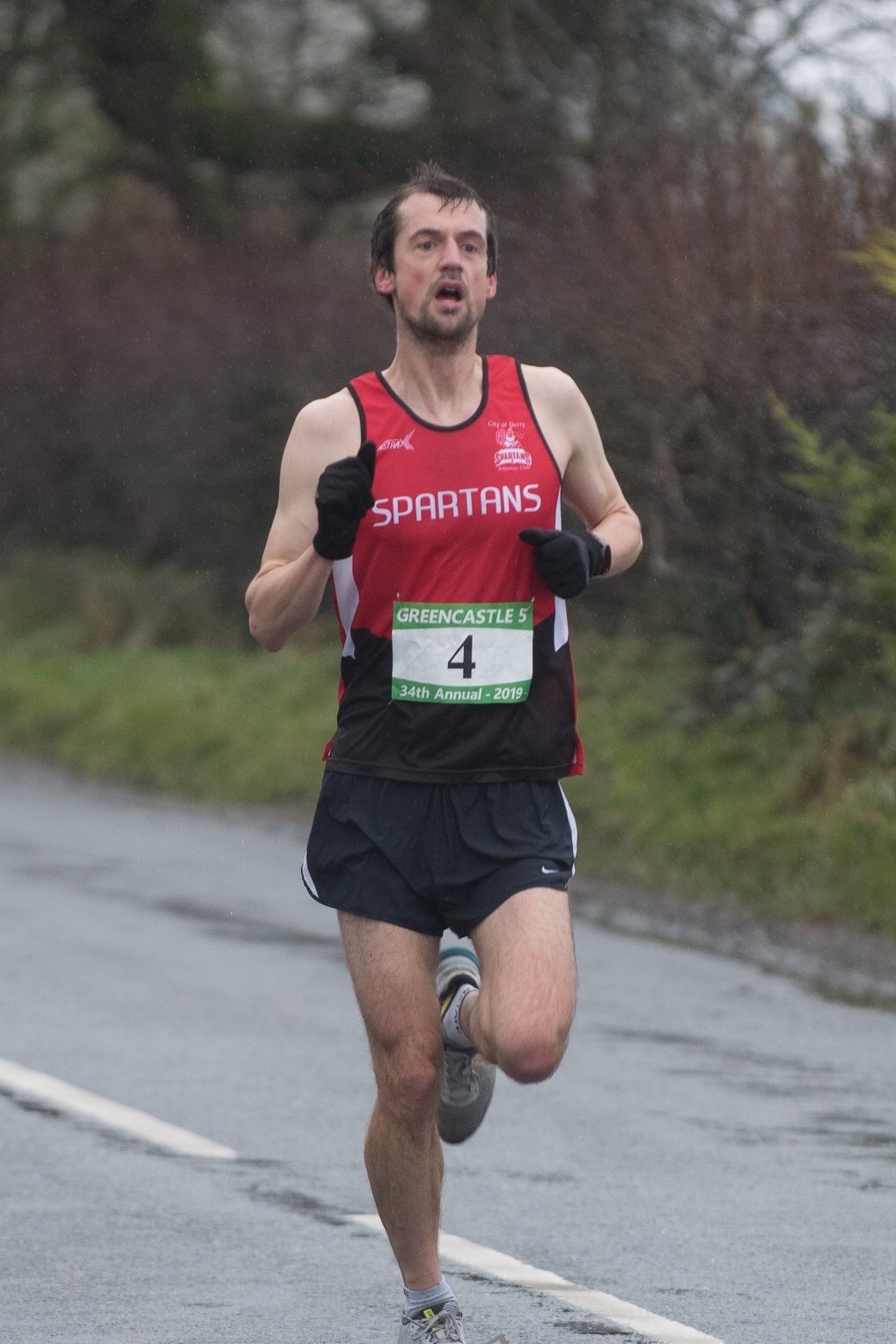
8th year in a row at Greencastle. A super event.
I wasn't particularly keen on being given the number 4, because
I knew I would be nowhere near the top 4 this year.

A bit of Christmas Day slashing and hacking with my brother. 

Ultrasonic probes and frozen peas for the knee, in addition to 
various gels, creams, pills and exercises.

A vibrating massage gun, also used to try to help the knee


The Ulster cross-country championships are very important to me. I don’t often get the chance to race “at home”, and I’ve got a good record at the Ulsters, being on the scoring 6 for my club every year I’ve ran it since 2006. I’m keen to keep the record going. So I gritted through the pain in training, and tried and tried to get fit. I need to be fit if I want to make the scoring 6.

I somehow managed a second place at a local cross-country race in Scotland. That was the third time I’ve been second at the East Lothian cross-country championships race. I’d really love to win a cross-country race. Not this year… even if I’d been fit, I’d never have won it – the winner sprinted off and disappeared off into the woods when the starting gun went, and I never saw him again. He was in a different league to me on the day.

A pretty cool photo, at the East Lothian cross-country. Second place got me two beers.
I still haven't drank them...

I also somehow managed to sneak under 16 minutes at a 5K relay event in Glasgow. That sounds OK, but what would have been a sub-15:30 at halfway turned into a terrible final 2km. But I kept at the training. I just wanted my knee to get better. I made a few tentative enquiries about getting an entry to the Armagh 5K, but when that fell through I wasn’t too bothered. I’ve been there and done that twice. It’s an incredible, high-calibre event but you want to be in tip-top shape to race in such a big event, and I knew I wasn’t.


Finally the Ulsters rolled around. Over the past 5 years they’ve always been held in Lurgan Park. I’ve always enjoyed the trips to Lurgan as I’ve got family there. This year, they moved to where I first ran the Ulsters back in 2006, in Coleraine. It’s a tough, hilly course. It was so mucky. I knew I wasn’t as fit as I wanted to be, but I had done all I could to be fit. It was a horrendous run. It wasn’t a “run”, it was a case of hauling yourself through it as best you could. It was the stickiest mud I’ve ever had to plough through. And the wind as well. I can’t remember whether it was Storm Dennis or Storm Ciara but it was very, very challenging. You couldn’t run. You just had to fight and fight and fight.

When I’m hating a run (i.e. when body and mind and fitness levels are not working together), my head dips a bit. Sometimes in races, it doesn’t dip at all – this is when body and mind work together and the pace is well-judged. Sometimes it’ll dip in the final third or quarter of a race if I’ve gone out too hard. In the Ulsters this year, my head was down in every single one of the photos I saw, right from the start. I remember someone shouting at me from the sidelines “Head up John!” I tried to lift my head in response and it nearly fell off. All my energy was going into keeping my legs moving. There wasn't much left to hold my head up. It was a brutal day. I had been a decent seventh the previous year. I was fourteenth this year. I managed to be fourth scorer on the team, but we “only” managed team silver on the day.


Now a balding MAMIL


My last race as we know it for some time...

I tried to kick on after this, and I got a run for Scotland East at the UK inter-county cross-country championships in Loughborough. But I wasn't kicking on at all. The Ulsters had been a huge effort and my running just seemed to be going backwards afterwards. I had a terrible run in Loughborough. My knee needed to get better. I went to see an old-school cash-in-hand part-time physio, and by whatever miracle, whatever he did, my knee suddenly became almost completely better. I was genuinely gobsmacked.


I started planning for Edmonton. I’d missed out on the gold medal in Lausanne last year by 70 seconds. I dissected everything about it, and came up with a list of 18 things I could improve on:

1.       Specific swim training: Training last year (which was dominated by Ironman, with Lausanne almost being on a whim) had been one long swim per week. A sprint triathlon would need much more high-intensity sprint-focused swim training, which I knew I could implement.

2.       Swim technique: I’ve never been coached. Over the winter I asked a couple of coaches for pointers on my technique. I read a few books on swim technique. Better swim efficiency and technique would mean I’d be faster. I also got my head round needing to swim 2-3 times per week, which I’d have to implement.

3.       Swim the race more aggressively: I’d need to swim hard, fast, and aggressively to get with the faster swimmers, get their draft, and get out of the water in a better position. My swim in Lausanne was quite conservative. I started away off to the right hand side, and swam wide (and therefore longer lines) to avoid the scrum. I would need to be more aggressive in Edmonton.

4.       Specific bike training: In Lausanne in 2019, I went there with Ironman training in my legs. Proper, focused, high-powered, high-intensity, shorter-duration bike training would definitely make a difference. I knew what I’d do in training. I’d need to get my FTP up to over 330 watts on the bike, and my weight down to 62kg. I was confident I could do that. I’d seen 70kg+ on the scales just before Christmas, as heavy as I’ve been for years, but I could soon lose it.

5.       An aero helmet: I raced in Lausanne with an old, cheap, standard road helmet. It didn’t help my cause. A good aero road helmet with a visor (to avoid wasting time in transition with sunglasses) would be worth a good few seconds. I found a bargain on ebay and with the help of some green stickers, I did a nice job on it. What looks cool must be fast:


6.       A better aero bike: I raced Lausanne on a second hand Boardman road bike, which I bought in 2013 for £500. It’s probably a 2011 model. Old technology now. It’s not very aero. A new, stiff, light, aero bike would make such a difference. This was the only change that I deemed to be expensive enough to have to really think twice about. I did look though. I looked at new frames, discounted frames, second hand frames, at all the options and permutations, and in the end coronavirus (more on that later) put paid to this whole idea, for now anyway.

7.       A lower front end on the bike: I remember when I got my first Ironman bike (a fairly basic Giant Defy), I kept lowering and lowering the front end, and being surprised how much faster it got with every incremental lowering. I seem to be able to hold contorted positions quite well. The bike I raced on in Lausanne was my road bike, and for the Ironman training rides I’d done, for comfort, I’d got quite a high front end on it. I could “slam” the stem, drop the whole front end by about 3cm, and it would give me good speed gains.

8.       An aero bottle: Marginal gains indeed, but I’d raced in Lausanne with a big chunky standard bottle on my down tube. Getting a smaller aero bottle would help.

9.       Quicker tyres and tubes: I’d used standard butyl tubes and Continental GP 5000 tyres in Lausanne. Ideally they’d be 25mm, but then they wouldn’t fit my time trial bike (I’ve only got one set of race wheels which are interchangeable between bikes). I could run latex tubes (lighter and faster) and also faster tyres (which are less puncture resistant). I thought a lot about this. It’s high-risk. You put everything into training and getting fit – do you run faster tyres and tubes which mean you’re more likely to puncture? If you puncture, it’s game over, you’ll be winning nothing… in the end I bought latex tubes and Vittoria Corsa Speed tyres (which do indeed feel very thin), but I haven’t installed them yet…

10.   Shoe covers: I can cover my bike shoes to make them more aerodynamic. I bought aero shoe covers on a trip to the Tour of Flanders in 2014 and was mocked. A couple of months later I did 3:59:39 for a 100 mile time trial, wearing the shoe covers. I don’t think I’d have broken 4 hours if I hadn’t been wearing them… mock all you like but I’ll take the sub-4…

11.   A waxed racing chain: You really can buy speed. I usually install a new chain just before any big races. You can buy specially-treated racing chains which are proven to be faster.

12.   Shimano kit: I’d been using Sram stuff on my road bike. Over the winter, a shifter snapped off. I’ve got a friend who’s a bike mechanic. He offered me an old set of Shimano Ultegra stuff for a good price. He said it would be compatible, and indeed it was. It’s probably slightly better equipment, slightly lighter, and the brake hoods are much better in terms of being able to grab onto them and get down in an aerodynamic position.

13.   Shaved legs and arms: I never thought I’d do this. Specialized, a major player in the world of bikes, did a wind tunnel test which showed that shaved legs save 60-80 seconds per hour on the bike. You’re probably also faster in the swim with shaved legs (assuming of course it’s a non-wetsuit swim).

14.   Specific run training: Last year I went to Lausanne with Ironman run training in my legs. If I had specific short-course run training in my legs, I am sure I could run faster.

15.   Nike Vaporflies: The miracle shoes. I disagree with the way running shoes are going now – super-expensive, super-bouncy, carbon fibre soles, huge thick soles. If I ever break 32 minutes for a 10K, I can say for sure I will not be wearing Vaporflies or anything like them. But for a race where positions rather than times are the end goal, then I’ll wear them because they are legal to wear, everyone else will be wearing them, and they are undoubtedly faster. I even had the chance to trial a pair over the winter and I can confirm that they feel unreal and very fast…

16.   “Back not wrecked”: When flying out to Lausanne last year, carrying my luggage down the stairs, I pulled something in my back. I had recruited a friend to carry the heavy stuff. I did the damage when carrying a fairly light case. Bah. Then I had to drive for hours to Liverpool airport, sit on the flight, carry everything on the train, carry everything to the accommodation etc etc. My back was a mess. If it wasn’t a mess, I’d be faster.

17.   A non-strenuous race week: Race week was stressful. Travelling on public transport in Switzerland was not ideal. I should have rented a car. The accommodation was down several flights of steep steps, which I had to ascend and descend so many times, often with heavy luggage. I ended up walking too much, and the day before the race I walked from the lake up to the accommodation, probably a mile and a half up a 25% gradient, carrying shopping from the supermarket. If I hadn’t had to do any of this, I would have been faster.

18.   Not having done an Ironman 6 weeks previously. This speaks for itself… I remember trying to do the 1-mile relay race in Edinburgh about 2 weeks after the Ironman. Usually I’d be thinking I’d break 5 minutes for a mile. In this case I literally hobbled round in just under 7 minutes. That’s the state of the shape I was in, just 4 weeks before Lausanne.

I calculated what I thought were the maximum and minimum times I would save by implementing each of these 18 things. It involved some reading, some research, and some educated guesswork, but I reckoned the minimum time I’d save would be around 90 seconds, but I also reckoned in the best case, I could save over 3 minutes. So, it was realistic to think that I could challenge to become a world champion in Edmonton.

Then I started thinking, how much time I would save in an Ironman if I made these changes… Admittedly not all of the 18 items could be applied to an Ironman, but of those that could, and the additional one of having a new, tight, crease-free “second skin” tri-suit (duly bought – the limited edition Huub DS green tri-suit obviously wasn’t selling well and was reduced from something like £200 to about £60), I reckoned I could save somewhere between 6-12 minutes. I also reckon the experience of having been to Kona, knowing what to expect, and knowing how not to mess up my transitions would be worth another few minutes. So breaking 10 hours at Kona should be possible. Breaking 9:50 should be possible. But actually qualifying to get back there would be the problem…

Upgraded aero brakes on my tri bike

A horribly un-aero stem faceplate. How could I improve this? Aero stems can cost anything up to £300. 
A new integrated front end including stem, bars etc, can cost over £1000. Could I improvise?
What do I have lying around that would be a good shape to cover the stem faceplate? An eggshell? 
Certainly the right shape. Can I buy a plastic eggshell shape and tape it on...?


Hmmmm maybe not this one. Far too big and it seems you can't buy black ones. 
I'll keep an eye out for a second-hand 3T Integra stem - that's the one I want.

"Weight weenie-ing" to the extreme. My road bike seat post is too far set back, so I needed one with no offset,
in order that the saddle could be mounted in the middle of the saddle rails, to avoid it flexing too much and breaking.

I got a £100 zero-offset seatpost for £19.99 and a new version of the original (basic) saddle.
17g heavier...

I also got a heavily discounted carbon stem, which combined with a spare "good" saddle, 
saves 130g. Almost as much as two energy gels...


I’m very glad I had the year I had last year. I’ve watched all the videos and highlights from Kona. It was absolutely fantastic. The whole year was brilliant. Had I planned to try and qualify this year it would have been a disaster with all the races being cancelled. As I predicted, about 4-5 months after Kona, Ironman started selling off all the Kona merchandise at hugely reduced prices. I confess I indulged a little bit. I picked up a couple of $30 baseball caps for $5. $100-plus tops for $20. Ironman must make a huge amount of money in the merchandise tents if the mark-ups are so big…

Anyway. Coronavirus came, and with it came lockdown. Life as we know it changed. One by one, races were postponed or cancelled. Edmonton didn’t immediately cancel, but eventually they did. It became clear that there wouldn’t be much happening in terms of racing over the summer. Triathlon Ireland said they hoped to have a few races later in the season. I had thought I would try to race the Irish sprint triathlon championships in June, which have been provisionally delayed until September. Even now there is still a question mark over this for me in terms of will I be able to travel, or will I want to travel? Will entry numbers in races be reduced to accommodate social distancing? Will costs therefore go up? Will races be like time trials now with racers starting individually at set time intervals? Who knows...

I went to see the British Universities cross-country championships on the iconic 
Holyrood Park course. How long before we see scenes like this again...?

Virtual racing took off in a big way. This is where you run or cycle by yourself, whether indoors or outdoors, recording your activity with a GPS device, and then you upload your results to a central online platform. There were too many virtual races coming from all angles on social media: Running club virtual races, Scottish Athletics virtual races, Ironman virtual races, Cycling Ireland virtual races, Triathlon Ireland virtual races. Some dubiously fast times were recorded. Wind assisted. Downhill. I did a couple of the running virtual races but it wasn’t the same. My running still wasn’t going well, and when my ankle got really sore I decided to have a break from running, and focus on cycling. I was pretty demotivated for a week or two, but then I decided that my “thing” to focus on, my target, would be trying to break 330 watts for 20 minutes on the turbo trainer. This was the highest I’d seen during my time in London, and I didn’t think I’d ever get to that level of intensity again.

With so many literally incredible (or un-credible) times being posted, the rules around virtual racing tightened up, increasing credibility somewhat. Ironman offered qualifying slots for the half-Ironman world championships, by means of competing in a virtual series consisting of run-bike-run races. I wasn’t interested in trying to qualify for a slot, because the world championships are due to be held in New Zealand – a long way away, with no certainty on when they can actually happen. But I would have been keen to have competed in the virtual races, and see how I measured up. But you needed a smart turbo trainer for this, and I don’t have a smart turbo trainer. You can pay anything from £700-1500 for a smart turbo trainer. You also need running fitness, which I don't have... And there are still ways to artificially enhance performance, which is a shame.

It’s probably only a matter of time before a “machine” is available which will allow you, from your home, to “swim” on a bench with resistance cords, to cycle on a bike which is hooked up to virtual reality on your TV, and to run on a treadmill, while recording yourself doing it, while having your weight and heart rate monitored, and while your position on the bike is monitored by a camera which will calculate your coefficient of drag and which will use this, along with power and gradient, to determine your virtual speed. And a fan will blow air on you at this speed to make the speed seem realistic.

So I ended up cycling 5-6 times a week, not doing any running, and using my new swim cords in my flat to try and mimic swimming two or three times a week. Not being able to swim was disappointing, as I’d spent all winter doing swim drills intended to make me a faster swimmer. I had been doing doggy-paddle drills, spear drills, shoulder-touch drills, rolling drills, side-swimming drills, breathing drills, underwater arm recovery drills, all the drills. All designed to try to get my body rotating more, get my stroke driven more from the torso and hips (where the strong powerful muscles are) rather than from the shoulders (which have weaker, smaller muscles). Also designed to get me swimming smoother, and going faster, for less effort. Swimming is a bit paradoxical - smooth and effortless is fast. When you feel like you are making effort, generally you are not as smooth, and so you are slower through the water. I had read a few books on how to swim better. I had done a few swimming time trials and seemed to be swimming as strongly and as smoothly as ever, putting down good times for seemingly less effort. Then when the pools closed, it all stopped. Which was a shame, as I'd been working hard on my swimming.

"Swimming" in the "new normal" in lockdown. Tougher than it looks...

My 20-minute FTP on the bike progressed as follows (all of the FTP tests were done as hard as possible, despite what the average heart rate says):

December 7th –   304 watts, 174bpm (probably at around 70kg)
December 21st – 308 watts, 168bpm
January 15th –     313 watts, 167bpm, 68.1kg, 4.596W/kg
March 18th –        317 watts, 165bpm, 65.6kg, 4.84W/kg
May 8th –             320 watts, 177bpm, 62.8kg, 5.092W/kg
May 23rd –           326 watts, 175bpm, 62.7kg, 5.199W/kg
June 27th –          308 watts, 168bpm, 63.7kg, 4.835W/kg

The first 5 of these were done on the road bike. The penultimate one was done on the tri bike, but in an upright riding position. The last one was done on the tri bike in the aero position. It seems I can produce a bit more power when sitting upright on a tri bike compared with a road bike. It seems that my aero position FTP is around 6% lower than my upright FTP (admittedly I was slightly less tapered for the aero test), and that I can't quite hit the highest heart rates when in the aero position. I think it's easier to maintain higher watts on the TT bike when actually on the road compared with on the turbo. It's probably also easier to maintain the aero position when actually out on the road versus when on the turbo, for whatever reason. I found it tough to maintain the aero position at high intensity for 20 minutes on the turbo - this was the first time I've ever done it. It took me 6 months of hard bike training to gain 22 watts...!

The lowest I've seen this year, down from 70kg at Christmas. Not as low as a very
dehydrated 60.6kg I saw last year...


I enjoyed using my heavy hybrid bike for exercise during the lockdown. I had put clippy pedals on it, and I used it a lot. I didn’t take my road bike out until a couple of days ago. It was a novelty cycling around the quiet city streets, to parts of town I’d never ordinarily have gone to. May was a great month – spring was well and truly springing, the weather was fantastic, and the city looked great in full bloom. I was developing good leg strength and overtaking plenty of road bikes on the Arthur’s Seat climb. Various photos follow:

Plane spotting

The Korean War memorial in the Bathgate Alps.
The site was chosen because the landscape is said to resemble Korea. 
It was indeed quite like Korea. 

Taken on a pre-lockdown trip


Cherry blossoms are spectacular but fleeting

Yellow whin is spectacular


I see these guys a few times a week. They grow quickly!


Fantastic community art project on the old railway tunnel. Also painted on the tunnel walls are
excerpts from the poem "From a Railway Carriage" - one of my favourite poems. 


I did dip my feet in one night thinking I would like to take the plunge. I knew I wouldn't though, I knew
it would be too cold. And it was too cold. I can't cope with it. Plenty of others were in swimming.
Maybe I'll get the thermal wetsuit out and get into one of the lochs or reservoirs which might be a bit warmer...


Summer solstice sunset


This is pretty much the first year in a decade that I haven’t had any summer Ironman (or half Ironman) events. I suppose I have realised that I really enjoy the process of training for and competing in a long-course event. I love putting a plan together. I love getting out on the bike. Swimming. Running. I love feeling the strength coming over months of training. I love being able to race well. That’s what I do. That’s what I want to do. I dabbled in mountain walking in the months after Kona. It just wasn’t the same. I get more of a buzz from a well-executed turbo session than from walking up a mountain.


Just not the same as a turbo...?!

As much as I love long-course (and indeed shorter) training and racing, I don’t love working on bikes. I mentioned having bought fast tyres. I tried to install them. I couldn’t. They are so tight. So tight. I did some research and I bought a couple of special tools to help, but I haven’t yet tried again. If I raced with these tyres and I punctured, that would be it. I wouldn’t be able to change them at the side of the road. Also I very definitely don’t love continually thinking about what I can do with my equipment to make it faster, because it’s just money, money, money. I’d love for money to be no object and for someone to say, “Here’s the fastest possible bike, fitted perfectly for you.” But I’m not good enough or rich enough for that, so I will continue to weigh up the cost of the various upgrades versus the gains they would give.

How much longer I will be able to continue with high-end competition is another question, but for now that’s what I want to do. I would love to do another Ironman. I have found a formula that seems to work now. I could tweak it a little to make it more effective and efficient. I’d love to go back to Kona… but I could do everything right, and do two Ironmans per year for the next ten years, and never qualify again. But I'd love to try at least once though. And if ever they offered qualifying slots for Kona in virtual races, then I’d be very tempted.

I recently did my first run for 2 months. An easy 30 minute run, at 7 minute per mile pace. It was as part of the club’s summer solstice longest day relay from dusk to dawn, to raise money for a local charity. It was a great day, watching it all unfold on social media. But oh dear, even though it was an easy run (or should have been an easy run), my legs were in pieces the next day. They were so deconditioned for running. And worse, after 2 months of non-impact exercise, the ankle trouble I had been having was no better. I get sharp stabs of pain down the front and top of my ankle. I can’t see or feel anything wrong. I don’t know what to do. I’ll have to see about getting it seen to, but that’s not easy in these times.

I also became a journalist. Of sorts, anyway. I wrote a little bit about this this in a previous blog post, and I hope to continue with it in future. I'll shortly be writing an article about the longest day relay. I quite enjoy it. I also received quite a nice compliment from a fellow triathlete: I had been discussing my Kona qualification and what I had done to make it possible (outlined in Post 210). The principles aren't just for Kona-seekers, I think they would work for all levels of Ironman racing. A guy had read it all and told me I should be a coach, and he hadn't said that to anyone in (if I remember right) 30-odd years. I'd love to be a coach. But that will have to wait until I move on from competing. "You can do anything you want, but you can't do everything." If I am going to do something, I will give it everything and do it as well as I possibly can. So there is a limit to the amount of stuff I am willing to take on, because I know that taking on too much and not having the time or energy to give it my best will just frustrate me. "If something is worth doing, do it well..."

And finally...
The droplets represent blood, sweat and tears...

“Everesting” has become very popular in recent weeks, as cyclists/triathletes/endurance athletes started looking for a challenge in the absence of races. Many years ago, before it was ever popularised, I had thought it would be cool to try and climb the height of Everest on a bike (8848m, or nearly 30,000 feet, the height of a jet aircraft in flight). I’d never done anything about this idea other than keep it in the back of my mind. There was never a good time to do it anyway, because I was always training for something, and doing an “Everest” would have been detrimental to the goal race. But now there isn’t really a goal race this year, and so I’m thinking about Everesting.

I saw the stats from a girl who broke the British record – she had climbed Alpe d’Huez in 50 minutes (as have I – 50 minutes and 3 seconds – raging not to break 50, but I was carrying 2 litres of drink and 2 extra kilos make a big difference). This girl did her "Everest" in around 10 hours. So I thought great, 10 hours, a long day but not ridiculously long.

I started looking for a possible hill on which I might make my attempt. You need a steep, straight hill with a consistent gradient. This is so you can descend quickly, and gain altitude quickly on the climb. I found a hill I thought might do it, and headed out to have a look (on the road bike). Blitzing the climb at 360 watts meant a 4:30 ascent, with a 2:30 descent (I simply do not have the bravery, or foolhardiness to hammer down the descent at 50mph – I know what it’s like to crash a bike and I know that serious damage can be done).

Taking the climb “as slowly as possible”, as would probably be the case on an Everest attempt, at just under 200 watts, meant a 7-8 minute ascent. So I'd maybe manage 7 ascents per hour. On this particular hill, I’d need 100 ascents. I’d be looking at around 14 hours. But I don’t know. That’s why it’s exciting. Maybe I’d be faster. Maybe not. Maybe I should embrace the “dead stop” at the bottom rather than extending the descent round the roundabout to save a big stop each time (I’d save 10-20 seconds each time, which adds up to about 30 minutes…) Maybe I should only ride 80% of the way up, and avoid the flat section before the final kick to the crest – the flat section obviously gains no altitude, so you’d save another 20-odd seconds per interval.

"Everesting" is intriguing… I have reasonable bike fitness just now, but I probably lack a bit of endurance fitness. I can't swim at the minute and haven't been able to for months, and I have done pretty much no running. And I have no races to train for. If ever I am going to do an "Everest" surely now would be the time... Watch this space…

Tuesday, June 23, 2020

Post 213 - Journalism! (of sorts...)

I've always enjoyed writing, and I've always wanted to do it, so that's one of the reasons why I started this blog. I suppose I do enjoy it, because like Ironman racing, I keep coming back to it and doing more!

When I started running a bit more seriously in my late teens and early 20s in Aberdeen, a former top-class marathon runner-turned journalist would occasionally write about me in the paper. Those were good days. Literally every race I did for about 3 years was a PB and I was wondering where I could go with it. On the one hand I could say I got further than I ever thought possible, but on the other hand I didn't. Such is how it goes.

He didn't just write about me in the paper, but also about the local athletics scene, and everyone involved with it. He was very inclusive. A great guy. A modest guy, who has remained a fan and an enthusiast of athletics. Fast forward nearly two decades and he is still writing for the paper, and he was gracious enough to give me a few tips about it. 

I did a 5K relay in Glasgow earlier in the year. It was a major, high-calibre national event, and our club’s A-team was spearheaded by a 1500m Olympian. The racing was top-class, and thrilling. Our A-team won the day. I’d never seen a single story about local athletics in any paper in Edinburgh, so I thought well, if this wasn't worthy of something in the paper, what would be?! I put together a story and got in touch with the paper. And they were happy to publish it, so it mustn't have been too bad...!

When the cross-country season wound down with the UK inter-county championships in Loughborough, just a few days before lockdown, I put together a summary of the cross-country season. The paper again seemed pretty receptive and I hope to continue with this in future. Often at races I will whip out my phone and take whatever photos I can of the races. I've become somewhat known as the club photographer. So I have some good photos I am able to use to support the articles.

The difficulty is keeping to the word limit. I always tell myself to keep these blogs short and stop spending so much time on them. And inevitably they still end up being long, rambling, cathartic essays. You can’t write like that for the paper. I summarised the cross-country season in 1000 words (not many words, and difficult to do) and then the editor said I had to cut it to 600 words - not easy!


Post 212 - Musings on the future of Ironman, written in early 2020

Bit of a long post here on the future of Ironman…

I love endurance sports. I love pushing limits. I love the concept of doing things that seem outlandish, perhaps a bit crazy. I love fighting the odds. I love a challenge. I love the attitudes needed to do such things. Taking Ironman not as a corporation, but taking Ironman as a concept, as a race distance, it is all of those things. It is incredible. I think that Ironman and Hawaii, that Ironman and Kona are so closely bound up as to be disentanglable.

I’ve learned a little bit about the fantastic history of Ironman, and the pioneers who took it on in the early days. I said I’ve learned a “little bit” – I could never possibly have all the great names on the tip of my tongue. But, to start with, I’m talking about the people who dreamed it up. “Let’s combine the three toughest single-day sporting events on Hawaii (which would have been on a par with the three toughest single-day sporting events anywhere in the world at the time), let’s combine them into a single race and whoever finishes first, whoever survives it, shall be called the Ironman.” Born out of a sense of pushing and exploring limits, of trying to make the impossible possible.

I’m also talking about the likes of Dave Scott, who initially said an Ironman would be a tough 3 days. Dave Scott, to me, is as much a pioneer and adventurer as, for example, the astronauts. No-one knew if the human body could complete an Ironman. No-one knew if the human body could race an Ironman. Dave Scott took “completing” an Ironman and through his bloody-mindedness, showed that it could be raced – he went from “completing” in around 10 hours, to “racing” in just over 8 hours, and I would say on a par with today’s technologically enhanced performances.


Nicknamed "the Man". He was the man. He is the man. 
I met him and liked him, he had time for everyone.

Also people like Mark Allen, who fought the Ironwar with Dave Scott, capturing public imagination.


Surely one of the most iconic sports photographs ever

People like Julie Moss, who pushed so hard she ended up on her hands and knees, reduced to crawling desperately for the finishing line. People like John and Judy Collins, who set the race up in the spirit of endeavour, in the spirit of sport, in the spirit of exploring limits.

And where one leads, others follow. It is incredible that we, with training and discipline and the attitudes and qualities described above, can do likewise. We can complete an Ironman. We can qualify for Hawaii and follow in the footsteps of pioneering greatness.

To me, that is what Ironman is. Ironman is more than a triathlon. Ironman is the ultimate challenge. Hawaii is the ultimate destination. It is the stuff of legend. Ironman have the ultimate challenge in the ultimate destination. It’s a race, of course, but more so than any other race (any other single-day race anyway), it is a competition against oneself. I love it.

However, I am not convinced that Ironman is necessarily being run in the spirit in which it was set up. In today’s world, corporatisation, profit and monetisation are becoming more and more prevalent. Ironman seems to be following that trend. It has become a global juggernaut. Races abound. 1500 cash cows are needed to make a race viable. How much longer can such growth continue? I think there’s a growing sense that Ironman are simply a for-profit corporation, and I think they need to be careful about that.

And these races can only be held with the goodwill of a huge number of volunteers. The volunteers and communities make the races what they are. I’ve done races where third parties are paid to do the roles of volunteers. These paid third parties usually couldn’t care less about the race. I’ve finished races and gone back to jog along the course to support slower (but not lesser) athletes still out on course. The third parties are generally not interested in the race in the slightest. Not a single clap (think of the London marathon debacle of last year where they were laughing at competitors). The volunteers do it because they want to be there. They want to help. They want to encourage. They are fantastic. Ironman’s whole “business model” is based on goodwill. And I think they should remember that goodwill is a multi-directional thing.

Ironman must have something like 100 races per year. If 2000 people enter each race and pay an average of, say, £400, then Ironman are pulling in £80 million per year. Huge sums of money. They must also pull in a lot of money on merchandise. Kona 2019 merchandise and gear is now available online for a quarter of the price that it cost at the event. Yet you read of professionals who win an Ironman and for this, they get a few thousand dollars. And I think there’s a perception that, given that the “workforce” who allow them to put on their races are all volunteers, where does all the money go?

I’m a strong believer in fairness and in fair play. To get involved in Ironman, and certainly to compete in Ironman, you need to have money. You can buy speed. Equipment is constantly changing. There’s a need to keep up in the “arms war.” You read about people who qualify for Kona, but can’t afford to go.

So I have a few suggestions for things that Ironman could do differently. I’m no expert, and some of this might not be possible or feasible, but these are my observations/thoughts.

Here’s the first thing. They need more coverage of their races. And they need that coverage to be free and widely available. These are the greatest races in the world and yet they barely get any mainstream media coverage. I doubt there are many in the BBC who even know who David McNamee is. Admittedly a 9-hour Ironman is a tough race to “sell” to the average punter, but a really well-done highlights package, with knowledgeable and enthusiastic commentators, and background stories/interviews with the pros, and indeed the age-groupers, would do so much for Ironman. It would be a great showcase.

With this, then Ironman could go after big sponsors more aggressively, in the same manner as their aggressive growth strategy over the past decade since I’ve been involved. This would bring more money into the sport (when I say “sport”, I mean into Ironman – I almost see Ironman as a separate sport to triathlon). This would then allow them to pay their professionals more, and look after them better, and build loyalty among them. And it would make Ironman a viable career for more of them.

There seems to be a lot of unrest along the professionals, which has led to the formation of the professional triathletes organisation. They’ve got Ironman, they’ve got Challenge, they’ve got the ITU races, they’ve got all sorts, but they don’t have a lot of coherency as far as I can see, and it’s tough to make a living for all but the very top pros. And yet Ironman pros are among the nicest and most approachable people you can ever meet, I’ve met a few of them and they’ve all been great.

I think Ironman should be run by people who know Ironman as a sport, as a concept, rather than as a corporate business. To me it would have been a great idea for the professional triathletes’ organisation to have taken over the reins. To me it somehow seems wrong that the pros didn’t get to buy it but some glossy venture capitalist did. Again, not really being run in the spirit in which it is set up. It’s like people managing (for example) teachers and doctors, who have never taught nor been on the medical front line. The pros would “get” Ironman and the spirit. They’d have been ideal custodians (to my mind).

I realise it might be difficult, but I think they should go all-out to make the world championships a 2-day race. The half-worlds in South Africa 2018 did this, and it worked really well. Nice 2019 was the same I believe. You got to watch a race, and then compete in a race. The world championships is becoming more and more difficult to qualify for, with fewer slots per race and the standard of athletes getting higher and higher. (I can only hope there is no mechanical or pharmaceutical assistance). Having a 2-day race would mean more people could qualify and it wouldn’t become quite so impossible (I do realise I probably got a bit lucky). This is all assuming that after the Coronavirus outbreak passes, the world that emerges will be one in which we can still travel internationally...

There is so much drafting at Kona. I saw a lot of drafting in 2019, even with the new wave starts. So they could break up the age-groups. M18-24, M30-34, M40-44, M50-54 on one day and all other males plus females on the other day. And have strict drafting penalties. I’d also say there needs to be much more of a chance you could be drug tested or your bike tested, with big penalties that will actually deter people. You can’t just act on tip-offs. If someone is doping, they aren’t going to tell many people about it!

It could be a Friday/Saturday race, or a Friday/Sunday race, to allow a day of normality between races and to allow re-stocking of aid stations etc. Then you could have 1.5 to 2 times the number of competitors there, and so the world championship dreamers would actually stand a much better chance of being able to qualify against the uber-age-groupers who are now dominating.

I think they should rotate the world championships to allow everyone a better chance of being able to afford the trip to a more local world championships. They could still hold a Kona race every year. In the non-world championship years, they could have it (possibly) as a 1-day event, open for entry via a variety of means: general entries, a ballot, legacy/commitment entries, and possibly a number of funded spots for people who have qualified in previous years but who have had to decline their spot because they couldn’t afford it. In the world championship year, it could be a 2-day affair. The world championship could then rotate around some of the other iconic courses on the different continents as a 2-day event. Kona favours an athlete who can go well in the heat and who is a big powerhouse on the bike. Somewhere like Wales would favour a climber who likes cooler conditions. It would make things interesting.

I do think that there should be some “pre-requisites” which you have to meet before entering an Ironman. I believe for various hill and mountain races, you have to show that you have completed “less extreme” races successfully. So possibly there’s an argument to say that you have to have done an Olympic triathlon including an open water swim within the previous 2-3 years before you enter an Ironman.

I also do think that they need to make a distinction between “fast” competitors and people who just want to get round. I am not at all belittling anyone – anyone who finishes an Ironman is worthy of high praise. But the big running races often have elite or “good for age” entry, and separate starts etc. But then how would Ironman do that? They shouldn’t do it by virtue of All World Athlete status, because I think that’s just a way to keep people coming back and coming back – if you don’t race, you lose your status. I was very disheartened when I missed Kona by one place at Wales 2014 to receive an email from Ironman immediately afterwards saying I was so close, my dreams were almost a reality, “you have the fitness, all you need is the race” and why not take the next opportunity to qualify… at Ironman Melbourne? I’m not made of money…! Nor do I have the ability to race continuously…

Maybe some sort of proof of recent results, watts per kilo held, swim time, half marathon or marathon time etc could help with this, and then you get to start in a mass start (I say mass start, but maybe this would only be the top 300-400 per race, which wouldn’t be too massive), and then it’s a true race to the finish line, without worrying about time deltas.

I think they could do better with their deferrals and refunds etc. People generally don’t take an Ironman on lightly and it dominates the best part of 6-12 months. To me it seems harsh that not only is a year of work wasted, but all the money as well, if you get injured in the run-up to a race. I’m not sure how it could work but surely developing some sort of system where you get all your money back up to, say, 3 or 4 months beforehand, and then a deferral option into a non-sold out later race or the same race next year.

Or if it’s a popular race, then why not have a waiting list where you could transfer your entry to someone on the waiting list. You could get all sorts of stats on it – you might get 10% of entrants looking money back with 3-4 months to go, in which case Ironman can still accept new entries. Then you might get another 10% looking to defer with less than 3 months to go, and you could get the stats on it and tell people on the waiting list that based on previous years, you’re number 57 on the wait list and last year number 10 had a spot with 2 months to go, number 50 had a spot with 1 month to go, and number 80 had a spot with 2 weeks to go, and then people could make their own decisions about how likely they were to get a place. It just seems that there’s a perception that they want to fill their races, get the money, and that’s all they want – you’re then a number on a list who has, by and large, irrefundably committed the money come hell or high water.

Also, and I thought this a while ago, I can see them now moving towards online racing. Swim technology is going to develop a lot in future. I can see swim power meters, goggles with built-in displays of data (heart rate, power etc), and swimming machines in homes. I can see running power meters too. I think there could end up being an online race series. And they’ve already started this with the coronavirus crisis and having to cancel all the races. I can see there being fees for this, race goody bags sent out, finisher gear being sent out, results posted, possibly with the carrot of qualifying for Kona, and as is already the case the Taupo worlds (if that even goes ahead).

Or maybe they will create a virtual world championships. I could see them creating a smart contraption like the Transformer robots which will encompass a swim machine, a bike trainer, and a running machine, along with scales, a flatscreen and a video camera. It’ll fold away and it’ll be a virtual race platform, for use in the home or in a club’s central location. Whatever they do, I’m sure you’ll have to pay for it…

Whatever they do, I really hope they do keep the founding spirit alive…

Post 211 - How I could have performed better at Kona

Being something of a relentless perfectionist with high standards, wanting to get the best out of myself, I've been thinking about how I could have performed better in Kona. Certainly a sub-10 is possible, and I would think I could probably do a sub 9:50 and possibly a sub 9:40. If I chose to spend a huge amount of money on a new uber-bike, then there would be a small chance that a sub-9:30 might be possible.

Even if I did a sub-9:30 at Kona, it would be nowhere near topping any age-group podiums or anything, but that's not the point. The point is to get the most out of yourself! However, improving my 10:05 time at Kona wouldn't necessarily be the problem, but qualifying to get back to Kona would be, if I decided that it was something I wanted to target again...

I would also love to go to a flat Ironman course like Barcelona and see just how fast I could go. If I am saying that a sub-9:40 might be possible at the hot, windy, humid and fairly hilly Kona course without having to buy a new uber-bike, then surely at a course like Barcelona (which is flatter, and less harsh in terms of heat, wind and humidity) a sub 9:30 would be possible...?

An interesting saying is "You can have anything you want, but you can't have everything..." meaning that you can target excellence in one thing, but not everything, as has been evidenced by not being the best runner I could possibly be over the years that I've been doing triathlon.

But I think if I had to target either a fast Ironman PB or going back to Kona, I would target qualifying for Kona again. To me, a two-time Kona qualifier with a Kona PB of something like 9:47 would be worth more than a 1-time Kona qualifer with a Kona PB of 10:05 and an Ironman PB of 9:29. 

Which begs the question: why not just qualify for Kona at Barcelona then...? Simply because I am not good enough! You'd need to do something like 8:30 to 8:40 to qualify at Barcelona. I know what is realistic or not. 8:30 is beyond me. Which begs another question: why not chase an Ironman PB at Barcelona after Kona? Well I'd have to first qualify to get back to Kona (which may never happen), go to Kona, and then decide to do yet another season of Ironman after that...

Anyway, all that is not really for consideration or discussion right now...

After reflecting on and dissecting my Kona experience and Kona race, I came up with the following list of what I could/would/should do to improve my Kona time.

1. Don't race the world sprint and standard triathlon championships 6 weeks after your Kona qualifying event and 6 weeks before Kona! This is too tiring, and short-course training is very different to long-course training. Focus entirely on Kona and on long-course Kona-specific training.

2. Don't force the Kona-specific training. I probably forced it just a little bit too hard (which is a product of not having quite enough time after the world sprint and standard championships to prepare exactly as I would have liked for Kona. I probably did a little too much heat training, and came down with a cold the week before travelling to Kona, because I was so fatigued and had asked a bit much of my body. I could have been a bit fresher going to Kona. The excitement and adrenaline of it being Kona probably helped to carry me through.

3. Don't over-do things in Kona in the 7 days before the race. With hindsight, I did too much. It's a difficult balance between enjoying the trip of a lifetime and seeing and doing "fun"/touristy things, and maintaining focus on the race. The priority should have been the race. The long day spent travelling to and from Volcano National Park was a trip too far and ended up wrecking my neck.

4. Build a lot of "doing nothing" time into the week before Kona. Sitting (in the shade) by the pool or by the ocean is better than chasing round Hawaii being a tourist. I was constantly on the go during race week. At the time, it felt sensible and fine and manageable and enjoyable (apart from the sore neck), but again, adrenaline and excitement probably helped carry me through. Had I been at home, my preparation would have been different in race week.

5. Don't get too much sun during race week, and don't forget that in the heat, you will dehydrate, so drink. But don't over-drink - it's a delicate balance.

6. Travel with a friend who can take the strain - I was with three others in Kona but we all arrived at different times. I arrived first and so had to deal with sussing everything out myself. I "most needed" someone to help with the travel, luggage and associated thinking needed to get from one side of the world to another, as opposed to "needing" help when everything was "set up" in Kona in terms of car rental, luggage handling and unpacking, settling into the condo etc.

7. In the mornings don't let waking up time slip - the couple of mornings after arrival were early wake-up mornings, due to the jet lag. As time passed, waking up got later and later. I should have gone to bed at 8pm and got up at 5am consistently as then the body would have been better ready for the early start on race day.

8. I knew the course well, but I should have "learned" transition better when I was racking my gear. I should have insisted to my volunteer helper when I was racking in transition that I needed 10-20 minutes to walk through it all as it would happen on race day, from the points of view of swim exit, bike exit, bike in and run exit, and taken photos that I could look back over later to imprint it all in my brain. I made a mess of my transitions (in particular the swim to bike transition), I couldn't find my blue bag in the melee when I'd finished the swim, and was not at all mentally ready for the heaving, sweaty mass of bodies in a small transition area - usually when I'm in transition I'm one of the first out of the water and mostly have the transition area to myself, but in Kona everyone is a fast swimmer and a lot of people all exit the water at the same time. Which means transition is chaos...!

9. My swim wasn't bad. It was salty and long. It was a good call not to do the official full-length practice swim, this would have just tired me out. I should have been more careful entering the water and wading out to the start, as I stood on a stone and it hurt (although it turned out to be superficial, it could easily have been a lot worse). I wasn't at all mentally ready for or expecting the super-strong swimmers in the starting waves behind me to come charging over the top of me. Coke and water in transition was good to get rid of the saltiness. And I made sure to have suncream put on, which I thought was a very good idea.

10. Going up Palani hill for the first time on the bike, I was intentionally so slow compared with most others. Still, I was doing 240 watts, which isn't that low. People were absolutely flying up the hill, which I am sure would cost them later in the race. As 6-time champion Dave Scott told me, "the bike doesn't start until you get to the airport..." (which is after about 15 miles).

11. Knowing how to approach the aid stations on the bike: pour any remaining water over your head and body, ditch the empty bottle, grab a new cold bottle and put it in the bottle cage, grab a gatorade and have a swig then ditch the gatorade bottle. All while watching out for other riders, staying upright, and not hitting any discarded bottles (this nearly caught me out at one aid station). You had to be on the ball with all of this, and it took me a few aid stations to develop a system for getting through them effectively.

12. A lower front end on the bike, with narrower arm pads, and aero bars angled closer together to make my hands more of a single unit, would have made me more aero and therefore faster. And, a more aero computer mount would also help, as would reducing the amount of bar tape on the base bars and making sure the bar tape only remained on the front of the hand grips rather than following the curve of the bars. Small gains here with the aero computer mount and bar tape, but it all adds up...

13. Faster tyres and (latex) tubes (all at higher risk of puncturing) would make me faster.

14. Better clothing - I had a cheap pair of shorts and an old top - a new super-tight, wrinkle-free, super-aero skinsuit would make me faster. Also, you can buy aero socks and aero arm cooling sleeves, which would also help.

15. A new uber-bike: When I started triathlon in 2010-2011, £6k would have got you a really top-end bike. My bike isn't bad but it's getting on for 10-year old technology now. A new uber-bike these days could cost £15k-20k. It would have a fully integrated front end, no visible cables, properly integrated hydration and storage, electronic gear shifting, hidden aero brakes, the best bearings, CeramicSpeed jockey wheels, top-end super-light components, the best wheels, 11-speed gears, the latest and stiffest carbon fibre, the best of everything. Undoubtedly it would make you faster... I can dream... this is the only time-saver than is unrealistic for me to implement, unless I suddenly become very wealthy. But instead of a new aero bike, I can buy a new aero stem, which will give some small benefit!

16. A specially-waxed racing chain on the bike - this would help to save a few watts and give me a little more speed. Every little really does help...

17. Shaved legs and arms. I never thought I'd do this... But recent wind tunnel studies by Specialized (a top bike manufacturer) have showed that shaved legs save around 60-80 seconds per hour at race pace, and shaved arms save another 10 seconds or so per hour. That's a total of about 90 seconds per hour, or 450 seconds (7+ minutes!) over the 5 hours of an Ironman bike - that would have been an easy way to go sub-10... plus, being hairless would save time in the swim too.

18. Having a heart rate monitor that worked - mine died after about 90 minutes on the bike (I don't recommend Garmin heart rate monitors!) - I paced the bike reasonably well but the winds were sapping and tough, and the climbs on the way back were tough - the climb into the wind up from Kawaihae and the climb up to the scenic point were tough and and a bit dispiriting. Having accurate heart rate data for the whole bike (and the run) would have been helpful.

18. Using the aid station on the pier just before the run starts. This is a tricky one to see as it's kind of "hidden" as you are focused on getting yourself kitted out for the run and making your way off the pier and onto the run course, and you are looking for where the run course actually starts. I ran right past this aid station and suffered a lot in the first few miles of the run, in the hottest part of the day, when I had just lost the cooling effect of the speed on the bike. I should have walked through this aid station, put ice down my front and back and shorts and in my cap, put cold sponges down my top, drank some cold water, fuelled up with a gel, got myself cooled off, and I would have been in much better shape for the start of the marathon.

In transition, still on the pier, having ran right through the "hidden" aid station and 
not taken anything to fuel or cool me - error. All the cups and sponges on the ground
should have been an indicator that aid was available but I was too busy getting my watch 
on and trying to work out where to start it (i.e. where the marathon "start line" actually
was, to see or notice or do anything about this aid station...

19. Knowing how to "use" the aid stations on course. Everything in the aid station comes so quickly, so you need to be prepared. I thought an aid station might be 100m long with short gaps between each item in the aid station. But everything was just one thing immdiately after another. You need to take out the pre-existing (now warm) sponges from your clothes to make room for new ones, you need to be able to identify and grab what you need and put it where you need, you need to have taken a gel before you take a drink, and in short, you need to be really on the ball, know the order in which the items will appear as you run past them, and know your system for approaching and getting through them. It took me a while to got this sorted.

20. I should have used the special needs bag in the energy lab. I carried a couple of emergency gels in my back pocket but I needed more, and the special needs bag would have been an opportunity to re-stock for the final 10 miles.

21. Where I didn't manage to get what I needed from an aid station (as happened in the energy lab), I should have stopped, reversed, and got what I needed. This is more important that "keeping running."

22. I should have started on caffeine sooner - on the climb out of the energy lab. See next point for the reason!

23. Once you get out of the Energy Lab (and the climb out of the energy lab wasn't actually that bad), you think you're "nearly done" and it's just a short run remaining: less than 10km along the Queen K and then a victory lap in town to the finish line. The 8km or so from the Energy Lab back to Kona were very tough. Into the wind, and undulating, which at that stage of the race meant "mountainous"! I should have trained on my long runs with hills in the final 2-3 miles. The last climb from the Makala boulevard up to Palani was very tough and so slow. Had I fuelled a bit better in the Energy Lab, then I might have been a bit stronger on this section.

24. Nike vaporfly shoes. Apparently they can give you 2-4 minutes in a marathon... and in addition, if I could be something like 15-20 minutes faster on the bike, then I will be 15-20 minutes less tired on starting the run, which will mean (in theory) more energy for the run.

25. Enjoying Ali'i Drive and the finish - I should have really, really, really savoured it, as it might never happen again. I should have listened for Mike Reilly saying "you are an Ironman" as I've never heard this being said to me at the finish of an Ironman - it has always just been a blur.

26. Experience. The experience of having been to Kona once before would in itself be worth a bit of time.

27. Training: I could probably train more specifically for Kona. I would adopt the philosophy that, for an Ironman, it's not about improving your maximal output (as is the case for short-course), rather, it's about improving the length of time you are able to spend at a lower intensity.

Some of the above could be applied to a qualifying race as well. I reckon that the time savings I mentioned at the beginning are realistic. The faster tyres and tubes would be a tough call if I ever got back to Kona: all that effort of qualifying again could go to waste with a flat tyre. It's so tough and time-consuming to change a flat tyre as they are so tight-fitting. I could run tubeless tyres with sealant, but my "old" bike doesn't accommodate wide enough tyres for tubeless to be an option. I would also wrestle morally with the Vaporfly shoes and their big bouncy soles and carbon fibre "springs". But they are legal... I wish I could buy a £15k bike, but I think all the other points I made could be implemented.

The problem is simply qualifying to get back there, if I did decide that was what I wanted to do. It took 10 years to qualify the first time. I don't know if I could do another 10 years... but I've learned all the lessons and found a formula that works for me to do an Ironman as well as I can, and with the lessons above implemented, then it shouldn't take 10 more years to deliver an Ironman as well as I can. And that's all I could do - deliver a qualifying race as well as I can. If that resulted in Kona, great, and if not then you'd just have to say you couldn't have done any more...

Post 210 - Things that helped me to qualify for Kona, often learned the hard way

Some experiences and lessons learned throughout my Ironman career:

After 10 attempts, a lot of very tough lessons, and some terrible circumstances, I finally qualified for Kona at IMUK last year. Kona was brilliant and it was absolutely worth it. I made quite a few changes in 2019, all of which I think helped.

Palani hill, Ironman day, 2019. Just gone 08:00. Smiling!


Ali'i Drive. Ironman day 2019. 14:37. It was worth it.
Who'd have thought the little cheap Kitvision camera would 
take such good photos?! You can even read the time on my watch!


I knew Ironman UK would suit me – been there, done that, know it all well. A benign warm lake swim would suit me. A cold, choppy sea swim wouldn’t (6ft1 and 62-63kg means I don’t like the cold!). For these same reasons I tend to go well on the hills, and the Ironman UK 2019 bike course was nothing if not hilly.

I don’t travel all that well and was keen to minimise the “occasion” and the “excitement” so wanted my A-race to be UK based, but I did think long and hard about South Africa, having had a great time there at the half worlds in 2018. In the end I thought it was too far away, not hilly enough, too early in the season, and with a sea swim.

Previous seasons started in January and by May/June I was burned out and frazzled, so by the time July/race day came around I was long past my peak, hanging on. In 2019, I trusted that I could start specific training in April with a 3-month build up (admittedly off a good level of base fitness – I’m a much better short-distance athlete). The idea was to arrive at IMUK fresh and sharp. This worked well.

I trained specifically for Ironman UK. I cycled on hills all the time. All my long runs were hilly. I structured my training differently. Previous years I’d have had Monday off, Tuesday bike intervals followed by a short run, Wednesday run intervals, Thursday tempo bike followed by a run, Friday swim intervals and single leg bike drills, Saturday long bike and short run, Sunday swim and long run.

In 2019, I decided that being fresh was more important that piling on the volume. So my weeks looked like this: Monday rest, Tuesday bike intervals, Wednesday tempo run or run intervals, Thursday easy bike, Friday swim, Saturday long bike occasionally followed by a short run, and Sunday long run. The hard sessions were hard, but I was ready for them because I had more recovery.

I followed a “2 hard weeks and 1 easy week” structure and this worked well, helping to keep me fresh. I was absolutely ruthless with everything else in life. For 3 months I had the mentality of “if it doesn’t help the Ironman, don’t do it.” This included giving up on cycling to work, because it was unnecessary time and effort for pretty much no gain.

I worked a lot on my core strength and flexibility. Reducing my swim/bike/run training hours meant I had more time to devote to core work and strength etc. This definitely helped in the later stages of the bike and run. My body felt strong.

I invested in regular sports massages and podiatrist appointments. At the start of each easy week, I had a sports massage. I didn’t feel any niggles when I was training. I trained exactly as I planned. I had no issues with callouses, blisters or sore feet as I’ve had in the past in long runs. This was money well spent.

I made sure immediately after training I took on hydration and recovery nutrition, and that I got over 8 hours of sleep per night. I trained in the evening which meant when I was fatigued and my immune system compromised, I could sleep it off rather than having to sit in an office. I started using Tailwind nutrition on the bike and it was really good.

In previous years, I think my taper was too easy, which always left me feeling funny. My taper wasn’t as easy in 2019, which meant I felt better in the few days before the race and during the race.

In previous years I stayed in a hotel during race weekend. This time I rented a house, and had peace and quiet and access to a kitchen where I could continue to eat my normal diet at my normal times. This was really helpful. In previous years, the day before race day would have been a “rest” day. This year I did an hour on the bike early on Saturday morning, with a few intervals, to get the legs firing. This definitely helped.

For the race, I pared back the weight on the bike. I removed the aero tool box, only carried one spare tube and one CO2 canister, no pump, removed one of the saddle bottle cages (so instead of carrying 2 x 1 litre bottles behind the saddle, i.e. 2kg) I carried 600ml of concentrated Tailwind drink, which I took with my front-mounted water bottle.

I got a new aero helmet because my old one pinched on my ears and gave me a headache. I used bike gloves to help to minimise the road vibration. I read up on tyre psi and ran a lower psi. I used tri shoes rather than road shoes, to allow my feet to breathe and any pee soaked up by my socks to dry quickly.

I was lucky on race day that the weather was good. I’ve had terrible weather in previous races. IMUK 2019’s weather just clicked for me. Dry, calm, warm(ish) and overcast.

In the swim, my mentality was to do the swim and come out feeling as if I had done pretty much nothing. Nice and easy and smooth. I could probably have pushed and swam 54-55 minutes. I was happy with 59 and trusted in the plan. I’ve started Ironman bikes in previous years at 170bpm and from there it is very difficult to get the heart rate down to a sustainable level. A lower heart rate coming out of the swim meant transition was nice and smooth as well.

I took my time in transition. I had a small bottle of flat Coke in my transition bag. I swilled a mouthful and spat it out, then drank a couple of mouthfuls. It helped to clean my mouth out after the lake swim, and gave me a bit of an energy boost. I made sure my feet were dry. I put on socks and bike shoes so my feet weren’t picking up dirt and grit on the way to the bike mount line. Yes I could have been faster in transition, but I wanted to be comfortable. It’s a long day.

In previous years, my marathon usually fell apart – port-a-loos, vomiting, walking, collapse etc. The literature tells you that you do your 20-minute FTP test, multiply by 0.95 to get your FTP, and then ride to 70-75% of that for an Ironman. I learned the hard way that I can’t maintain that sustainably in an Ironman bike, and my run suffers. This time, I rode to a lower percentage of my FTP, made sure to cap the power on the hills, and as a result, despite my slowest ever Ironman bike (admittedly due in no small part to the difficulty of the course), I had my best ever Ironman marathon.

In the South Africa half ironman worlds I got about 60% of the way through the bike and I was starting to struggle with my pace, when I had an issue with my front brake – I had to stop at the mechanic station for 8 minutes to deal with it. I was in a terrible mood at this point. The enforced break meant I had some recovery and I flew back on the bike and had a much stronger run than I thought. So I said to myself, why not apply that to a full Ironman and freewheel on the bike as much as possible…?

So I did this. IMUK doesn’t really lend itself to powering down hills anyway, but I was happy to freewheel, stand up, stretch, relax etc on all the downhills, and take the recovery and lower the heart rate. The lower the heart rate, the better I can tolerate my nutrition and hydration, and the better off I will be on the run. I really do highly recommend Tailwind nutrition/hydration, it worked a treat for me at IMUK and in Kona. I probably could have biked a bit faster, but at what cost on the run? In previous years I was biking at 150+bpm. This year I tried to keep it under 140.

Also, I knew that bike course inside out. It was a tough (10,000 feet of climb), and some said dangerous bike course. I made a trip there earlier in the year and drove and rode the course. Someone posted a YouTube video of the course. I watched this a lot, and noted all the tricky points – descents, braking areas etc. Then I re-watched and re-watched all the tricky parts. So I knew which descents and corners I could take fast, and which ones needed caution.

I tried to enjoy the support on the bike – it’s a long day for supporters too (been there as a supporter) and it helped to pass the miles.

Again in T2 I took my time – dried my feet, changed my socks, put Vaseline on, got comfortable. It could be said that a marathon is long and boring, and when I am bored I tend to want to eat, and to feel I am hungrier than I actually am. In 2019, I told myself on the run that I would consume what I needed and not what I felt I wanted. I carried a bottle of Tailwind which got me to halfway along with aid station water and gels every 25-30 minutes. Kona is made or broken in the second half of the run and I wanted to get to the second half of the run in good shape to give me a chance.

I was strong on the hills and my body was ready for them as I had trained on them. I remember the exact point where, in previous years, it would have fallen apart – exiting Queen’s park on the third lap after the steep uphill, going through the mist spray at the park gates. I got back on the main road and my pace came back and I knew then I could be strong and maintain pace until the end. That was such a boost. I also knew at this point I was sixth and the top guy had already qualified and that there would be four or five slots…

I had a full gait analysis done earlier in the year by an expert (hadn’t had a gait analysis for years) and he recommended Asics Dynaflyte, and they felt great.

In the final lap, I kept telling myself to make the most of this – everything had been as good as it could have been, keep giving it everything, and I kept it going to the finish. Looking back, there is nothing I could have done better on the day. So whether I qualified or not, I would like to think I would still have thought it a success. I had no stomach issues, no port-a-loo stops, no vomiting or diarrhoea. Which all came from nutrition that agreed with my body, and pacing properly.

For me, stomach and gut issues are caused by over-pacing, and relying on race-day energy drink – you don’t know what concentration they are making it to, it’s not necessarily what you’ve trained with. Water is water, I was happy to pick that up. Gels are gels. But on the bike and in the run, I took my own Tailwind drink at the concentration I had been training with. With 30 minutes to run, I had a slug of Coke to get me through the final stretches.

In the end, I got the third slot and the fourth slot ended up rolling down quite a long way. Again, it just clicked for me, finally. I’ve been on the wrong end of this before – fifth and expecting five slots and there only being four, and no roll-down.

An overall summary:

Less training, a shorter build-up, more focussed training, more recovery, confidence and trust in my experience and that what I was doing would be enough, investing in regular massage and foot care, a more “strenuous” taper than normal (but still a taper!), staying in a house rather than a hotel, getting lucky with the weather, course chosen to suit my strengths, giving up time in the swim to come out feeling as if I had barely exerted myself, reduced bike weight, knowing where my bike limits were and trusting in them, freewheeling/recovering/stretching as much as possible on the bike, knowing the bike course inside out, Tailwind nutrition, discipline with not over-eating or over-drinking on the run, that little bit of luck at the allocation/roll-down.

And then some more discussion below:

I had lots of realisations and learned a lot of lessons on this Kona “journey”. Many of them are obvious now with hindsight, but they were hard-learned.

One was that I’m not a pro, I can’t train like a pro, and I can’t race like a pro. I am time-limited and don’t have the back-up they do (massage every day, rest, recovery etc). I think a lot of the training programmes out there are written from the point of view of pro training and don’t give much consideration for “real life” being time- and situation-constrained. I also think they are quite generic and don’t take account for “different horses for different courses” – my long-course stuff is much “worse” than my short-course race results and training would indicate that it should be. So I had to find something that worked for me and my circumstances, and finally in 2019 I cracked it.

I'm not sure how true it is to say, “If you aren’t quick at shorter stuff you aren’t going to be quick at longer stuff.” I know a guy who I usually beat by 2 minutes in a 5K. A marathon is 8 times a 5K. 2 minutes multiplied by 8 is 16 minutes. Which means I should be running a marathon in 2:18…! Which, needless to say, I doubt I could... When I was training in winter 2018/19 (mostly for pure running and cross country), it was one kind of training. Ironman running training was very different. The tempo runs were slower. The long runs were longer. And there were more of the intervals (26 hill repeats when “usually” I would do 14, but done at a slower pace).

I can hugely empathise with all the “misery photos” – been there many times. It’s such a tough sport and I really do take my chapeau off to anyone who does it. The highs and lows are intense. But the lows make the good days so much better.

My training was pretty simple. 2 weeks hard, 1 week easier. Massage at the start of each easy week. Monday rest. Tuesday bike intervals/tempo bike, and core/stretching/strength. Wednesday run intervals/tempo run, and core/stretching/strength. Thursday easy bike. Friday single-leg drills on the bike, and a swim (alternated weekly between endurance, speed and drills). Saturday long hilly bike/turbo sometimes followed by a short run, and core/stretching/strength. Sunday long hilly run and core/stretching/strength.

This was a good mix of training, a good balance, tolerable for me, and backed up with massage/podiatrist, excellent nutrition, good sleep, good body strength and flexibility, and apart from having to go to work, absolutely zero social or life engagements for 3 months. All of which meant I stayed healthy and injury-free and so my training consistency was excellent. I didn’t do any racing in the build-up. Racing costs you 2 weeks – you have to taper into a race, and you have to recover from it. I didn’t feel I needed to do a race to "practice" anything as I’ve done it all so many times before. Similarly, going to a wedding or similar costs you a week at best or an illness at worst. If I’m putting in all that effort and time and money, I’m not going to do anything to jeopardise it.

Single-leg drills on the bike were great. Done every week. 30-40 minutes. Built up over weeks/months from 30 seconds per leg to 5 minutes per leg, at a range of cadences. With regular 2-legged pedalling as well to reinforce the drill. I built up from the “clunk” on the deadspot every stroke to being really smooth. The difference it makes on the bike is significant. When you are pedalling along and you think “pedal circles” (as per the single leg drills) you become so much more smooth and you get more power for the same effort, or the same power for less effort. Well worth it. Now when I pedal a bike with flat non/clippy pedals, my foot shoots up off the pedal on every “pull”, it’s quite funny.

New chain and cassette, absolutely. Apologies if this is common knowledge to people – it wasn’t to me until I was told. The chain wears and stretches, quicker than you'd think when you're putting 200 miles a week on it with a mix of intervals, high/low cadences etc. If you let it stretch beyond a certain amount, it wrecks the cassette and chainrings, so when you put a new chain on, the teeth are now too spread out and worn (from the old stretched chain) to intermesh correctly with the new non-stretched chain, and the whole system is messed up, needing new chainrings, cassette and chain. So keep on top of changing the chain regularly and it’ll preserve the more expensive cassettes and chainrings. I always had a new chain put on a couple of weeks before race day.

Also – oiling the chain. It’s not just a case of slopping oil on. The oil has to go into the pins and links of the chain. So you lightly run the tip of the oil container along one edge of the chain to oil it, then lightly along the other edge. Then you take a rag in your hand (a rag that won’t shed fibres into/onto the chain), hold it in the palm of your hand, make a fist around the chain, and vigorously wipe all the excess oil off. All that’s needed is what has gone into the pins/links. Anything else will attract muck and dirt and will foul up the chain in no time. Keep the jockey wheels clean with a brush as well. Makes such a difference. On race morning I’ll re-lube the chain and wipe it down. I used ProLink lube and have been told by an expert that it’s excellent stuff.

I definitely don’t run as well/fast in an Ironman as “conventional wisdom” says I should be able to, given my shorter distance times. Nor can I cycle as fast in an Ironman as “conventional wisdom” says I should be able to, given my numbers in shorter events/time-trials. I ran a 15:22 5k and 32:17 10k in the early part of 2019. I can do a sprint tri 5k in 16 minutes (I won a silver medal in the world sprint tri not long after IMUK19 but I would never ever be anywhere near this in an Ironman). I can do a standard tri 10k in 35. 70.3 half marathon in 83 minutes (which would have been quicker had I been able to train). I could probably do a standalone marathon in 2:30-2:35. But could I break 3 for an Ironman marathon? Not in a million years… but it took me a while to realise this…

I’ve heard it said/written I should be under 3 hours for an Ironman marathon. I’ve done 100 miles on the bike in 3:58 (265 watts) and so I’ve heard it said/written that I should be able to hold much higher power than the 203 watts NP in IMUK2019. So I tried to go with the “textbooks”/"conventional wisdom" etc in previous years, riding 220-240 watts on the bike, fading massively in the final quarter of the bike, starting the marathon at 7 minute mile pace and then ending up walking/collapsed/covered in puke/diarrhoea/in an ambulance at half distance.

So for me IMUK2019 was based on my own learning and experience: 200 watts tops on the bike. I actually aimed for 210. But it was a long, tough bike course and ended up 200. That's what I knew I could tolerate and sustain, from experience. That would enable good digestion of my nutrition. There is a huge difference between 220 watts and 200 watts. In previous years it was easy to be going even 10 watts too hard and saying “but it’s race day, but I’ve tapered, but I’m racing, but look at all these people flying past me” – this year I did my own race to my own numbers and ignored everyone else. 

I went backwards for the first hour on the bike. People were blitzing me on the hills. But I was confident in what I was doing, not necessarily that it would good enough to qualify, but that it was what I needed to do to race strongly to the very end, which I always believed would give me a chance of Kona. It was 203NP and 193 average if I remember right, at about 63kg. So a variability index of 1.05, but given the amount of freewheeling I did, this isn’t bad. On a hilly course it’s more about watts per kilo. On a flat course it’s more about the watts you put out for the drag you produce. Which is why the big powerhouse bikers kick my ass on the flat.

In Kona, there were about 200 in my age group. I was around 70th in both the swim and the run, but 160th (160th!!!) on the bike. My first reaction to this was “WTF?! That’s terrible!” But. There was a lot of drafting going on. My bike was honest. It wasn’t like IMUK (proper hills and proper freewheeling which played to my strengths and minimised my weaknesses). And, on reflection, my bike was as good as it could and should have been. I rode to my numbers. I could see my heart rate going up before the sensor packed it in. So because I didn’t want to be walking most of the marathon or suffering along at 10+minute mile pace, the bike was what it was. For me it was about as good as it could and should have been. And I ran 3:27, which I’ll take!

I also disagree with the “swim really hard for the first 200-300m” approach. Maybe this applies for the pros, and for shorter draft-legal triathlons, but for me, what a way to ruin your Ironman in the first few minutes. Swim easy, then take the easiness to another level. So easy. I said to myself I’d come out of the water feeling like I’d barely done anything in 2019, as opposed to previous years when I pushed it and then couldn’t get the heart rate down on the bike. Also, perversely, swimming smoothly and easily is actually quite fast (unlike cycling and running where effort directly correlates with speed), so although an easy swim feels dead slow, it’s actually not…

An Ironman isn't about "leaving it all out there." You have to spread where you leave "it." You leave minimal out there in the swim. You leave minimal out there in the first two-thirds of the bike. Then it will start to feel harder and you start having to leave a little out there to get through the rest of the bike. The first half of the marathon you leave as little as possible. Then you should have a good chunk of "it" left, which you then start leaving equally and consistently spread over the final 10 miles, until there's nothing left and you've got half a mile to go and the adrenaline will get you through and the finish will suck you in. 

So, most of "it" is left in the final 10 miles. I'm sure like most, I've done shorter triathlon races, which you do indeed race. In an Ironman, you don't "race" it, you "pace" it. It's so counterintuitive. We are racers. We train to race. We want to race. Racing means going hard (usually!) An Ironman is different. You don't start racing it until 10 miles to go. And even then it's not cardivascularly out-of-breath type conventional "racing", it's just forcing yourself to keep going against the fatigue and not slow down.

Rough roads and fatigue – I bought 5 sets of elbow pads for my bike and replace them every year. I used the same set for a few years initially and they were shot to pieces, with very little cushioning, but again like the noisy transmission, you don’t realise how bad it is until you replace. I love the neoprene idea. I’m sure the new 3D printed full length arm rests make a difference but they are beyond my means. One thing I do when on the bike, and it looks stupid but it works, is every 10-20 minutes I will ride with one hand, and with the free arm I will make a number of massive exaggerated  running movements, and the a number of massive exaggerated stretches of the arm up my back, helping in keeping the shoulder and the elbow from seizing up. Obviously I will do this for both arms. 

Similarly I will ensure I stand up on the bike every 10-20 minutes to keep the blood flowing “down there”. I didn’t do these things years ago and since I’ve started doing them, fatigue on the bike is minimised, power doesn’t drain away like it used to, and I start the running feeling like I can actually run (it’s a good feeling!)

Also, I got really aero when the going was good. No point in scrunching yourself up into a tight aero position at 16mph and cramping up and stiffening up. At these lower speeds I loosened out my arms as described above, drank, ate, stood out of the saddle, and on stretches over 20mph on the flat (e.g. the Chorley new road) I was turtling like a frightened turtle and shrugging my shoulders tighter than a guilty teenager. Drag is way higher at higher speeds so I did what I could at the higher speeds to reduce it. But I still kept to my power cap. It was such a boost to be passing people on the final 10 miles into T2 in Bolton when I had the flexibility to go super aero, and the legs to maintain my power.

Another point of note is I don’t run a bottle attached to either the down tube or the seat tube – I figure (or at least I hope) a lot of science and aerodynamics has gone into making the frame aero, so why ruin it with one or two bottles? Also this encourages carrying more weight than needed. One bottle behind the saddle containing concentrated Tailwind or gels/water or whatever is needed for the whole course, and one water bottle between the aero bars, which can be replaced at aid stations, is enough. I used to carry 5 bottles on my bike. Talk about needless weight and aero disruption… a bit of freewheeling through an aid station doesn't lose that much time, and the recovery you get in doing it pays dividends later on.

A lot has been said about gearing. Apart from Kona and South Africa, I’ve only ever raced hilly UK based courses. I run a compact 50-34 and an 11-28 on the back. I’ve seen so many people labouring up hills at 40rpm, and trashing their legs because they have the wrong gearing and don't have a low enough gear. I’ve seen people snapping chains and walking their bikes up the hills because they have the wrong gears. I spin up the hills nice and easy. There’s a big difference between 220 watts at 50-60rpm (fatiguing) and 220 watts at 90-95 rpm (less fatiguing). 

“What if I spin out and haven’t got a high enough gear?” I used to ask myself. I spin the 50/11 out at about 28-30mph. I’m not a pro. I don’t need to push 250 watts at 30+mph. If I spin out my compact, then I take the recovery! That benefits my race time way more than having higher gears and pushing big watts at high speed and consequently labouring up the hills.

I thought long and hard about putting a standard 53/39 on for Kona. In the end I didn’t. I couldn’t justify the money. On the fast descent from Hawi in Kona, I covered 5 miles in 8 or 9 minutes at high speed, in top gear (50/11), at about 150 watts. I maybe lost a minute (or two at worst) to the pros here (i.e. not much!), but the pros were pushing double my power and got no recovery. On the Palani hill at the start of the bike course, (way steeper than I expected) I spun up at 90rpm at 200 watts. Riders were absolutely blitzing it. 300-500 watts I’d say, out of the saddle, low rpm. It was such a compliment when the only other “sensible” rider (i.e. slow spinner! said tongue in cheek of course) said to me “Look at us, now that’s how to ride Palani!” So my point here is, for me, the highest gear on a compact 50/34 and 28-11 is enough and it gives me the low gears not to trash my legs. Plus I imagine a compact is lighter!

I would say for IMUK and IM Wales, if you’re not a pro, then low gearing is the way to go. Yes it’s a pain to buy a new cassette, crankset and possibly a new derailleur, but when you’re labouring up Sheephouse lane or heartbreak hill at 50rpm and you’re absolutely dying and you’ve got yet more hills to come, and then a marathon, you’ll likely be wishing you had made the change…! I run the same on my tri bike and road bike and I’ve never once said “I wish I had higher gears.” But I've always been glad of the lowest gear.

Maybe less directly relevant, but in the last couple of years I have gone mostly vegetarian. I don’t buy or cook any meat for myself. It’s all falafel, tofu vegetarian sausages, and the odd bit of fish. We have a canteen at work and maybe once or twice a week I’d eat meat there, with fish on a Friday. I also used to eat brown pasta almost every day but no matter how much I ate, soon afterwards I would feel hungry again. So I switched to rice and it seems to make me feel fuller for longer and seems to release its energy over a longer time. Anecdotal I know but there you go, it works for me.

All things I have learned the hard way! And all things that worked for me – they may not work for everyone because of “horses for courses”. And I doubt a pro would benefit from doing what I did - they are different beasts. But apart from pros , they all are things that could apply right through the field, not just for Kona aspirants.

https://www.endurance-data.com/en/search/?s=john+lenehan

(A website of performance history.)