Saturday, September 3, 2016

Post 139 - "Ah feck it"

When I had my MRI scan done on my knee, and when the results came through, I had a discussion with the consultant. At the time of the discussion, my knee was getting so sore when I ran, that I couldn’t even have contemplated another Ironman. I was literally having to stop after a mile or two, in severe pain. But the consultant told me that the MRI scan showed there was no major damage (no ligament, tendon, cartilage or bone damage). He did say that there was bad bone bruising, but this didn’t classify as “major damage”.

So my first question to him was, “How long will it take to clear up?” And my second question was, “If I run on it when it is sore, will I do any further damage or make things worse?” He said that usually it would take 6 weeks for any major improvement to bone bruising injuries. There are 8 weeks between Ironman UK (where I injured my knee) and Ironman Weymouth (my last-chance race this season (or ever?))

So I was stuck in no-man’s-land, waiting for my knee to improve, not willing to pay out a small fortune in race entry fees, hotel bookings, car hire and everything else while I had no confidence in my knee. In training, I’d run on it, have to stop after anything between 5-20 minutes because of the pain, wait for a week, hope that it would improve, try running again, have those hopes dashed, and the cycle would repeat with not much improvement.

Then, sure enough, after 5 weeks, I managed to do a 20-minute run without any pain coming on. My knee felt uncomfortable, and it felt like if I continued running then the pain would come on again, but 30 minutes fairly pain-free was great. Some improvement at last. But at this point there were 3 weeks to go until Ironman Weymouth. A 30-minute run is very different to an Ironman marathon, and I still had no confidence in my knee being able to hold out for a full Ironman marathon.

I realised with a few weeks to go that I was going to have to make a decision soon about entering Weymouth or not. I was worried that the event would sell out before I made a decision, and also that I might not be able to find suitable accommodation or find anyone to travel down with me at such short notice. So to make that decision I needed to really test my knee. I needed to know how it would feel. I increased the frequency of my shorter runs, and tried a couple of 60-90 minute runs, culminating in a fairly tough brick session of 3 hours on the bike and then a fairly fast 10-mile run.

The longer runs all seemed to go OK, and I got through them without too much pain. My knee still felt uncomfortable, but there was none of the excruciating pain I had felt when trying to run only a couple of weeks previously. I had kept up with swimming and bike training since Ironman UK in the hope that I might be OK for Weymouth. It seemed that I was in a position where I might be able to get through it.

I did a couple of swims at an outdoor heated pool in Covent Garden in central London. It’s a great place to swim, and not horribly cold either. I want to try and swim there when it is getting dark and lashing with rain. Something to pencil in…


After one of these swims, I met up with my brother and cousin and had dinner and couple of drinks. It turned into a really mad night. I’m now in my 30s, and mad nights are slightly different to what they were back in the day… I ended up in a bookshop at 10pm during the bank holiday weekend, and bought 6 books… great success…
 

I had to really weigh things up. What to do? Enter Weymouth or leave it? An Ironman marathon is a tough thing and a long way. My knee might not hold out. I haven’t had time to build up again to 20-mile training runs, so I haven’t been able to give it a full test. I might enter Weymouth and go through the whole rigmarole of another Ironman race weekend, build-up, financial outlay, all for nothing again. Swimming in the sea is not something I am keen on and it’s a sea swim at Weymouth. Running an Ironman marathon is not something I am keen on. And even cycling the final 40 miles of an Ironman bike is not something I am keen on.

But, I have a level of fitness that has taken months to achieve, I have all the equipment, I have everything I need, I’m still set up in London with a great house for training, and so I had a look at available accommodation. Weymouth is a British seaside resort on the south coast of England. It consists almost entirely of B&Bs, guesthouses and hotels. Everything was fully booked. There was only one place available anywhere near Weymouth and it cost £800 for 3 nights…

So I looked a bit further afield and found a cheap Travelodge in Poole, maybe 30 miles away from Weymouth. That would have to do. I called my brother. He’s in London now for 6 months. Would he fancy an all-expenses paid weekend in Poole/Weymouth? I was quite persuasive. He agreed that he would go. I decided we would travel down on the Saturday rather than the Friday to save the cost of a night’s accommodation. Weymouth should only be around 3 hours from London, and even if traffic is bad, it shouldn’t be more than 5 hours, so hopefully if we leave early on Saturday we will be there by midday with enough time to get everything set up.

So that’s when I decided “feck it”, and I entered. One last lash. One final roll of the dice. It’s a bit of a gamble. But feck it. I’ll never know if I don’t try.

I called my parents and told them. They booked flights, and so I booked two rooms at the Travelodge. My cousin is also going to go. What a fun family weekend it’s going to be. Ha. I have no expectations for it. I guess I’ll get through the swim. I hope the sea is calm and I don’t come across any jellyfish. I guess I’ll also get through the bike, because I have been doing long turbo sessions for the past month. I reckon the bike course could be quite congested because they are running a half-Ironman and a full Ironman concurrently. I have no idea about the run. I may get through it, I may not. That’s the risk I’ll take.

If Weymouth had been 3 weeks earlier, there’s no way I’d have had enough confidence in my knee to enter. Even as it is, I don’t have anywhere near the level of confidence in my knee that I would like, but things are better than they were a couple of weeks ago, and if I didn’t feel that there was some sort of chance that I’d get through it, I wouldn’t have entered it.

Ultimately, I’d like to get through it and finish well. That may not happen. I reckon there will only be two or three world championship qualification slots for my age group, and because it’s a non-professional race, this means that if I want to stand a chance of qualifying, then I need to be well inside the top ten overall and probably even the top five.

I don’t know how strong the competition is going to be, but one thing in my favour is that this race was only announced long after all the other UK (and most of the European) Ironman races had fixed their dates. So, at the end of 2015, athletes would have planned their racing seasons, booked their races, paid for their accommodation in advance, and set everything up on the basis that Ironman Weymouth didn’t exist. Then the Ironman corporation announced the Weymouth race. I doubt it’ll have as many entrants as other UK-based Ironman races, but then again Weymouth only has 30 Kona slots overall, compared with 50 for Ironman races in previous years and 40 for other Ironman races this year.

It seems wrong that Ironman, now under Chinese ownership, is introducing quite a few races in China, with Chinese half-Ironman races having more Kona full Ironman qualifying slots than most other global full Ironman races.

But feck it, I’ll go to Weymouth and give it a try and see what happens. Other stuff is happening too. Our office has moved to Wimbledon on an indefinite, possibly short or medium term basis. It now takes me nearly two hours each way to get to work and get home. This is intolerable and unliveable. I’m lining up a new job. So hopefully not long after Weymouth, I will finally be out of the London rat race for good, and that is going to be a happy day. If I don’t qualify for Kona at Weymouth, I may well call time on Ironman racing. If I do somehow manage to qualify, then I guess I could make an exception to continue next year to train for the world championships, but that training will be done in a location that is not London…

I passed through Edinburgh recently, and on display at Edinburgh airport was Mark Beaumont’s round-the-world bike. He’s a Scottish guy who has done lots of long-distance bike rides – round the world, the length of Africa, you get the idea. Part of me would love to buy a bike like this, load it up, and take off around the world. Hmmmm...
 

Training done in the past couple of weeks is as follows:

Mon 15 Aug: Rest
Tue 16 Aug: 40 minute turbo, 20 minute run
Wed 17 Aug: Rest
Thu 18 Aug: Swim 4.1km (65:50, 3.8km Ironman distance in 62:30)
Fri 19 Aug: 30 minute turbo (single leg drills)
Sat 20 Aug: 4:05 turbo, 20 minute run
Sun 21 Aug: Swim 3.1km, 90 minute run

Totals: Swim 7.2km, Bike 115 miles, Run 19 miles

Mon 22 Aug: Rest
Tue 23 Aug: 1:15 turbo
Wed 24 Aug: 60 minute run
Thu 25 Aug: Rest
Fri 26 Aug: Swim 3.1km, 30 minute turbo (single leg drills)
Sat 27 Aug: 3 hour turbo (215W/141bpm), 70 minute run
Sun 28 Aug: Swim 4.1km

Totals: Swim 7.2km, Bike 110 miles, Run 19 miles

Friday, August 19, 2016

Post 138 - In limbo

Well, at the minute I am in limbo. My knee is not better. My “last chance” race this season is just over 3 weeks away. Every day that passes now, things look less and less likely that I’ll be lining out at Ironman Weymouth on 11th September. All I can do is wait and hope. After 11th September, regardless of whether I race or not, that’s my season over. Ironman Wales on 18th September is not an option – if my knee is not OK for Weymouth, it’s unlikely to be OK for Wales a week later. And I want to go and support Matt at Wales anyway. There’ll be nothing more to train for this year after Weymouth. I’ll come down off this fitness peak, and likely leave London and make a new start, and I’m not sure I want to go through all the training and punishment and sacrifice and spending and stress again next year to try again.

I had an MRI scan on my injured knee and I finally got the results back: all clear. By that, I mean that there are no broken bones, and no damage to ligaments, tendons, cartilage or muscles. It’s “just” very bad bone bruising. How long does that take to recover? How long is a piece of string? Weeks, months… It must have been a heck of a crack when I hit my knee off the rocks. So I’m playing the waiting game.

It is good news that there’s no serious damage to my knee. Yes, it should never have happened, but at least there’s no serious damage. Still, when I try to run, my knee becomes excruciatingly sore. I’ve got a high pain threshold, but when I try to run, it is off the scale. So I literally can’t run. Everything else seems to be OK now: walking, cycling and swimming. It’s just the impact of running that brings on the most awful pain.

I tried to run one week after the injury, and it was awful. I had to stop within 5 minutes because of the pain. Then I waited 10 days to allow recovery, and I tried again. I had the same horrendous pain, but it came on after 10 minutes rather than 5 minutes. Then I waited another week, and tried again. And it was the same horrendous pain, but after 15 minutes. So the pain isn’t getting any better or worse, but it’s taking slightly longer to start getting horrendously sore. I just think that it’s not getting better quick enough.

20 or 30 or even 60 minutes of mediocre, doubt-filled running is no good to me. I need to be able to run well for a marathon distance, after a long swim and bike. I don’t want to fork out a lot of money and enter Ironman Weymouth with doubt, wondering if I’ll be able to run the distance. I want to know that my knee is good enough to be pain free and to allow me to run well. For that reason, I haven’t entered Ironman Weymouth yet, nor have I made any other travel, car rental, or hotel arrangements for the race. If I do enter, it is looking like it is going to be a very late call. I hope if I make the call to enter, there will still be entries available, and that there will be a hotel room somewhere close to the start, and a car available to rent.

So I’m very frustrated because I have a lot of fitness that I can’t do anything with, and I’m frustrated that I have nothing to show for all the effort Ironman-wise (again). I am still training on the bike (turbo trainer), still training in the pool, still doing my weights and core work. But it’s a struggle to get myself properly fired up to do it, because of the fact that there might not be an end product, so it all might be for nothing. And I can’t stand doing things for no reason. Things become pointless without a purpose. So this is quite tough mentally and emotionally, because I continually hope that things will be OK and that my knee will be fine, and I force myself not to run, and I think my knee might be starting to feel better, and then I go out and try to run, and it’s still bad, and I wonder will it get better quick enough to allow me to race in September, and I wonder is that it for my Ironman career, and it’s all very frustrating.

But anyway, I am training as much as I can, because all I can do is assume that I will be competing. There’s no point in not training while there is still a chance that I will be able to race in September. So I’m trying to maintain and/or improve my bike and swim fitness. Whatever small amount of running I have done, I hope it’s enough to maintain some sort of conditioning in my legs and feet, to be able to withstand the pounding of running. Legs de-condition from running very quickly, and once they are de-conditioned, it takes a while to get the conditioning back. If you do run on de-conditioned legs, your muscles fatigue a lot quicker, your joints get sorer faster, you are more prone to getting blisters, and you recover slower.

I have written to the Ironman organisation several times about what happened, and all they have written back, on each occasion, identically written on each occasion, is “it is with our insurers and we will make a statement in due course”. So I guess they realise they have a problem.

I’ve been away on two work trips recently – one to Italy, and one to Devon. In Italy, I went to a factory in a small town not far from the French border. It was nice enough.  There’s a big central square, closed to traffic, and the main drag in the town is a long straight road that leads all the way to the French border. The hotel was right on this square. After work, I noticed quite a few fancy bikes lapping the square, and some sort of event being set up at the far end. I wandered over to have a look.

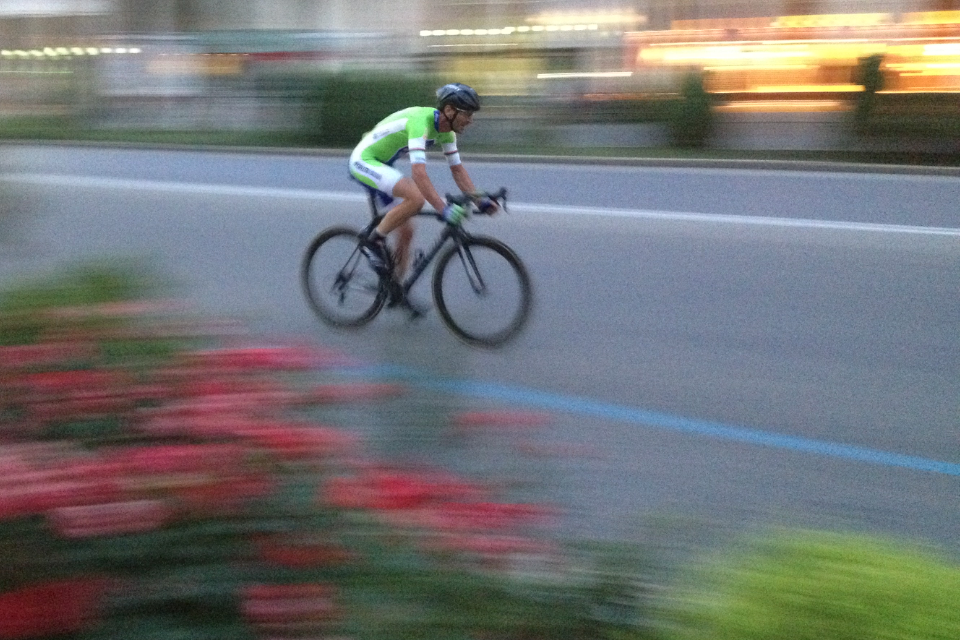
It turned out that it was a cycling time trial event, open to all. It was a 2km event – down a starting ramp at the edge of the town square, up the main drag for 1km, around a turn-around marking, and back down to the square. They had closed the roads. It looked amazing. A big wide, empty, closed road, the whole town out watching, and people of all ages taking part. Even little kids. Bikes and good vibes everywhere. A nice warm evening. I watched it for hours, and got chatting to a few people. It was great. I wished I’d had a bike. I walked the full length of the course, and took some photos. Below are the best of what I took, but I was pretty restricted by the crappy camera on my old iPhone4. Saying that, I tried to be a bit creative and some of the photos aren’t bad:


I’ve been doing a lot of strength work in the pool recently, using my hand paddles and doing single-arm drills to try to build strength in my arms and upper body. In Devon, I went to the pool after work one day, and it was almost empty. I decided to do a 4km “time trial”. Time trials are usually flat-out efforts, but I did this time trial at what I thought was Ironman intensity, so a bit less than flat out. It’s the first time in 3 or 4 weeks that I’ve done a “normal” continuous swim without the hand paddles. It felt great, I was just cruising up and down the pool, in a great rhythm, in the zone, feeling great and feeling strong. I did the 4000m in 65 minutes, which means I’d have done a non-wetsuit Ironman-distance 3800m pool swim with no tumble turning in 62 minutes. For me, that’s not bad. But as pleased as I was, I was all the more frustrated at knowing that my knee is still not allowing me to run. For what I’m trying to do and for what I’m training for, having good swim and bike fitness is pointless without the ability to run well.


Devon hotel, middle of nowhere, silence, nice

Another thing that happened recently was that I got the angriest I’ve ever been on a turbo trainer. I was doing a 4-hour session. Mind-numbing. I was watching stuff on the laptop, but not really engaged with it, because everything was just mind-numbing. My feet got really sore because it seems that either my bike shoes have shrunk, or my feet have got bigger, or a mixture of both. My legs hurt, my arse hurt, and my arms hurt because I had forced myself to maintain the aero position for hours on end. It was warm and I was getting dehydrated, so my head hurt. I tasted of salt, I was caked in salt from my sweat, and I was questioning what the point of it was when I don’t even know if I’ll be competing, and realistically it looks less and less likely that I will be able to.

The session I did was what I call an “increasing block” session. I did 15-minute blocks, starting at moderate intensity, and ramping up every 15 minutes. Then after an hour, I took the intensity down, but not down as low as it had been at the start of the previous block. So by the time you start your 4th hour, you’re riding at an intensity that’s as tough as the toughest intensity from the first hour. The first couple of hours are OK, by the end of the third hour things are getting bad, and then the entire fourth hour is just a nightmare of pain that gets worse and worse, because like some sort of masochist you keep ratcheting it up every 15 minutes. I was effing and blinding and huffing and puffing and grinding and gritting and grunting and gutting it out, and wanted so much to quit in the fourth hour. I was asking myself what was the point of all this pain. Literally everything hurt. I need bigger bike shoes. But I didn’t quit. I got through it. The angriest turbo session ever.

And then a week later, I did a similar session, knowing full well what I was in for. For the past however many years, I’ve been doing similar sessions. I don’t know how I make myself do it, but there’s no choice to be made, I’m training as if I’ll be competing at Weymouth, and so I have to do the work. I planned an hour at Ironman race intensity, then an hour at slightly higher intensity, then an hour at slightly higher intensity again, then a final hour at slightly higher intensity again. The aim is to get used to maintaining the high intensity when you are tired.

When I was on the turbo trainer on this occasion, my tyre completely shredded itself. I noticed that my pedalling suddenly felt different after about 2 hours, and it felt like the back wheel was slipping slightly. I looked back, and visually, things looked fine. I hate getting off the turbo in the middle of a session, but I sort of needed to pee anyway, so I got off. The tyre was flat. I needed to take off the back wheel, take off the tyre, and put a new tube in. But I was mid-session and didn’t want to spend 5 or 10 minutes doing this. So I pumped up the tyre, and because I expected it to go flat again, I cranked up the resistance on the turbo trainer to compensate.

The tyre was fine for about 5-10 minutes, then went flat again, but my pedalling wasn’t affected too much as I had increased the turbo’s resistance. So I just got on with it. 2 hours to go. Things went OK until I started the fourth hour. By then I was working hard and didn’t want to take time out to fix the tyre properly. I was doing all I could just to keep pedalling, and I’d have been too uncoordinated by now to change the tube properly anyway. So I tried to ignore the smell of burning rubber…

Only an hour to go... 50 minutes… 40 minutes… the smell was getting worse. The tyre was shredding itself against the turbo flywheel. I had to put the bike in top gear to maintain the resistance level. I looked back. Flecks of black rubber were all over the carpet and wall in my room. Not good. 30 minutes to go. I was having to pedal fast at 100rpm to maintain the wattage that I wanted, and this was making my heart rate skyrocket. 20 minutes to go. Now I was having to go at 110rpm. I couldn’t pedal any faster. I wanted to finish the session, as much as I was hating it. I hoped I’d finish before I started a fire…

By the time it was over, I was wrecked. My light-coloured carpet had turned black with shreds of rubber. My light-coloured wallpaper had turned black immediately behind the turbo trainer where flecks of warm rubber had been shredding off the tyre and firing at the wall. There was even rubber on the ceiling. My room stank of burnt rubber. The tyre itself was ruined, and warm and sticky to touch. It was a new tyre too, installed only a couple of weeks ago as I had finally managed to destroy a Gatorskin tyre over the last couple of years on the turbo. Gatorskins are almost literally bulletproof tyres. My Gatorskin on the turbo had finally given up on me after countless thousands of miles over the years, the sidewalls torn, the rubber worn away, and it making a horrible screeching noise on the turbo by the end of its life.

So I had to deep-clean and deep-ventilate my room, i.e. I got the hoover out and opened the all the windows in the house. My relationship with my turbo trainer has deteriorated quite a lot in the last few weeks and months. The last two long turbo sessions I’ve done have not been good – they’ve left me swearing in awful pain, they’ve left my room stinking and black, and they’ve almost burned the house down (exaggerating only slightly…) If and when I leave London, hopefully I can actually go outside and actually properly cycle out of doors.

What else can I write about? Ermmm… probably not a lot, I’m just hoping for a miracle now with my knee, and that it’ll allow me to run 26.2 miles after having swam 3.8km and cycled 112 miles… I will give it every chance and continue to train and continue to hope, and if there’s any way at all I feel that I can compete at Ironman Weymouth, on 11th September, I’ll be there…

Friday, August 5, 2016

Post 137 - Another aftermath

In the aftermath of another Ironman disaster, I have no idea what to do now. Any decision I might make about trying again soon in another Ironman is going to be at the mercy of how quickly my right knee gets better - that’s the worst injury I took. It is really sore. I can’t run at all. I can cycle, but it’s painful and then it stiffens up after I cycle. I can swim as long as I push off the wall predominantly with my left leg, and as long as I don't kick much, My knee is generally always stiff and sore. I tried a run last week and it was excruciating. I’ve got a pretty high pain tolerance, but it was so sore that it drew tears and a dark, dark mood.

I don’t think I want to end my Ironman career like this, so the only realistic options I have for using this year’s fitness are two UK-based races in September. Going overseas to a warmer race towards the end of the year is too expensive. Ironman Wales is on 18th September – I’ve been there, done that, and know the “horrors” of that race – a choppy sea swim, jellyfish, a hilly, hilly, hilly bike, with lots of steep hills, and a hilly, hilly, hilly run. And great support. But a tough, tough, tough day out. My friend Matt is doing Ironman Wales and I’ve always said I’d go there to support him. So that pretty much rules out Wales.

Over the past few years, there has been a non-Ironman long-course triathlon in Weymouth, Dorset, on the south coast of England. The Ironman behemoth has taken over this race, and on 11th September (little over 5 weeks away) there will be a half-Ironman and full Ironman running concurrently. These are non-professional races and there will only be 30 Kona qualifying slots available at Ironman Weymouth.

My opinion is that Ironman, in the last year or two, are saturating the market with races, which means each race now has fewer Kona slots available. It’s generally the bigger age-groups that lose slots, so the male age groups from 30-34, 35-39 and 40-44, and probably even 45-49 may have had 6 or 7 or 8 slots per age group in the past, and now they’ll be lucky to have 3 slots. Ironman were recently bought by a Chinese conglomerate, and they are introducing a lot of new Ironman and half-Ironman races in China – there’s a couple of new half-Ironman races in China which will have 50 qualifying slots for the full Ironman world championships, at the expense of slots at full Ironman races elsewhere in the world. I completely disagree with this. Anyway, that’s an argument for another day.

There’s not much accommodation left around Weymouth for race weekend, and because it’s a non-professional race, with only 30 Kona slots, I’d need to finish top two, maybe top three, in my age group, which would mean probably top 5 overall. Tall order? In 5 weeks from now? With a ruined knee? And even then, if I went to Weymouth, and somehow qualified, I wouldn’t be going to Hawaii until October 2017, which would mean another build-up next year. I’ve said I’m not keen on another build-up next year. I guess I’d have to make an exception to go through it all over again if I was going to the world championships.

But anyway, all these thoughts aren’t worth anything until I know that my knee can cope with a full Ironman distance, and at the minute I can’t even run for 5 minutes. I don’t think I want to come down off this fitness peak and go through another months-long build-up, as I’d have to do next year. So I’d really like to be able to compete at Weymouth, but I’m not going to fork out a fortune for entry fees, accommodation, car hire etc, and drive myself mad trying to train when I’m physically not able, and if I don’t have confidence that my knee will be OK. So it’s a waiting game, and I’m in limbo.

I am worried that I’ve done some serious damage to my knee, so I had an MRI scan a few days ago. I’m currently waiting on the results. The worst-case will be that I’ve damaged ligaments, cartilage, tendons or bone, and this may need surgery to repair, and/or extensive rehabilitation and no impact exercise. In that case, I won’t be able to compete again this year, nor will I be able to do much else. 

The best case will show no damage, but the pain of it means it’ll still take a while to recover and get better. And “get better” is not really good enough, I need my knee to be strong enough to do a fast Ironman. I’m not just going out to run a few miles, I’m trying to qualify for the Ironman world championships. I need every part of my body to be in excellent working order. I’m currently waiting on the results of this MRI scan, and until I have those results, and have a discussion with a specialist, I’m just waiting in frustration and losing fitness.

I have tried to do a few half-hearted turbo sessions, and I’ve been in the pool a couple of times. I can get away with swimming as long as I minimise kicking and push off mainly with my left leg. The cycling does cause pain, but the pain doesn’t seem to restrict my cycling. Although I don’t know if the pain is causing more damage when I cycle, or if I shouldn't be cycling at all. I don’t have the confidence in my knee to go out and cycle for hours on end - the longest I’ve been on the bike has been just over an hour since I got injured.

Everything was 100% geared and focused for Ironman UK, and now that it’s over, it’s difficult to motivate myself, and it’s even more difficult when I don’t have a definite target and when my knee is so sore. It’s so frustrating. I know that there were some bad injuries sustained on the rocks at Ironman UK, including broken bones and deep cuts requiring stitches. It was pretty bad.

There are videos online of the 2015 and 2016 Ironman UK swim starts. Watching the video for last year, you can see people jumping off the front right of the pontoon with no problem, and you can see that the water must be well over 2m deep, given how everyone jumps in. It’s tough to watch the 2016 video - people jump in off the same front right spot on the pontoon, as would reasonably be expected, and they just trash themselves on big, sharp rocks in murky water that was 1 foot deep. No warning, no marshals, nothing.

I’ve allowed myself a bit of a release since Ironman UK – I think I’d have gone mad if I didn’t, particularly with the injury. I’ve been socialising, eating burgers and pizza, drinking, playing table tennis, messing about, doing fun, normal stuff. I could get used to it. I guess when I’m training and when I’m focused, I’m a long way removed from normality. It will be great, at some point soon, to draw a line under all of this Ironman business and move on. I just don’t want to draw the line without having achieved something to show for everything that I’ve put into Ironman. I’ve been at it since 2010. In that time, I could have done and achieved a lot of other stuff – I could have become a very good runner, I could have become a very good tennis player (or any other sport), I could have become a very good guitar player, I could have bought a car, I could have had nice holidays, etc etc.

I wonder how it’s going to pan out, I wonder will I be able go to Weymouth and do a race that will allow me to draw a line, I wonder if I won’t be able for Weymouth and if I’ll then want to try again next year when the injury gets better, I wonder, I wonder, but for now it’s just waiting and hoping…

Grimpeur-mouton et jaune-mouton

The fastest way to go downhill

Every bit as awful as it looks...!

Saturday, July 23, 2016

Post 136 - Ripped to shreds

Well, another disaster. Another DNF. It’s becoming the norm to be honest. In the build-up to race day, I was almost waiting and expecting something to go wrong. I could hardly believe that I made it to the start line in great shape and in a great frame of mind. I really thought it was going to be my day. Even the weather was good. And then it went wrong…

The final taper week was good, I did what I had to do and felt good. My knee cleared up. I had to change my chain in the final week, but this was OK. The old one had stretched a bit, so I got a new one put on. No problem.

I knew I was in good shape. Based on previous Ironmans, and based on comparing my training to previous years, I thought as best and worst cases that I’d swim 55-65 minutes, ride 5:20-5:30, and run 3:20-3:35. Adding 10 minutes for transitions, this would give me a finishing time of somewhere between 9:45 and 10:20. I really expected to go under 10 hours. I was fairly certain that 9:45 would qualify. I thought it was reasonably likely that anything under 10 hours would have a good chance of qualifying, and anything between 10:00 and 10:30 would still have a chance, but not as good a chance.

The drive up on Friday with my brother was a nightmare. What should have taken less than 5 hours took 8 hours. Too much traffic and not enough road space. We drove up in convoy with Chris and Kim – Chris was also racing, in his first Ironman. I made registration with 5 minutes to spare. I went for a short bike ride when we got to our hotel, and then had dinner and went to bed. The hotel staff were great about microwaving my dinner and porridge. One less thing to worry about.

On Saturday I got everything ready, my mum and dad arrived from Northern Ireland, and we all went and racked our bikes and bike bags at T1, and our run bags at T2. The transition by the lake was an absolute muck bath, ankle deep in mud. I’ve never seen it as bad. With everything set up, we went back to the hotel, I went for a short run, Matt arrived, and we went to sleep early.


Optimism the day before

Sunday morning was no problem. I didn’t sleep too badly, I had my breakfast and we drove to the start. I loaded my drinks and Garmin onto the bike, and made a mental note to carry my bike out of transition. I didn’t want to get it covered in mud, and I didn’t want any mud to get onto the braking surfaces.

I put on my wetsuit, went for a short jog, did some arm windmilling and stretching, wished Chris a good race, wished everyone else a good day, and went to join the long queue of Ironman athletes snaking back from the swim start. Ironman UK used to be an in-water start. An in-water start at Ironman UK is no problem – it’s fresh water, not particularly cold, there’s no swell and no waves, there’s a lot of space and no mad dash to a close first turn buoy – it’s a long 800m to the first turn.

But for whatever reason, they’ve changed it to a land-based start. It’s a 2-lap swim and by the time they get over 2000 people in the water, the faster people are coming through to lap them. This isn’t particularly safe because slow swimmers often do breaststroke, which means the faster swimmers can get “mule kicks” to the face, and it can’t be very safe or enjoyable for the slower swimmers to have the faster people swimming over the top of them.


Anyway, it is what it is. I lined up very close to the front, hoping for a sub-60 minute swim. The pros started in the water at 5:55am. We were away at 6am. I was really calm in those 5 minutes. Here I was, unbelievably, against the odds, in great shape, with a great day and good weather ahead. Let’s do this.

The starting hooter went and we went down to the pontoon and jumped in. I noted the “no diving” signs. I was on the right hand side and jumped off the front right of the pontoon. It wasn’t even a “jump”, just a step down from the pontoon into the water. Nothing more or less than would have reasonably been expected. And with that, my day was ripped to shreds. The water couldn’t have been more than a foot deep and there were massive sharp rocks. About 15 or 20 people all piled in on top of each other before anyone realised what was going on. There was no warning, no pontoon marshals, no water marshals, no canoe marshals, nothing. Pretty bad organisation.

There was a lot of swearing and yells of pain. Everyone starting at the front would have been racing for a world championship qualification slot, and would have put a hell of a lot of time, effort, money and sacrifice into their preparation for this day. I know what I’ve been through to get to the start line. It was just unbelievable.

The shock and pain of it, and having people behind stumbling and suffering the same fate, meant we all just fell over, onto more rocks. I hurt/cut/injured the soles of my feet, my left shin, both knees, and both hands. I literally could not believe what had just happened.

I staggered my way out to deeper water and I swam on, but deep down I knew my day was ruined. My initial thoughts were that the sole of my left foot was cut, which would mean I’d struggle to cycle and run. As I continued to swim, I realised that when I kicked, my knees were sore and my shin was sore. I couldn’t kick properly. The palms of both hands were sore. But I couldn’t really look at the damage when I was swimming, I just battered on.

The first lap of the swim passed for me in around 29 minutes. If I hadn’t been injured, maybe it would have been a minute to two quicker. This would have been a great first lap. As I exited the water and ran over the timing mats, the sole of my left foot was really sore. I didn’t fancy a full marathon…

I got back into the water, and almost immediately started to lap the slower swimmers. Many were doing breaststroke, and I got two mule-kicks to the face. I can’t understand why Ironman UK doesn’t do an in-water start. You could be injured really badly by a breaststroke mule kick. The second lap was no fun, and I exited the water in 61 minutes. This wasn’t a bad swim to be honest, but my mind was full of dark, dark thoughts. I was raging. Race ruined. It should not have happened. Would I be able to cycle? Would I be able to run? I was also pretty sure that my wetsuit (worth £500, yes crazy money, I know) would also be ripped and ruined.


I made up my mind to get on the bike and try. In transition, I realised I had badly cut my left hand and it was bleeding a lot. I did what I had to do in transition and got away on the bike. To cut a long story short, the bike was 6 hours of misery. Because of where my hand was cut, there was pressure on the cut every time I got up off the aero bars (which was often, given the hilly and twisty nature of the course), so it never got a chance to congeal and stop bleeding. I had a cut on my right knee too. I literally bled for the whole 6 hours. To try to stop the bleeding and wipe away the blood, I had to wipe my hand every few minutes on my brand-new white aero triathlon top (worth over £100, yes, crazy money, I know).

Matt was watching from the first climb on Sheephouse Lane, having cycled out after the swim. He was cheering really enthusiastically, and I showed him my hand as I passed. He realised that things were not going good, and his reaction was like a balloon being deflated. He just went “Ahhhhhhhhh.”
I realised that the worst injury was to my right knee. It had a small cut, but I was more worried about what the impact on the rocks had done to it. It hurt every time I made a pedal stroke. It didn’t hurt to the point where I had to stop, but it didn’t help matters. I biked just under 6 hours, which was 30 minutes slower than I wanted. I got to the second transition area, got off the bike, and pretty quickly realised I wouldn’t be able to run.

Well-supported, in parts

I spent ages in transition and the medics insisted on cleaning out my cuts. Talk about pain… I took stock of the damage. The soles of my feet, although sore, weren’t cut. My calf compression tube was ripped, and I had a big cut on my left shin. My left hand was a mess. My right hand was sore. Both knees were sore. I tried to run out of transition and quickly realised that I would have to abandon. I wasn’t surprised.

I used a marshal’s phone to call Matt (a good lesson here is to always write the names and phone numbers of your spectators and emergency contacts on the back of your number). He had cycled into the centre of Bolton to the run course. He cycled out to meet me and we went to the finish area together, where I picked up my bags, got changed and ate junk food. Then we went to meet up with everyone else on the run course and cheer Chris on.

By now it was hot (this would have suited me), but Chris was going well, and he finished in just over 13 hours. A great effort. I was pleased for him, he had put a lot of effort in. I went through the motions for the rest of the day, getting back to the hotel, eating dinner (I couldn’t even be bothered with a pint) and then trekking back to the transition area to pick up our bikes, getting showered and cleaned up, going to bed, and driving back to London. I just was completely fed up. My injuries were sore.

Ironman Chris at the finish

I’ll probably write a letter to Ironman about what happened, but I doubt they’ll do anything. The clock can’t be wound back. There’s no compensation for all the time and effort and money and sacrifice that’s gone in. I don’t know what I will do now, but I really, really want to get out of London, and a big, big part of me wants to never do another Ironman race and build-up again because a big, big part of me is sick to death of it at this stage. So much effort and time and sacrifice and money, for what...?

It was even more galling to find out that the final Kona qualifier in my age group did 10:39. If you'd told me before the race that 10:39 would qualify, I would have smiled a giant smile.

Here’s the full misery story, with a new chapter to be added, entitled "Ironman UK 2016..."

Ironman UK 2011 (pre-London) – done on entry-level cheap bike, didn’t have a clue, 11th in age group, good enough to plant the seed but ran out of money and couldn’t afford to try again.

Ironman UK 2013 – now working in London, got a new expensive bike (3 years to pay it off), was winning my age group with 10 miles left to run, started explosive vomiting and diarrhoea with no warning. Likely food poisoning from the hotel. Collapsed, game over, ambulance etc.

Ironman Wales 2013 – a few weeks later, not fully recovered, finished 5th in age group. 5th had been good enough at Ironman UK a few weeks previously. But slots only went to 4th in Wales. Some slots “roll down”, because some people decline their slots for whatever reason – already qualified, for example. Usually a handful of slots roll down. Went to the awards ceremony. No slots rolled down. Gutted.

Ironman UK 2014 – I moved up to a tougher age group. I trained hard and was very fit, far better than in 2013, was looking to mix it with the pros. 2 weeks before the race, had a sports massage. Ended up in hospital for 3 days with horrendous leg infections. Went to the race anyway. Had nothing. DNF (Did Not Finish).

Ironman Wales 2014 – not fully recovered, went in desperation more than anything, I faded halfway through the marathon when I was in 6th. 6th would have done it. I couldn’t hang on. I don’t know where I finished.

Ironman UK 2015 – went through the 7-month build-up again, was optimistic going into the race. Monsoon conditions, freezing cold, windy. I was frozen, and my power output was terrible. Could not get going. Bad circulation in my frozen hands meant I couldn’t feed myself nor drink (both essential…) This sounds like excuses, I’m not making excuses, it wasn’t my day, but I’m skinny and don’t go well in the cold (6 feet 1 and only 66kg, I was "too skinny" for the conditions). I usually train indoors in 25-30 degree heat, I go well in warm conditions, not in cold.

Ironman Wales 2015 – trying to salvage my season, didn’t feel well the week before the race, ending up vomiting in the swim hanging off a lifeguard canoe, got frozen, got brought ashore, game over.

Training done in the final week before the race was as follows:

Mon 11 July: Rest
Tue 12 July: 1 hour turbo, 15 minute run
Wed 13 July: 30 minute bike, 15 minute run
Thu 14 July: Swim 1.5km
Fri 15 July: 15 minute bike
Sat 16 July: 10 minute run
Sun 17 July: Ironman UK

Tuesday, July 12, 2016

Post 135 - First week of tapering

This was the first of two taper weeks before the Ironman. All the hard training is done. All the work is done. There’s nothing more to gain. I just have to keep ticking over and maintaining, and get through two more weeks. Arguably these last two taper weeks are the toughest two weeks because although I don’t train hard when tapering, if anything goes wrong then there’s very limited time to put it right.

Anyway, being offered the opportunity to work from home for the final two weeks before race day removed a huge amount of stress – no commuting, no germ-infested trains, no germ-infested air-conditioned offices, more time, more sleep, things would be better all round. Every little helps, every marginal gain helps, and working from home is a big help. It's not something I would have been especially comfortable asking for (maybe I'd have asked for unpaid leave for a week or two) but it was offered and I was happy to accept - I think my local management team are sympathetic after some of the unwarranted stuff I've had to deal with this year. 

Fairly (very) true

It’s strange that after having been so focused, relentless and disciplined in training, for months and months on end, that tapering feels so lethargic and sluggish. It’s a big mental and physical relief to do the last tough training session and then to know that’s it, no more tough training, just a two-week taper and then a race. You expect to feel great in the taper, full of beans, full of energy, like an aircraft sitting on the end of a short runway with the engines on full blast but being held by the brakes. And with working from home, and the extra time I have due to not having to commute, I’m getting 10 hours in bed every night too, so I should be well-rested.

However in reality, I’ve found when tapering, you feel tired, you feel sluggish, it’s difficult to find motivation to do those remaining easy training sessions, and your body seems to not be your own – you feel niggles appear that you’ve never felt before, you feel washed-out, you almost feel like you are coming down with an illness or a bug.

But I suppose all this is a natural reaction to removing all the physical and mental stresses of training (and in my case, removing the commuting and working in an office too), the body just goes a little bit haywire and doesn’t really know what has hit it, and probably a lot of energy is diverted into repair and recovery from all the training done. And I said in previous posts, before I even started my taper, I had felt a bit sniffly and I had a bit of a niggly knee.

I read triathlon internet forums from time to time. I read with interest some of the comments on tapering :

Several times now, once I have physically & mentally taken a big sigh of relief as the long training ends, I get cold-like symptoms as the body starts trying to repair itself. The first time I was worried, but then it happen the next time too, and I was familiar with the way my body worked. Knowing your own body is very useful, something that comes with years of experience.

I remain bitter about how bad taper feels.

Going through my first proper training programme 5 years (?) ago I imagined how great taper would be, thinking I'd have a satisfied smile on my face with all the hard yakka banked, that I'd feel sleek, fit and confident and would be fizzing with energy and vitality - in the peak of health and barely able to hold myself back until the start. I couldn't wait for taper to start, especially during the last heavy block.

When I got there I spent the whole time feeling #@?#, full of doubt/worries, cold like symptoms and entered some sort of lazy mode where I'd not want to do even gentle sessions - and even when done they'd seem hard, clunky and make me feel even worse...

Learning to expect this, and see through it sufficiently to trust the training and know that this is part of the process took a while (and a few cock ups). I remain annoyed that it just feels so unpleasant though....

Anecdotally, I've heard a lot of this. We both get it, and I've heard of others guys talking of 'taper fatigue'. It's basically the body sorting itself out, and using a lot of 'energy' doing it. I can almost imagine all the little 'doozers' (remember fraggle rock?!) in my body focussing on repairs & stockpiling energy, at the expense of being able to 'operate normally'.

I've also had twinges all over my legs the days before an Ironman, then done a PB! I think some of it is psychosomatic.

I too am going through the taper madness currently. I feel like I have been 12 rounds with Mike Tyson! I am knackered, everything aches, I feel heavy legged, out of breath going upstairs etc.
I cannot be bothered. I think with taper you switch off and you start to think well it doesn't really matter. It is really hard to drag yourself out I find.

I’m glad it’s not just me who feels like this…

And then, when you finally get through the taper and get to the race, and you get through the swim and the adrenaline is pumping and you’re on the bike and really getting into the race, finally your legs will feel good, and the output will feel easier because you have tapered and are well-rested. This is a dangerous time. It’s all too easy to push a bit harder, even just a little bit harder than you should, and ruin your race. Any degree of overcooking on the bike will come back and bite hard in the second half of the marathon.

I plan to ride at around 220 watts for the Ironman bike. When I finally get onto the bike on race day, I expect 220 watts to feel easy, certainly for the first couple of hours. I’ll have to force myself to hold back, and not creep up to 230 or 240 watts. This would ruin my overall finish time. Indeed, for the first half-hour, I’ll try not to go much over 200 watts.

For context, for my 100-mile time trial last month, I averaged 263 watts, but for the first couple of hours, 270-280 watts felt absolutely fine. It wasn’t fine though, as my fade in the final 20 miles proved, when I was struggling to produce 240 watts. And it’s the same idea in the Ironman swim and the run. “Pace it, don’t race it.” And, paradoxically, “The slower you go, the faster you’ll go…”

Having finished off my tough training last weekend with a bit of a sore right knee, I decided that Monday and Tuesday this week would be complete rest days, to give the knee a chance to recover. And also to give the body in general a chance to rest and recover after all the training done. I did some foam rolling, took a couple of anti-inflammatories, and went to the osteopath as usual.

I mentioned to the osteopath that I had a bit of a sore right knee, and he had a look at it. I wish he’d told me what he was about to do because I’d have told him no way, but he got into the back of my knee and I almost jumped off the table in pain – the back of the knee is a delicate place and I didn’t want anyone touching it. I only had a minor niggle in the front of my knee that would probably (hopefully) clear in a few days by itself, but after this osteopath visit I now had a sore back of the knee too…

Thankfully, about 4-5 days later, both the front of the knee and the back of the knee seemed to have cleared up somewhat, so hopefully they will be OK for the race. They haven’t restricted me in terms of the training I’ve done this week, but I’ve been aware that they don’t feel 100%. Hopefully the final easy week before the race will see them back to normal. Fingers crossed.

I got on the turbo on Wednesday and did an easy hour, but with 5 sets of 2 minutes going a bit harder. I need to make sure I incorporate a little higher-intensity work into what I do while tapering. I went out for an easy run on Thursday, on grass around the park to reduce the impact on the body. I had an easy swim on Friday. I didn’t do much on Saturday – a few weights, some core work, foam rolling, and a lot of watching of the Tour de France on TV. With some cake… and some Guinness… tapering is about relaxing, right? It's about carbo-loading?


Nice-looking cake, but "sneaky bites"?! 
The whole thing was gone in about 2 seconds,
I literally can't stop eating...

Saturday’s Tour de France stage was in the Pyrenees, around where I worked in the summer of 2006. That’s ten years ago. Crazy. I worked in Saint-Lary-Soulan, between the Col d’Aspin and the Col d’Azet in the Aure valley. A magnificent part of the world. On my days off I was able to rent a bike and do some cycling – some of the mountains I rode up included the Col du Tourmalet, the Col d’Aspin (where I had my bad crash), the Col d’Azet, then Col de Peyresourde, Piau-Engaly and the Pla d’Adet.

I watched the 2006 Tour de France from the Col de Peyresourde and took a young, keen French kid (when I say kid, I mean kid – I was 21 and he couldn’t have bene more than 13) named Guilhem with me, who was staying at the holiday village where I worked. We cycled over the Col d’Azet and up to the top of the Peyresourde. He did really well, at such a young age, to get up those hautes montagnes en vĂ©lo. As we went up the Col de Peyresourde, a French TV crew drove alongside us and asked a few questions, then they stopped us and interviewed Guilhem. He was on the TV later that night. Pretty cool.

So I watched Saturday’s stage of the Tour with interest as it wound its way along the roads and over the mountains that I got to know pretty well back in 2006. Below is an antique photo from the top of the Col du Tourmalet – I had no cycling shoes, no cycling jersey, no mobile phone, no digital camera, and no clue or idea what I was doing. 10 years later, I might have all the gear now (bike shoes, bike jerseys, gadgets), but I still have no clue what I am doing…


I had planned to do a 2-hour turbo session followed by a short run on Saturday but I decided to have a rest day on Saturday to give my knee a bit more time to get better. It seemed to be on the mend, and an extra day would do it no harm. So on Sunday I got through 2-hours on the turbo, with a few short higher-intensity bursts thrown in. I followed this with a 25-minute run on grass. And that was week one of the taper.

I’ve been thinking about how much to carry on the bike in the Ironman. The lighter the weight, the faster I will go – the course is hilly and twisty. I’ve always carried two spare tubes, two inflation cartridges, one small hand pump, 2 x 1-litre bottles and 1 x 900ml front aero bottle. If I get a flat tyre, I’ll lose 5-10 minutes. If I get two flat tyres, I’ll lose so much time that qualifying will be off the cards. So I think I’ll only carry one spare tube and one inflation cartridge. Leaving out a cartridge, a tube and the pump will save me 250 grams (yes I checked). Also, instead of carrying 2 x 1 litre bottles, I’ll carry 2 x 750ml bottles, which will save 500 grams. And instead of a 900ml aero front bottle, I’ve got a new 750ml aero front bottle. So that saves 150 grams. This means I will have to do one extra water bottle pick-up at an aid station, but the total weight saving of almost 1kg will hopefully save me a couple of minutes.

I’ve also been doing my sums. Realistically, I think I will do the swim and first transition in 65 minutes. I hope to average between 20.5 and 21mph, which will be between 5:20 and 5:27 on the bike, so I hope to be starting the marathon after 6:25 or 6:30 or so. If I average 8 minutes per mile, I’ll finish in just under 10 hours, and if I can hold 7:40/mile then it’ll be around 9:45. I think 9:45 will have a chance of qualifying. 9:55 will have a lot less of a chance.


I’ve been on the juice this week, and will be on it next week too… the beetroot juice that is. Studies have shown that it can enhance athletic endurance, it’s good for the blood, is full of nitrates, and it is becoming popular. Every little edge helps… I’m still playing around with gear and kit, but fortunately the long-range weather forecast for Bolton looks good at this stage, so hopefully I won’t have to contend with rain. That’s a big plus for me. I don’t go well in wet and cold conditions. Hopefully race day will be a good day all round.

I ordered a few stickers from the internet.
I'll stick a few of these on the bike, 
they will obviously benefit my speed and fortune...

One week left… Come on body, give me one more week. Give me one good race…

Training done this week was as follows:

Mon 4 July: Rest
Tue 5 July: Rest
Wed 6 July: 1 hour turbo (5 x 2mins harder)
Thu 7 July: 25 min run
Fri 8 July: Swim 2.1km
Sat 9 July: Rest
Sun 10 July: 2 hour turbo (10 x 1min harder), 25 min run

Totals: Swim 2.1km, Bike 65 miles, Run 8 miles.