Sunday, May 10, 2015

Post 78 - Maths and formulae

This week I had to go to Italy with work. Next week I also have to go to Italy with work. Not ideal, with the North Norfolk 100 mile time trial following immediately afterwards… lots of stale aeroplane air, carrying heavy luggage, hot meeting rooms, squeezed taxis, standing around, eating strange hotel food, sleeping badly in stuffy hotel rooms, unable to train as I want… none of which is great, all of which causes stress. Buuuuuut what can I do other than drink lots of water and cross my fingers?

Italy was hot and sunny. I managed a short and easy 30 minutes on the exercise bike in the hotel gym on Tuesday evening. I didn’t want to push hard because it’s impossible to set an exercise bike up properly and to get a good fit. I don’t want to push hard on an ill-fitting bike and end up wrecking my knees or back. Plus, pushing hard in a hot and airless hotel gym is pretty much asking to get sick. After the 30 minutes, I jumped in a hot bath, right up to my neck, to try to heat all my muscles and allow them to de-tension a bit. On Wednesday evening I went out for a short and easy 20-minute jog, and jumped into another hot bath. It was scorching (on the run and in the bath) and I was sweating so much that I poured an entire litre of cold water over my head (in the bath). As well as treating myself to a scorching hot bath, I also treated myself to some steak...


Who photographs their food anyway?!


It was uncomfortably hot at night, but I didn’t want to put the air conditioning on. It’s an old hotel, with an ancient ventilation system. Turning it on would have been asking to get sick. So instead I slept with no covers and tried to make the best of it, but I didn’t sleep great. It’s not that long since I was in Italy and it was freezing, icy and snowy, when I filled the bin in the hotel room with hot steaming water, and I put it beside my bed to try to humidify the room at night. The things I do. Crazy.

I had brought with me three big tupperware boxes full of oranges, bananas, apples, flapjacks and vitamin tablets. Fruit is delicate as I discovered to my detriment on a previous trip, when I opened my bag to discover squashed banana mulch all over my stuff. Put the fruit in a tupperware box and at least it is protected.

My Garmin bike computer was also protected by one of these boxes, and I spent some time this week fiddling about with it in Italy. Having invested in a power meter this season (I say invested rather than bought, it makes me feel better…), I now need to work out what data I want to have displayed when I am on the road. I still haven’t worked this out. A single screen can have 8 data fields displayed, and ideally I don’t want to have to programme the Garmin to scroll through different screens, I want it all on one screen. But there is too much data for a single screen – I want to be able to see current speed, average speed, distance, time, cadence, heart rate, average heart rate, 3-second power, average power, intensity factor/%FTP, and normalised power. So I’ll have to get my thinking cap on and sort my power meter data fields. I've also been buying a few bits and pieces because I'll have to get my bike serviced before the time trial next week.


Possibly the best tyres you can buy:
Continental GP 4000 S II with black chili compound.
At £60, they better be good and not puncture...!


Bike servicing orders...
To this was added "properly lube chain and transmission",
"replace any bearings if necessary", and "check greasing of
all bearings including wheel bearings and regrease if necessary".
Need to have 100% confidence in the bike!


I survived Italy and used the weekend to catch up on sleep. I’ve found it’s much more effective to go to bed at the same time each night, rather than staying up a bit later at the weekend and then sleeping very late. Last season, I used to really binge on sleep at the weekend, and stay in bed until as late as 11am. Now I try to get up between 9 and 10am at the weekend, which keeps my natural body clock slightly more aligned. During my weekend swims this week, I felt that my right shoulder and down through my upper right arm was a bit sore. So much so that on Sunday in the pool, I mostly did kicking drills without much arm action at all. I hope that tapering down for the 100 miler next week and not doing much swimming or weights will allow it to settle. I also noticed that my right calf is a bit sore, and again all I can do is hope that the easy tapering week ahead will allow this to settle down too. Cross my fingers and hope for the best…

My Ironman bike strategy this year will be to “spike” as little as possible. I’ll really try to minimise spikes in heart rate and power output – this will mean taking it a bit easier up the hills, using lower gears, and not accelerating too quickly out of the corners. I’ll keep everything nice and steady and controlled on the bike. This will hopefully set me up for a better marathon. I’d rather lose 5 minutes on the bike and gain 20 minutes on the run.

With the power meter, I can now do a lot of number analysis. I like this, as I enjoy working with numbers, graphs, data and science. With the power meter, I can know the intensity factor (IF) and variability index (VI) of my training (and racing). These are interesting figures, but to understand these, some other values must be discussed. The power meter tells me my instantaneous power (based on a 3-second average). That’s easy to understand. It also tells me my average power – again simple to understand – the numerical average of my power for an entire session, including any times at zero power (for example when freewheeling).

It also tells me the normalised power. This is a bit more difficult to understand. When riding, power output is rarely constant, especially on the road – hills, weather conditions, road surfaces and all sorts of factors combine to make a power output graph look “jumpy”. Normalised power is simply an estimate of the power output that could have been maintained for a ride if the power output had been completely constant. Normalised power will always be higher than average power. Makes sense…?!

Variability Index is another important measure. If a ride is not “consistent” and involves lots of surging, climbing and accelerating, it stands to reason that normalised power described above will be much higher than average power, and the ride will feel tiring. If a rider maintains a consistent power output, then the normalised power and average power will be more similar. VI is a measure of how steady a rider’s power output was. Normalised power divided by average power equals variability index. Let’s say I did a smooth turbo session at an average of 250 watts for 2 hours. Let’s say that my output for this turbo session was fairly consistent, with no surges or high-intensity efforts. My normalised power might therefore be 255 watts. My VI would be 255/250 = 1.02.

Now, let’s say I cycled the Ironman UK bike course – a tough, hilly, twisty 112 miles. Let’s say I averaged 210 watts for 5-and-a-half hours. Let’s say I didn’t hold back, pushed hard up the hills, and accelerated hard out of the corners, and generally rode the course as if I didn’t have to run a marathon afterwards. My normalised power might be 240 watts. My VI would be 240/210 = 1.14. The closer the VI is to 1.0, the smoother the output over the whole ride. VI is very important for Ironman triathlon pacing, and should be less than 1.06.

Next, we have Intensity Factor (IF), which requires knowledge of threshold power. My threshold power is the maximum power output I can sustain for one hour. A one-hour threshold power test is a very tough session, so it can also be calculated by multiplying the 20-minute value by 0.95. A couple of months ago, my 20-minute test value was 324 watts, giving a threshold power of 307 watts (I’d like to think this value has improved since I did the test, and I will re-test myself in the next few weeks).

Anyway, the IF is the ratio of normalised power to threshold power. If I did the Ironman bike and my normalised power was 240 watts, given that my threshold power is 307 watts, then my IF for the Ironman bike would be 240/307 = 0.78. Generally, the intensity factor for “recovery rides” should be less than 0.75. An IF of around 1.0 could be sustained for a 40km time trial (roughly equivalent to a 60-minute threshold power test).

All this data can also be used to work out my Training Stress Score (TSS), which helps to determine how much rest is needed after training and how hard the training was. TSS = IF squared x time in hours x 100. A “very high” TSS would be 450+, requiring several days of recovery. But back to IF…

Generally on tough, twisty, hilly Ironman courses (such as Ironman Wales and Ironman UK), it’s easy to “spike” repeatedly. I know this from experience, as my heart rate got to over 170bpm on quite a few occasions in the bike section of these races. This would have led to a high intensity factor and a high variability index, setting me up for a poor marathon. My standalone run times indicate that my Ironman running should be much better than it is. So, maybe the problem is with the bike, and I need to calm things down, keep the bike nice and smooth, and preserve myself as much as possible. Then I might run a better Ironman marathon.

Tables exist to tell you how hard you should ride the Ironman bike. For me, I’m looking for something around 5:30 for the bike at Ironman UK. In a flat Ironman, I’d be well under 5 hours, but for Ironman UK, I’m looking at 5:20 to 5:30. According to the table below, if I assume that I am a “proven, strong Ironman runner” then I should ride at an intensity factor of somewhere between 0.73 to 0.75 to give me an optimal Ironman bike time which will also allow me to run a good marathon. This optimal Ironman bike time will be slower than if it was a standalone bike time, but Ironman is a sum of three parts… This level of holding back on the bike requires a huge amount of discipline and trust in the numbers.


On Saturday I did 2:20 on the turbo, with 2 hours at around Ironman intensity. I made the second hour a bit tougher than the first. For the first hour my IF was 0.73 (bang on for an Ironman), and for the second hour it was 0.81. The power difference between the first and second hour was 27 watts, and my heart rate only averaged 12bpm more for the second hour. So there’s a fine line between “too hard” and “not hard enough”. I’ll do a few more longer sessions at Ironman IF to learn how it feels and to see how my heart rate responds over a longer time, and to see how running feels afterwards.

A purist might say that all this data detracts from the age-old business of racing without technology, of judging by feel, of going at it without being “guided” by timers, beeps, power meters or heart rate monitors. I did the 2013 Ironman season without a power meter or a heart rate monitor. In 2014 I had a heart rate monitor, and it helped a lot. In 2015, I’ve got the heart rate monitor and a power meter, and they both help a lot. There’s a justifiable argument that says without these tools, you are disadvantaging yourself, and with the data available and the assistance with judging how hard to push, they are definitely useful. Unlike doping, heart rate monitors and power meters are completely legal, and are used by pros and amateurs alike, almost as standard. I’m looking forward to getting all this data on the 100 mile time trial next week.

But equally, you still have to have the fitness, the discipline and the strength. No amount of gadgetry or equipment or anything else can help you in the Ironman “death zone” beyond mile 16 of the marathon… then it comes down to pure guts and determination, when you find out how much you really want it…

Training done this week was as follows:

Mon 4 May: Rest
Tue 5 May: 30 minute ex bike
Wed 6 May: 20 minute run
Thu 7 May: Rest
Fri 8 May: Swim 3k (5 x 400m: 5:55-6:20, 40 second recovery)
Sat 9 May: 2:20 turbo (1 hour at 221W/141bpm/IF 0.73, 1 hour at 248W/153bpm/IF 0.81), 25 min run
Sun 10 May: Swim 3.1k (250s, normal/legs), 30 minute turbo, 30 minute fartlek run

Totals: Swim 6.1km, Bike 66 miles, Run 11 miles.

Monday, May 4, 2015

Post 77 - A back massage and a big weekend

My training over the next few weeks will be a bit disjointed and a bit disrupted by a couple of work trips to Italy. Also, tapering for and recovering from the North Norfolk 100 mile time trial will mean a couple of weeks of taking it easy. So I have to be flexible, to adapt and make the best of circumstances. Normally after two tough weeks I would have a full week of easy training, but with going to Italy next week, I decided to only take half a week easy, and then train hard during the weekend before going to Italy. In Italy I can do some light training, and then the weekend after that I can train hard again, then I’ll likely be out to Italy again where I’ll taper for a week before the 100 mile time trial. This seems like the optimal way to get the training fitted in around Italy, and to get myself to the start line in Norfolk in a fit and fresh state.

So during this week, I had three full days off training. No swimming, cycling, running, stretching, weights or anything. I was tired from the previous two weeks of tough training, and the three days off did me no harm. A mental break as much as a physical break. A trip to Phases Sports Therapy during the week did me no harm either – Des spent some time working on my back to loosen it out. It was good to chew the fat with him and have my back ironed out. After the treatment, I did have a bit more of a spring in my step. Des has been working with a few good athletes over the past year or so, and has seen his treatment sessions deliver big performance improvements. I’m hopeful that if I can have four or five good treatment sessions on my legs, I will see some similar performance gains which will help me on the road to qualifying for the Ironman world championships.

Getting treatment on my legs means that I will finally have to shave them, and that will be a sad day… But, whatever I have to do…

In terms of miles, this weekend was probably the biggest weekend I’ve done in training: 6.4km in the pool, about 120 miles on the bike, and 19 miles of running over three days. Friday’s pool session was tough. I like Friday afternoons in the pool, because the pool is always very quiet, and I can usually get a lane to myself. This week, I was doing 100m repeats, with the swim and the recovery taking 2 minutes. Do the 100m in 1:30, and you get 30 seconds of recovery. I wanted to do at least 20 repeats, and I also wanted to pace them well and not fade in the second half of the session. After a first 100m in 1:26 (too fast as usual – the first 100m feels so, so easy), I settled into 1:29 repeats. And I hoped I could sustain them. I got to 17 or 18 repeats and was starting to blow hard, but the times didn’t drop. In the end, I did 25 sets of 100m, all below 1:30, and I was happy with that. Single-leg bike drills followed, while watching Ironman Kona videos on the laptop for inspiration:


Saturday was to be a long turbo session. I needed to do 4 hours, with a 100 mile time trial coming up in a couple of weeks. So I got ready, and I got on, and I pedalled. I worked through the gears, getting progressively tougher every 15 minutes. At the start of each hour, I throttled back, but the starting resistance for each hour was progressively tougher than the preceding hour’s starting resistance level. Also, during this session I “kicked” every 10 minutes and really lifted my power output for 20-30 seconds. This was to simulate accelerating out of a corner and getting up to speed – Ironman UK will have a lot of braking and accelerating on the bike, and I wanted to practice this. After four hours I was pushing close to 300 watts, and I did 4:20 in total, followed by a short run. Not bad. Plus, I’d got to watch a lot of snooker on the laptop in 4 hours and 20 minutes…

On Sunday I hit the pool again and used my hand paddles, leg float and evil-rubber-band-for-tying-my-legs-together. A good pool session was followed by steeling myself for a long run. Of all the sessions I do, I dislike long runs the most. I find them tough on the body. But I have to do them. I’ve slightly changed my running training strategy this year and have been/will be doing a bit more speedwork and fewer longer runs. Too many long runs can create a bit of staleness and residual fatigue, so I’ve been mixing my running training up. But this means I have to be very careful not to get injured, and to make sure I am properly recovered.

Anyway, it was long run time this week so I stretched and warmed up and headed out. It was a bad day for a long run – quite hot and very humid. It had rained heavily earlier in the day, but a strong sun had come out and was now evaporating all the water off the wet ground. I like to try and do significant chunks of my longer runs off-road – in parks or along trails – so this worsened the humidity. It was like running in a tropical jungle and I was sweating a lot.

The idea behind my long runs isn’t to run them super-hard, risking injury and leaving myself wrecked for days afterwards. The idea is to just get used to running for extended periods of time. Ironman marathon pace will be something like 7:30-7:40 per mile, which for a standalone run is quite slow.

I started off at 7:30 pace, nice and easy, and without even trying, my pace gradually came down until after 14 or 15 miles I was running at under 7 minutes per mile. I got through the run, got back to the house and got a load of fluid down me. Then a protein milkshake, a banana, a flapjack and some porridge. Then I went outside and lay down and elevated my legs, to help to drain out any lactic acid. What you do in the 20-30 minutes after any tough session is crucial, and it will define how well you recover from it.
Feet up, lactic draining...
Nice decoration on the wall... great house 

After I had done the crucial things – eaten, drank, taken on protein, elevated my legs, done a little jog and had a shower, I was happy to sit in front of the TV and eat pasta, vegetables and salmon, while watching the first day of what looks like a classic snooker final. I’m a bit gutted I won’t get to see its second-day conclusion as I’ll be flying to Italy. Also during this week I got a pair of £60 cycling shorts for £37.99. If the pad’s comfort level is on a par with how futuristic it looks, they should be a good pair of shorts…
So next week I’ll be in Italy, I’ll train hard next weekend, then the week after this it looks like I’ll be back to Italy, where I’ll taper down for the North Norfolk 100 mile time trial on Saturday 16th May. Then I’ll take a week or so to properly recover, then it’ll be two more tough weeks, a week to taper for the Bristol triathlon, a week to recover from that, a final 2-week training block and 2 weeks to taper for the Ironman. Sounds straightforward… So near and yet so far. So much done, and so much still to do. I’ll get there. Hopefully… All I know is that I’m doing everything I can to maximise my chances, and I have to trust that’ll be enough…

Training done this week was as follows:

Mon 27 Apr: 14 hill reps: 70, 69, 68, 68, 68, 68, 67, 67, 67, 67, 67, 67, 67, 68
Tue 28 Apr: Rest
Wed 29 Apr: Rest
Thu 30 Apr: Rest
Fri 1 May: Swim 3.1km (25 x 100m off 2mins), 1:05 turbo (single leg drills, 7 x 3mins R, L, B)
Sat 2 May: 4:20 turbo, 25 minute run
Sun 3 May: Swim 3.3km (paddle drills), 110 minute run

Totals: Swim 6.4km, Bike 120 miles, Run 26 miles

Tuesday, April 28, 2015

Post 76 - The London marathon

After last week’s tough training left me unable to complete a longer turbo session last Saturday, I made it my priority this week to be able to do a good 4-hour turbo on Saturday. This would be my key session for the week. I need to do a couple of 4+ hour bikes in the next few weeks before the 100-mile time trial event in Norfolk on 16th May. So everything else this week was ever-so-slightly toned down to try to make sure that I still had decent legs by Saturday.

Tuesday’s turbo was a “hard” hour, but I kept it under control and wasn’t hanging off the bike by the end. On Wednesday I did a shorter fartlek run. In recent weeks I’d been doing 40-50 minutes, but this week I only did 30 minutes. On Thursday I did some high-wattage intervals on the turbo. Although this sounds tough, I was only maxing out for around 20-30 seconds in every 5 minutes. By “maxing-out”, I mean hitting around 500 watts or so – the wattages still had to be sustainable to repeat these intervals for an hour and a half. For each interval of 30 seconds, I used the first 10 seconds to build gradually and work through the gears. The middle 10 seconds were sustaining the high output, and the final 10 seconds were trying to hold it. So although it was tough, it wasn’t leg-shattering. I didn’t follow either my Tuesday or Thursday turbo sessions with runs, again to try to preserve the legs.

On Friday I did my first “critical swim speed” session of the year. These are tough sessions mentally and physically, based on swimming threshold swim speed intervals with minimal recovery time. For me, my critical swim speed is around 1:30 per 100m, so each 200m interval had to be done in 3 minutes, with 20 seconds of recovery between each of the 10 intervals. Last year, my legs used to cramp up when doing these critical swim speed intervals, I think mostly brought on by pushing off from the walls so hard.

Critical swim speed intervals, based on 1:30 per 100m pace for me

Anyway, the idea is that the intervals are done at even pace. I was able to glance at the timer on the wall during each repetition. The first hundred metres of the first repetition was 1:25, and the overall 200m was 2:55. Too fast. The next couple followed a similar pattern, before I settled into a good pace, but by then the damage had been done and the final couple of repeats were horrible, 10 seconds off pace. Must pace better. I keep saying this and keep trying to pace better in the pool, but still keep starting too fast. Next week…

On Friday evening, mindful of wanting fresh legs for a long turbo the next day, I decided not to do my single-leg turbo drills, and I rested instead. On Saturday, I got set up for a big session in the “pain cave”, with lots of liquid, gels and bars at the ready. I fired up the laptop, and mostly watched snooker (some would say that 4 hours on a turbo trainer with only snooker for company is the worst kind of torture imaginable, but I like the snooker!) I also took in a documentary about Paula Radcliffe, with the London marathon taking place the following day. I was happy to get through the turbo session still feeling strong by the end.

Pain cave ready

The 4 hours was split into blocks of 15 minutes, with resistance increasing every 15 minutes for an hour, and then dropping back at the start of each new hour, but not dropping back as low as the previous hour had started. So each hour got progressively harder until by the final 15 minutes, I was pushing something like 280-290 watts after 3:45 already behind me. Every ten minutes on the bike, I stand up on the pedals for 60-70 seconds, it helps to stretch the body out, keep the blood flowing, stop numbness, and I think it also helps the legs later in the session to maintain a good power output and not fade away. I did follow this long turbo with a run and felt surprisingly good, fairly effortlessly knocking out a few miles at around 6:45 pace. I ran for 25 minutes, and I wish I had some way to know how many miles I could have sustained at this pace…

I knew the London marathon was the next day. The weather forecast wasn’t great, but I didn’t want to miss the chance to see Paula Radcliffe. After an inspirational competitive running career with higher highs and lower lows than most, she had managed to drag her now-battered body to the start line of the London marathon for one final fling. I wanted to see her run – she’s very arguably the world’s best sportsperson, ever, with only a very few others I’d put at her level. She was and is a massive trailblazer, with a huge work ethic and ridiculous determination. People like this don’t come around very often, and as a sports fan, I wanted to get a glimpse.

Buuuut, I also had training to do. I’m usually in the pool at 10:15am on Sunday morning. The marathon started at 10:10am… A phone call to the pool established that lane swimming ended at 2pm, so to get a decent swim, I would have to be there at 12:30pm. That would give me time to see the early part of the marathon and get my swim done as well. This would lend itself to avoiding the maddening crowds in the later stages of the marathon. So I planned to go to a spot between mile 7 and mile 8, not far from a train station on my line into London. At the latest, I’d have to be on the 11:53 return train to make it to the pool in time, any later and I wouldn’t get my swim done. I didn’t expect to stay too long at the marathon and didn’t think I’d be catching a train as late as 11:53.

I got up early on Sunday and after a train ride and a short walk, I was on the course by about 10:30am. It was a very quiet part of the route. No major landmarks nearby, not many spectators, no barriers. Just what I wanted. Unfortunately, I was wearing waterproofs and I was cold. It wasn’t a great day for running. There had been quite heavy rain earlier in the morning, although it did seem to be easing as the morning wore on. The elite women and wheelchair racers had already passed through (Paula Radcliffe was starting with the masses this year). I expected the elite men to be through at around 10:45am, and then the crowds would follow.

Almost exactly at 10:45, the vehicles ahead of the lead group came through, followed by a group of about 10 elite marathon runners. Floating along, silently, almost effortless. Not at jaw-dropping pace – if I’d wanted to, I could have ran along with them. The jaw-dropping bit comes when you realise that they maintain their pace for 26 miles. They are averaging under 15 minutes for each 5km that they run, for 42km. Impressive. But then, these guys are the best in the world.


World's best marathon men (and pacemakers)

A few more elites came through, then the top amateurs and club runners. These guys were still running at between 2:20 to 2:30 pace. Greg, a guy I know from City of Derry, came through in a group of about 6 or 7. Greg would have been hoping for something around the 2:20 mark. He breezed past, looking good, but still with 19 miles to run… I gave him a big shout. He finished in 2:24 – still a hugely impressive time in the damp, windy and chilly conditions.

I couldn’t help but wish that I was out there gunning for sub 2:30 as well. Since I’ve been doing triathlons there has always been an element of frustration that my running has taken a hit. It might sound obvious, but to do an Ironman, you don’t have to be the best runner, cyclist or swimmer that you can possibly be. You have to be the best Ironman, balancing all three. You have to compromise performance in each individual discipline for the bigger picture of an overall Ironman performance. Ironman marathon running is like no other kind of running. I find this frustrating, as I want to be the best swimmer I can possibly be, and the best cyclist, and the best runner. But to be the best I can be at each individual discipline, I’d have to give up triathlon and focus on one specific discipline.

Then the star of the show came through, surrounded by a fairly big group f maybe 10 runners – I’m sure everyone would have wanted to run with Paula so it’s no surprise that she was surrounded. I had thought that she would be running alone, with maybe a couple of other runners just ahead or just behind, and maybe a TV camera motorbike with her. I had visions of sticking my hand out and getting a high-five. No chance. The group piled through, I gave her a shout, took some photos, and that was it. Great to see such a superstar doing what she does best. Although I have to say she didn’t look too comfortable, and I later heard that she had felt her Achilles’ giving her bother at around the 7 mile mark, right where I saw her. She still finished in 2:36. Not bad for a 41-year-old "unfit" (in her words), recently injured, recently unable to walk female... Still well inside the qualifying time for the Rio Olympics in 2016. Impressive stuff.

Paula Radcliffe, in the middle


#ThanksPaula - the previous day's paper

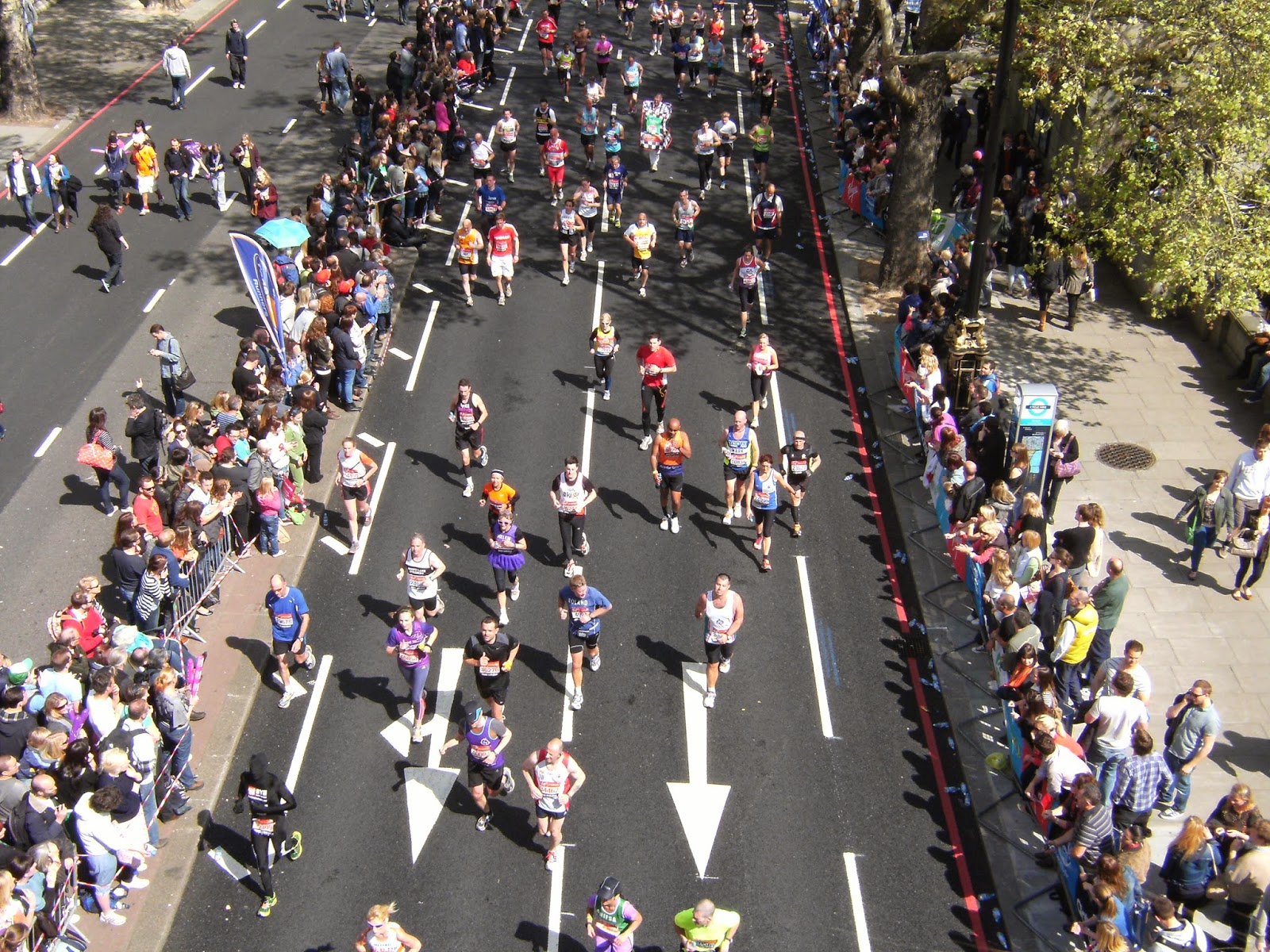
I thought after this I would head off and get myself into the pool, but the weather was gradually improving and the trickle of runners had turned into a steady flow. I ducked across to a traffic island in the middle of the road where I got chatting to a girl named Yen, who said she usually watched the marathon from this point. The traffic island turned out to be probably the best place in London to watch the race. Just a few short minutes later and the flow of runners had turned into a tidal wave, and we were cut off in the traffic island in the middle of the road. Literally stranded. The atmosphere was amazing. Electric. It made for some incredible photographs, with runners streaming towards the traffic island and parting at the last minute.


After a while, the 3 hour pacemakers came through – all of the people who had already passed were hoping to be sub-3! The depth of the field was amazing. In any other smaller marathon, there might be a handful of sub-3 runners. Here, there must have been thousands of sub-3 runners. 37,000 people would pass, in a continuous mass of ambition, emotion and sweat. Most people were still looking good and positivity was radiating, given that it was only 7 miles in. I stuck my hand out – everyone wanted a high-five. After a few minutes, my hand was almost literally in pieces. It was cold anyway, and combined with hundreds of enthusiastic slaps, it felt like my hand was going to shatter. So I had to give up on the high-fiving.


I was able to pick out some familiar vests, and give shouts to Metro Aberdeen club runners and Northern Ireland club runners. It was brilliant. The 3:15 pacers came through, then the 3:30 pacers. It was just a solid mass of runners. Surely the ultimate people-watching exercise?! I’m sure I saw every expression under the sun – determination, disbelief, thrilled expressions, pained and strained expressions, the “long-way-to-go” expression. What a position I had to view it all. So, so cool.


This went on for hours...

As time passed, more and more costumed runners came past – rhinos, beer bottles, a girl in a wedding dress (who got married on the way round), a phone box, a portrait, a guy bouncing two basketballs. A blind runner tethered to a guide. There were lots of charity vests, and obviously a lot of money was being raised. I had managed to take some super photographs. Someone had ditched their running gloves on the traffic island just behind me – I had no hesitation in grabbing them – they looked brand-new and I’ll put them to good use… I’m sure whoever ditched them would be glad that they’ve found a good home… I hadn’t expected to stay so long, but I was really enjoying it. I was mindful that I had to swim, and that time was getting tight. So I said bye to Yen and the only way to get across the flow of runners was to run with them, and gradually dodge my way over to the pavement.

Being charged at by a giant beer bottle

I made it to the swimming pool, and battered out a continuous 4.1km swim. I felt reasonably strong so I was happy with this. Normally on a Sunday after my swim, I would do a tough run: either a long run, a tempo run, or repetitions. Then the next day (Monday) would be a rest day, since tough runs for me require the most recovery time. This week was to be 14 hill sprints of around 70 seconds each, jogging back down to recover. On this occasion, I decided to put the run off for a day, because next week is an easy week and I can afford to “lose” a day. I thought I would get more benefit out of the run if I left it a day and did it on slightly fresher legs on Monday evening. Although I’ll still mark it down as part of this week’s training cycle.

So I got home from work on Monday and did my stretching and jogged down to the hill about a mile away. I wasn’t looking forward to the session. At all. 14 hills of pain. In previous sessions on this hill, I had been averaging around 70-71 seconds per hill, and I had it in the back of my head that from now on, I didn’t need to be absolutely on the limit, as the focus of my running has changed from wanting to perform well at shorter, faster running races earlier in the year (the NI/Ulster cross-country and the Garioch 10k in Aberdeenshire), to having an eye on the longer, slower Ironman marathon. Also, really tough running training can take time to recover from and carries a bit of injury risk. And I really don’t want to pick up an injury. Ironman race day is getting closer, and the margin for error gets tighter and tighter.

So I thought that repeats of around 71-73 seconds would do the job. It was a nice enough evening and I was out in my shorts and compression socks. The first repeat was a fraction under 70 seconds. Too fast, I told myself. But I felt good enough, and the next few were even faster, stabilising at 68 seconds. I just kept battering on, hoping I could sustain the pace for 14 of the repetitions. And I got even faster, averaging 67 seconds for quite a few. Although they were tough, and no doubt I looked a mess during the first minute of the jog-down (and sounded terrible too), I still felt strong and kept ticking off the hills. After having done 11 hills, I knew I wasn’t going to slip to beyond 70 seconds, and sure enough, I kept it together. A really good session. Really tough though, perhaps one of the toughest and best training runs I have ever done. And that’s saying something.

I was knackered when I got back to the house and had some protein and milk as soon as possible. I had averaged 3 seconds per hill faster than when I did the session in early March. Granted, conditions were probably a bit better this time around, and the extra day of recovery did me good, but there’s no doubt my fitness is coming along. There was a bit of frustration mixed in there as well, because I’m now very sure that I am in 32-minute 10K shape at the minute, and maybe even sub-32. I’d really like to get out there and do a fast 10K, and have something to show for all this training. The last 3 years have been frustrating in that I’ve put in so much time and effort and hard work, and have very little to show for it all. Ironman is tough, it’s not like a 10K where you pay £10 or £20 to enter and you can run loads of them every year. If a 10K goes wrong, for whatever reason, you can literally try again next week. If an Ironman goes wrong, a year of work and effort and sacrifice (not to mention a small fortune) is wasted, and there aren’t many alternatives. All the eggs. One damn basket.

But, I have to keep a focus on the bigger picture, and believe that this will be the year I qualify for Kona. After that, I can re-assess, and when my triathlon/Ironman career is over, I can hopefully look to resume my running career and beat my PBs from years ago. Sub-9 3K? Sub-15 5K? Sub-32 10K? Sub-70 half marathon? Sub 2:35 marathon? Hmmm… Hopefully by the time I call an end to my Ironman career, I won’t be too old and decrepit to achieve these running times…

Let’s get Hawaii done and dusted first…

Training done this week was as follows:

Mon 20 April: Rest
Tue 21 April: 1:15 turbo (1 hour hard)
Wed 22 April: 30 minute fartlek run
Thu 23 April: 1:30 turbo (16 x 30 second reps at approx. 500W)
Fri 24 April: Swim 3.1km (with 10 x 200m in approx. 3 minutes, 20 second recovery)
Sat 25 April: 4:05 turbo, 25 minute run
Sun 26 April: Swim 4.1km
Mon 27 Apr: 14 hill repeats: 70, 69, 68, 68, 68, 68, 67, 67, 67, 67, 67, 67, 67, 68

Totals: Swim 7.2km, Bike 150 miles, Run 15 miles

A solid 2-week block

Had to put this in - a pretty cool photo I took at the 2012 London marathon.
Another great vantage point, at the final turn before the finish line.
All the below pics are also from the 2012 London marathon.
I've been too long in London...


Monday, April 20, 2015

Post 75 - Tough stuff and Guinness crisps

I managed to shake off the rotten cold that had been plaguing me over the last couple of weeks, but there are only three months until Ironman race day and I’ve been starting to get the feeling that time is moving on quickly. Soon, my cycle of two tough weeks followed by one easier week is going to be dictated by the two warm-up events I’m doing – the North Norfolk 100 mile bike time trial in May and the Bristol triathlon in June, followed by the Ironman in July. I had a look at a calendar the other day, and leaving the current training block aside, there are only two more blocks of two training weeks left. And I have a lot I still want to do in training – critical swim speed workouts, longer bikes, longer runs, bike hill simulations, and so on.

I need to make sure everything is planned so that I don’t run out of time, and a lesson from this week is that I might even need to taper down for specific key sessions, so that I can absolutely nail them, rather than being tired and not able to do a key session as hard as I want to or need to. This might mean lowering the intensity of preceding sessions slightly, so that by the time a key, targeted session comes around, I still have reasonably good legs to maximise how well I am able to do the session. During this week, I’ve completed some good miles, and was happy with all my sessions except Saturday’s long bike.

On Tuesday I did an hour on the turbo with 2 x 20 minutes hard, followed by a short 20-minute run. During this turbo, the inside of my left knee felt a little bit dodgy. When I tried to do my squats afterwards, I managed three before I called a halt - my left knee wasn't comfortable at all and I didn't want to aggravate things further. I didn't do any squatting for the rest of the week - it's just constant management, reacting, and making the best of what the body lets you do. On Wednesday I did a 10km fartlek run, involving 15 sets of one minute fast and one minute slow running. Both Tuesday and Wednesday were “fair enough” sessions, tough but not too tough. On Thursday evening I was on the turbo for nearly two hours, and this session really knackered me. Not quite “fair enough” and maybe a bit too tough, given the training I still wanted to do on the Friday, Saturday and Sunday.

Thursday’s turbo involved a short warm-up, followed by a pyramid of 1 minute hard/1 minute easy, 2 hard/2 easy, 4/4, 6/6, 8/8, 10/10, then 8/8, 6/6, 4/4, 2/2 and 1/1, and finally a short warm-down. The hard intervals were all around 300-320 watts. The session was tougher than I thought it would be, and alarm bells should have been ringing when I was descending down the stairs afterwards… verrrrrry slowly, one step at a time, using the bannister and wall to take most of my weight, grunting and groaning the whole way down. Steve was in the hall at the bottom of the stairs, probably thinking, “What on earth is going on here…?” He asked if I was injured or if I’d just had a tough session… It had been a good session and a very tough one, but with hindsight, I should probably have taken a couple of easier days after it to allow for proper recovery, or else toned down the intensity and duration.

Struggling for photographic inspiration... 
answers (and/or suggestions) on a postcard...

On Friday I was in the pool and blasted out two sets of 10 x 100m. I hoped to pace these well, and hoped to be no slower than 1:30 per 100m, with 30 seconds of recovery up to two minutes. It turned out that my first set of 10 x 100m averaged about 1:27 and after a very slow 500m swim in between, the second set averaged 1:29. Not bad, but again my pacing was a bit off. I’d rather do 1:28 and 1:28. I have it in my head that my first set of this session is usually around 1:27-1:28 and the second set usually fades to something like 1:32, so I can’t be too disappointed. But I need to learn how easy the first few hundred metres of a swim feels – it’s not difficult to swim 1:22 for the first couple of hundreds and think that it’s sustainable, and then painfully realise that it’s not! On Friday night I did my single-leg turbo drills and watched the Crystal Maze on YouTube. The Friday night of dreams…

Ready for a long turbo/bike on Saturday...

On Saturday I planned a longer bike ride. I haven’t done too many long bike rides in training, and with a 100 mile time trial coming up, I need to get a couple of 4-hour rides done. So I got on the turbo intending to a 4 hour bike ride, with 3:40 at a good pace, between 220-230 watts. A few weeks ago I did 3 hours at 222 watts, so I didn’t see this long ride as being impossibly tough. The first hour went fine and my wattage was on target. The next 30 minutes also went fine. Then it got tough. I was holding my wattage but I knew there was no way I’d sustain it. I was hanging. Sure enough, it dropped away just before the 2-hour mark, down to around 200 watts. My legs just didn’t have anything. My heart rate was still fine at around 140-145bpm, but my legs were saying “too tired”. I made it through to 3:10, for a net 3:30 bike ride including my 10 minute warm-up and cool-down. I managed a 25 minute run afterwards. Very tough, and my body’s way of saying, “You can’t expect me to have a Thursday like that, and then a Friday like that, and then expect to do a Saturday like that…”

Not a good look: struggling in the pain cave.
Did I mention I was struggling for photographic inspiration too...?

For the rest of Saturday I was in zombie-mode, not fit for much except lounging about and resting. But I did have enough energy to think about how vital my longer bike sessions are becoming (I haven’t done enough of them and the 100 mile time trial is looming), and how I’ll have to prioritise these longer bikes in the weeks to come. This will mean slightly easing down the intensity of training during the week so that I have legs that aren’t too tired for the long bike on Saturdays. That way, I can really hit the long bike as hard as I need to, and get good benefit from it. I’ll put this into practice next week, and hopefully before the North Norfolk 100, I’ll have done two decent, strong, long bikes.

On Sunday morning I played with my toys. In the pool. Not rubber duckies or water pistols, but hand paddles, leg floats and rubber bands to tie my feet together. The rubber band is the worst kind of toy, rendering the legs completely useless when swimming, but helping to promote strength and good body position in the water. This was followed by a 70-minute run, with an hour at sub-6-minute-mile pace. Fortunately my left knee didn't give me any more problems this week, and not doing any squats definitely helped it. After Sunday's run, zombie mode kicked in again and I took things very easy. I even treated myself to a bag of Guinness-flavoured crisps. Wow.

Reward time

Bradley Wiggins is attempting to break the hour record in the London Olympic Park velodrome in June. He’ll probably smash the record. Tickets went on sale on Friday at 10am. I really wanted to get a ticket or two, because I’ve never been in a velodrome, and this hour attempt will be an awesome, awesome occasion. I’m sure a huge number of people were all online, trying to get tickets at 10am on Friday. I was trying too… After 10 minutes of frantic clicking and refreshing and selecting and frustration, I thought the chance had gone and that they’d have sold out. They weren’t even as expensive as I thought they’d be – I wouldn’t have been surprised at a hundred or even two hundred pounds, but they were priced between £29 and £49. Then, to my surprise, I got a message on screen saying that I was being offered 4 tickets and that I had 8 minutes to complete the transaction. Cue an even more frantic 8 minutes scrambling for my credit card, registering my address online, and making sure I didn’t mess anything up. Something to really look forward to.

Also, the London Marathon is next weekend. Paula Radcliffe – marathon world record holder – is running it as her final marathon. She ran 2:15:25 in 2003 and I remember being astounded and inspired by it, just as my running career was starting. This 2:15:25 is one of the single greatest athletic achievements ever. I’ll have to go and see her run next weekend, and work out how to fit this around my training. No tickets required for this one…

Training done this week was as follows:

Mon 13 May: Rest
Tue 14 May: 1:05 turbo (2 x 20mins hard), 20 min run
Wed 15 May: 40 min fartlek run
Thu 16 May: 1:55 turbo (1, 2, 4, 6, 8, 10 pyramid)
Fri 17 May: Swim 3k (2 x 10 x 100m off 2mins in 1:27, 1:29), 1:05 turbo (10 x 2mins R/L/B)
Sat 18 May: 3:30 turbo, 25 min run
Sun 19 May: Swim 3.3k (250/500 paddle drills), 70 min run (1 hour hard)

Totals: Swim 6.3km, Bike 165 miles, Run 24 miles.

Sunday, April 12, 2015

Post 74 - Got the cold

A cold-infested week. “Feeling a bit dodgy” last week turned into “feeling awful” this week. Snotty, sore head, eyes streaming, sore chest, coughing. Yuck. Monday and Tuesday were particularly rotten. I tried to keep out of the way of my housemates, one of whom is running a marathon next week. But to try and look on the bright side, I’m almost better and I had an enforced lay-off from training which will mean my legs are fresh for starting into a 2-week training block next week.

I spent the early part of this week hardly able to speak, nor could I look at someone for more than a few seconds without my eyes and nose dripping. Plus, I stank of garlic and chillies, having adopted a new diet to attack the cold and try to kill it. None of this was ideal given that my chartered engineer institution professional interview was on Thursday. A grim Monday and Tuesday turned into a slightly better Wednesday, and I had improved again by Thursday. Thankfully, I got through the interview, but I’m glad it wasn’t earlier in the week. It was a tough interview. I had put a lot of work into preparing for it, and I did the best I could. Finishing the interview almost drew a line under years of hard work. I will hear in a few weeks if I have passed, and if so, that will be a big end to what has been a lengthy and time-consuming process. Fingers crossed.

I took Friday off work and spent most of the morning in bed, trying to shift my cold. I envy full-time athletes – not because they have more time to train, but because they have more time to recover properly. I did a tentative easy turbo and run on Friday, followed by a slightly tougher turbo and run on Saturday, with a maximal one-minute effort at the end of every ten minutes on the bike. My heart rate was hitting 180bpm in these efforts, with peak power hitting over 600 watts. It’s bizarre how time slows down when heart rate and power increase – ten seconds at 500 watts feels like about ten minutes… I watched the Paris-Roubaix race today, and nearly 6 hours on those cobbles must feel like an eternity. After the Flanders sportive last year, I've so much more awe and respect for the pros and the Classics, but never again for me on cobbles! 

Painful

I’ll get back into my usual training routine next week. Time is moving on and I only have three more unbroken two-week training blocks, plus a couple of one-week blocks, before race day in July. I have got an event in May and an event in June, both of which will need a week to taper for and a week to recover from. Tapering for the Ironman will take two weeks. So that’s six weeks of tapering and recovering, with not much more than three months to go. The remaining training blocks are really important, I hope no work travel will get in the way because time is running out…

I recently read a book about cycling called “Faster”, by elite cyclist and time-trial specialist Michael Hutchinson. It was a great book, I’d recommend it to anyone with an interest in sport. Plus, it has an awesome cover page.

Time-trialling rainbow-jersey-coloured silhouette,
wouldn't look out of place framed and on a wall...

The book deals with the intricacies of going faster on a bike, and how to eke out those final little improvements that make the difference at elite level between winning and not. There’s obviously a slant towards British Cycling and Team Sky, who have taken the concept of “marginal gains” and turned it into a never-ending quest, the results of which speak for themselves. The book managed to be both pretty scientific yet still eminently readable, getting into the nitty-gritty of athlete physiology, respiratory and cardiovascular processes, nutrition, hydration, equipment, bikes, clothing, aerodynamics, testing, results, coaching, psychology, the search for gains, genetics, and the questioning of ingrained cycling "tradition".

The bike also deals with doping in sport. I find it very difficult to read about athletes whose blood is so thick with EPO that they have to set alarms through the night, and then get up and walk about, elevating their heart rates to make sure that their systems don’t clog up and that their hearts keep pumping. I find it difficult to read about lab tests on monkeys who have artificially had their oxygen-carrying red blood cell count artificially increased, and then whose immune systems respond by causing a severe anaemia which eliminated both the “new” and the “existing” red cells. I struggle to understand how people could do this to themselves, placing their health at such risk.

The heart is surrounded by a membrane called the pericardium, which protects and stabilises the heart – essentially it’s a protective mechanism to stop us humans from killing ourselves by overworking our hearts. I struggle to read about pigs who have had their pericardiums (pericardiae?) loosened, hugely improving their athletic performance and oxygen uptake by over 30%. The pigs were tested on treadmills and needless to say, after the test, they didn’t have their pericardiums or pericardiae tightened again, and they didn’t go back to normal piggy life. Ethical? What person could do this to himself or herself in the pursuit of a sporting goal? Messing with physiological protective mechanisms that have taken hundreds of thousands of years to evolve will surely only end one way…  
I’m always looking for any clean gain I can find with regard to the Ironman, so I enjoyed the book. In a 10-hour Ironman, if I can be 1% faster, then that’s 6 minutes. One-tenth of one percent will give me 36 seconds, which is still significant. The top four in my age group at Ironman UK last year were covered by… one second. So the value of these marginal gains is immeasurable. My problem is that I need to balance the gain with its associated cost. Yes, I’d like a new aero front brake, but is it worth £200? I’ve decided no. Yes, I’d like a more integrated front water bottle, but is it worth £100? I’ve decided no. Yes, I’d like a new £12,000 bike with a light disc wheel, but I’ll only get that one night if I have a nice dream…

Dream bike...? Dream rear wheel anyway...

One could torture oneself, as there is literally no end to the pursuit of speed on a bike, and no end to the lighter and more aerodynamic equipment that’s available and no end to the money that could be spent on “faster” in cycling. I’ve told myself, for this year at least, I have what I need in terms of equipment, and I will not be spending any more on upgrades. I’ll focus my efforts on effective training and recovery. There’s a very true saying about Ironman: “All the money in the world can’t help you at mile 16 of the Ironman marathon…”

Chapter One of the book was entitled “The Art of Being an Athlete”, and I could relate to a lot of it. Quite a while ago I made a decision that if I was serious about qualifying for the Ironman world championships, every decision I made would have an influence on achieving that goal. If something helps the goal, I’ll go with it. If it doesn’t help the goal, I’ll leave it. The mentality is that I’m an athlete first of all, and everything else is a poor second. This is why I find certain things very difficult to deal with – I control as much as I can, but there’s a lot I can’t control, and these uncontrollables can de-rail me. One example of this would be commuting with so many other people, many of whom are coughing and sneezing. Some quotes from the book follow, I can relate to all of these, so much so that I was almost laughing out loud on the train when I was reading. I’m glad there are other people who think the same way I do…

“We all make sacrifices to feed our passions…”

“I live in a world where, one way or another, everything is divided into things that might make me faster and things that might make me slower…”

“Pretty much anything pleasant falls into the second category…”

“Misery and loneliness make you slower, even the most committed have to choose between speed and sanity…”

“So scared of catching a cold that I avoid parties/cinema/etc at all costs…”

“Always running in the background are the questions, “How do I go faster?” “Will it make me faster?”…”

“The really difficult thing to deal with is that everything you do will make you faster or slower. This isn’t just everything from a training point of view, or even an eating point of view, but everything from an everything point of view…”

“Marginal gain or marginal guilt – your choice…”

“All the time you ask yourself “is there an injury risk? Will I get an infection?”…”

“There are reasons to avoid standing, walking, staying awake, or leaving the house for any reason other than training…”

“You can cheat or you can lose…” (referring to how bad and how prevalent the doping problem was in professional cycling not that long ago.)

“Marginal gains…”

“At what might seem like an absurdly basic level, you have to be able to tell when you’re too tired. Most athletes are very tired a lot of the time, and the edge that slips you into “too tired” is almost imperceptible…”

“Most people have absolutely no concept of how hard they train…”

“It has to be hard…”

“That it hurts is almost neither here nor there, you try to tolerate it, embrace it, deal with it in whatever way you can…”

“This sort of thing is “becoming a student of the sport”…”

“The aim of a professional athlete is to reduce life to training, eating and recovering…”

“Stresses stack up, wherever they come from…”

“It’s hard to ride seriously and hold down a job, even if the job is essentially sedentary…”

“There are moments when you feel the way a thoroughbred racehorse looks at full gallop. There is a balance and rhythm that is both irresistible and effortless. Every bit of you is part of the motion, even the bits that are still. The involvement, physically and mentally, is total, you’ve trained all of you for this, you’ve had the purity of purpose to do it without compromises. Everything you’ve ever done comes down to a single point. For a few moments you feel quite perfect…” (It’s this that helps to make it worthwhile. Nailing a good performance after months of focused training. Felling strong. A new PB. Exceeding expectations. Knackered satisfaction).

Training done this week wasn't much, and was as follows:

Mon 6 April: Rest
Tue 7 April: Rest
Wed 8 April: Rest
Thu 9 April: Rest
Fri 10 April: 30 min turbo, 20 min run
Sat 11 April: 1:05 turbo (6 x 1min very hard), 30 min run
Sun 12 April: Swim 2km (with 10 x 100m)


Totals: Swim 2km, Bike 30 miles, Run 7 miles

Monday, April 6, 2015

Post 73 - Hovering

Not a great week unfortunately. Most of my training weeks are tough weeks but good weeks. This one wasn’t a good week. I’m usually able to train pretty much exactly as I want, to do all my planned sessions, and to have enough recovery time to keep doing them month after month. I pretty much generated my own Ironman triathlon training programme based on what I had learned from years of running, mostly from hard experience. I just applied the same principles to triathlon. This is my fourth Ironman season now, so my training programme is the result of 4 years of trial and error, of learning, and of working out what I can realistically do in a week – tough enough to be tough enough, so to speak, but not so tough that I can’t function – at the end of the day, triathlon for me is a hobby (albeit a demanding one physically, mentally, financially and from a time point of view), and I’ll never make money from it. I have a “regular” job too that I have to be able to function properly in order to do.

Everything else I do is also tailored to support the goal of qualifying for the Ironman World Championships: if something doesn’t benefit this goal, I won’t do it. I’ve developed some really effective routines in terms of diet, time management, recovery, and minimising the risks of injury and illness. My diet is really clean: loads of fruit and raw vegetables, alkalising foods, reduced sugar, plenty of fluids, protein drinks, and a few vitamin supplements as well. All good quality, non-processed stuff, in as natural a state as possible. In terms of time management, yes there are plenty of sacrifices, but I’ve built myself into an environment where I don’t have much of a desire to do anything with my free time other than train and recover/sleep, and on the rare occasions where I might have a free half-day, I’m usually too tired to want to do anything other than sleep, lie in bed, or strum my guitar idly.

In terms of injury management, I spend a lot of time and effort on the “boring stuff” – the stretching, strength and core work that I do almost every day. My room is my mini-gym, and has weights and rubber bands for resistance training. My room is also home to my triathlon bike, clamped into a turbo trainer. With my dumb-bells, rubber bands, and a small area of floor, there’s a lot I can do. I’m convinced that this conditioning work has helped me avoid injury over the last couple of years. I was talking to my brother recently, he has picked up a back problem that may require surgery to treat. He’s sporty, and enjoys golf and swimming. Golf is tough on the back, particularly for more athletic golfers who have a harder and faster swing like he has. I’d be willing to say that his lack of warming up, stretching and conditioning on a regular basis has got something to do with his back problem.
Hopefully he’ll be OK. 

Some of my words to him, being the “wise” big brother that I am, were along the lines of “You’re nearly 30, you can’t do what you used to be able to do 10 years ago…” meaning that as we age, we need to take more care of our bodies, and put more time into preventative maintenance, strength work, suppleness, stretching, and core stability. I wouldn’t have a hope of training like I used to train when I was in my early 20s and a runner. I used to do intense session after intense session, really pushing myself, and allowing no recovery time. I always then used to be horribly frustrated when I’d inevitably get injured or ill on a regular basis. I probably needed a coach to rein me in. Experience has been a great teacher for me. My half marathon PB of 1:11 was run on a freezing cold Inverness day in March 2006. Just 4 days before, I had smashed myself over 14 hill sprints, each of about 80 seconds. I’m sure the 4 weeks before that race were all similar in terms of smashing myself. Taper? I often wonder how much faster I’d have been at Inverness that day in 2006 if I’d had a proper 2-week taper…

Illness avoidance has become something of an art as well. It’s tough, with commuting into London on packed commuter trains, and working in a busy office. Professional cyclists won’t turn on the AC in a car for fear of getting sick, never mind sit in an office with hundreds of other people. I can’t not work, so anything else I can do to help avoid illness, I do. The clean diet, the raw vegetables, the fluid intake, the vitamin supplements, the hand sanitising gel that I take everywhere and use all the time, the fortune spent on earplugs to ensure a good sleep, the prioritising of 8 hours of sleep, the reasonably good stress management skills. I’d like to think I have good routines and habits, and the result of this is that the last time I was sick or had a cold or any type of illness or infection that restricted my training was in January 2013, when I had a horrible flu (I don’t count my leg infections and hospitalisation just before Ironman UK 2014, that was a completely different freak occurrence).  

The best earplugs I've found so far. Really good on first use, but
not so good if re-used. I get fresh ones every weekend to help me lie in

One of my Korean colleagues is currently in the London office. He was full-time in London in 2013, but for most of 2014 he has been working from Korea, with visits to London. Every time he visits London, he seems to be sick – probably a combination of a different climate, a different country, strange food, long-haul flying, a new office, and stress. I try to stay clear of sick people at all costs. I’ll change carriages on the train if I hear a sneeze or a cough. I hardly ever go out. I sanitise my keyboard and mouse if anyone else uses them. I use hand sanitiser after opening every door. You get the picture. One day last week, I had been to Holland & Barrett to buy a few more ABC+ vitamin tablets, and a few other things. I then had a conversation with my Korean colleague about how he was enjoying his time in London. Answer: not much, because he’s expected to work every waking hour, and because as usual he has a cold.

I showed him my vitamin tablets, and told him about my routines. I then, with only the tiniest hint of satisfaction, told him that I hadn’t been sick for years. He went straight to Holland & Barrett. This was on Thursday. On Thursday evening I did 1:25 on the turbo, with 9 x 5 minute intervals at 300 watts. Tough enough. Getting off the bike, I felt a bit strange. A dry throat. I didn’t think too much of it. Next morning, I felt a bit snottier than usual, but again I tried to brush it off as nothing. I went to work on the Bank Holiday Friday. I’ve got my Chartered Engineer interview at the Institution of Mechanical Engineers next week, so I wanted to do some preparation, and needed access to the systems at work. Bank holidays are usually very quiet in the office, so the time is very productive and uninterrupted.

I swam at lunchtime, but I knew I wasn’t feeling100%. So I went to the shop and bought a pile of garlic and chillies. Thankfully, there were very few in the office that afternoon, so I ate the garlic and chillies, and doubtlessly emanated a bit of a stink, all to try and burn off whatever germs were making me feel dodgy. By the time I got home I still wasn’t feeling great. So much so that I decided not to do my usual Friday night single-leg turbo drills I rarely, rarely miss a session, so this was a big call. I debauchered my dinner with more garlic and chilli and then went straight to bed, thinking that a 14-hour sleep would help. By Saturday, I was still “hovering”, as I call it: Not quite sick, but not quite 100% either. I hovered all weekend. I didn’t swim at the weekend – the pool is not a great place to be when not feeling great. I did a turbo session on the Saturday and a longer run on the Sunday, and paid close attention to my heart rate. It was only a few beats higher than it would normally be, which gave me the confidence to complete the training sessions.


Eat up... and raw regular garlic cloves too...

Now, as I write this, I am still hovering between not-quite-sick and not-quite-100%. And there’s not much I can do other than rest and let the war happening within my body play itself out, hopefully in my favour. Usually when I get sick, I tend to hover for about a week, then I will get properly and fully sick, and come down with a cold or a flu for another week, and then it’ll take another week to fully recover. So a cold is quite costly in terms of time, disruption and lost fitness. I just have to cross my fingers and hope for the best and do what I can to help my body overcome it. This might mean an easy week next week, and re-adjusting my training block schedule.

I was feeling good that I had got through another winter without getting ill, and feeling good that I was able to help out my Korean colleague with a few recommendations, with the proof that I hadn’t been ill for years. Maybe I was inviting karma to do its thing, maybe I was just unlucky. 

Underpinning all this is a feeling that I’m halfway to Ironman UK 2015 – I started focused training at the start of January, and 3 months later here we are in the present day. In 3 more months I’ll be starting to taper for the Ironman. In less than 6 weeks I have the North Norfolk 100 mile time trial. I could do without being sick just now, I want to be cracking on and building up the longer rides and runs. So my mood is a bit dark. All I can do is try to be sensible during the week to come, and hope that by the end of the week I am feeling better. Argh. Such is the Ironman journey rollercoaster.

Training done this week was as follows:

Mon 30 March: Rest
Tue 31 March: 1 hour turbo (2 x 20mins hard) 
Wed 1 April: 40 minute fartlek run
Thu 2 April: 1:25 turbo (9 x 5mins hard (300 watts), 3 minutes easy) 
Fri 3 April: Swim 3.1km
Sat April: 3:20 turbo (3 hours at 221 watts, 143bpm)  
Sun April: 90 minute run


Totals: Swim 3.1km, Bike 125 miles, Run 18 miles